

laserscanner Industrial Inspection Guide
In this articleTackling Reflective Surfaces and Deep Recesses on the Shop FloorEngineering Foundations: Certification and InteroperabilityAlphaScan in Prac...
This article details how its architecture supports real-time tolerance verification, turning inspection from a line-stopping event into an integrated workflow.
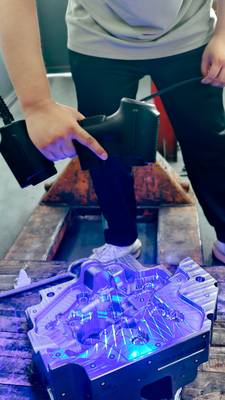
Tackling Reflective Surfaces and Deep Recesses on the Shop Floor
Conventional measurement arms and fixed CMMs struggle with part geometry, not just tolerances. Highly reflective finishes cause unreliable data capture, while deep-hole structures or internal channels are physically inaccessible. The INSVISION AlphaScan addresses this by bringing a 1070g sensor to the part.
Scenario Snapshot
A practical way to read the article is through this scenario:
- Tackling Reflective Surfaces and Deep Recesses on t…: Conventional measurement arms and fixed CMMs struggle with part geometry, not just tolerances.
- Engineering Foundations: Certification and Interope…: Metrology tools must provide traceable data integrity.
- AlphaScan in Practice: Workflow Integration for Hea…: Validation occurs in demanding environments.
Its blue laser technology is specifically optimized to handle reflective and dark surfaces, minimizing noise in the point cloud. For deep-hole inspection, operators can switch to a focused single-laser line mode, designed to penetrate and accurately map internal grooves or bore geometries common in hydraulic manifolds or aerospace fittings.
This eliminates the need for disruptive part transportation or destructive sectioning for quality checks.
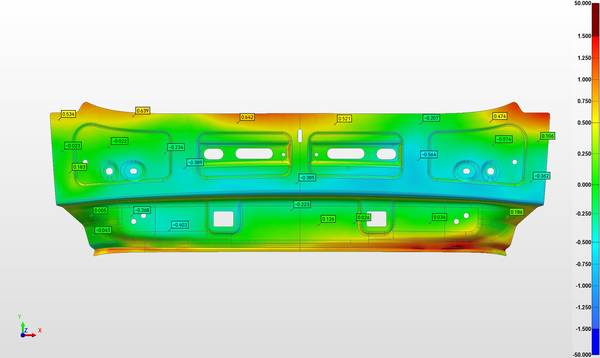
Engineering Foundations: Certification and Interoperability
Metrology tools must provide traceable data integrity. INSVISION develops its handheld scanners, including the AlphaScan series, at its Hangzhou R&D center, with a focus on algorithmic processing for stable field performance. The devices carry CE, FCC, and CNAS certifications, validating their compliance for industrial use across more than 20 countries. This engineering philosophy prioritizes interoperability;
scan data is structured for direct import into mainstream CAD such as SOLIDWORKS or CATIA, aligning with ISO and ASME geometric dimensioning and tolerancing standards. For procurement teams, this translates to audit-ready inspection reports generated from the factory floor, ensuring compliance without workflow compromise.
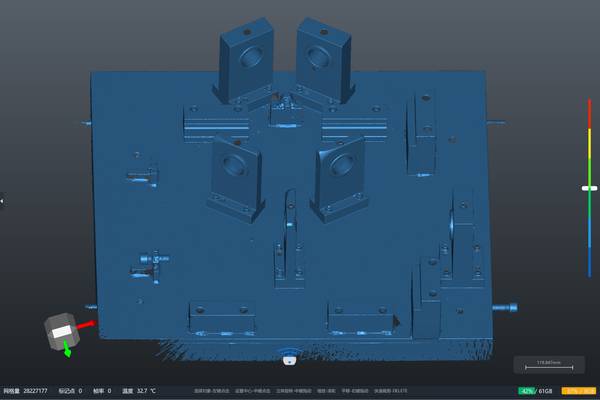
AlphaScan in Practice: Workflow Integration for Heavy Equipment and Aerospace
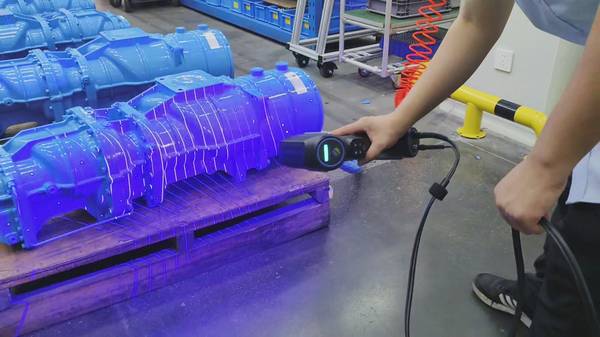
Validation occurs in demanding environments. In heavy equipment manufacturing, INSVISION scanners are used for inspecting V-groove anvil blocks for forging presses—a concave, wear-critical surface. On the aerospace line, they verify the placement and diameter of assembly holes on large structural components. The handheld device’s portability allows for in-situ scanning of these large, fixed items where a CMM is impractical.
The workflow is direct: capture a dense point cloud, align it to the CAD nominal in the real-time user interface, and generate a color-mapped deviation report. This enables immediate disposition of a part and creates a digital record for traceability in additive manufacturing or MRO documentation.
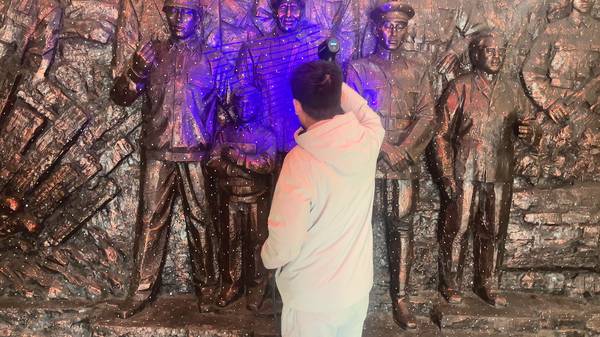
Configuring Your Inspection Process: A Decision Guide for Quality Teams
Purchasing a high-precision scanner does not guarantee results; correct application is key. The first step is a site and part assessment. Engineers must evaluate the primary inspection challenge: is it surface finish reflectivity, complex free-form curvature, or deep-hole geometry? This determines the optimal laser mode.
For instance, a polished compressor blade requires the full blue laser array for surface fidelity, while a fuel injector nozzle demands the single-line deep-hole mode. Before scanning, verify ambient lighting conditions and ensure the part is stable. For large components, plan your scan path and target placement to maintain global accuracy.
INSVISION supports this process with operator training and software updates tailored for continuous production environments.
Determining Your Requirements
To assess if this approach fits your operation, consider your specific part geometry, material reflectivity, and required tolerance class. What is the largest dimension you need to scan? Are your reporting standards based on ISO 9001 or specific customer GD&T protocols? Finally, consider your production takt—how much time can inspection consume without creating a bottleneck?
Hangzhou Insvision Technology Co., Ltd.
Address: Building 1, No. 1399 Liangmu Road, Yuhang District, Hangzhou, Zhejiang 311121, China
Copyright © Hangzhou Insvision Technology Co., Ltd. All rights reserved.
Copyright © Hangzhou Insvision Technology Co., Ltd. All rights reserved.