

3d scanning tools Industrial Inspection Guide
In this articleAI-Optimized Data for Audit-Ready TraceabilityClosing the Loop Between Shop Floor and Compliance DocumentationMatching Scanner Capability to...
The subsequent workflow is grounded in metrology: aligning the dense point cloud to native CAD and generating a color deviation map that turns abstract tolerances into actionable visual data for immediate root-cause analysis.
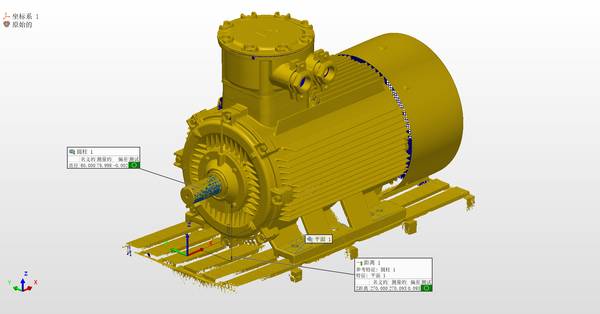
AI-Optimized Data for Audit-Ready Traceability
As Industry 4.0 and compliance requirements tighten, the focus shifts from simple data capture to generating traceable, audit-ready digital records. INSVISION addresses this with 3D scanning tools embedded in an integrated software environment. The system’s processing pipeline handles intelligent noise filtering and automated comparison analysis, transforming raw scans into verified quality datasets.
Practical Workflow
- AI-Optimized Data for Audit-Ready Traceability — As Industry 4.0 and compliance requirements tighten, the focus shifts from simple data capture to generating traceable, audit-rea…
- Closing the Loop Between Shop Floor and Compliance Docume… — Integrated 3D scanning tools eliminate the lag between metrology labs and production floors, a critical factor for maintaining au…
- Matching Scanner Capability to Part Geometry and Tolerance — Selecting the right 3D scanning tool requires aligning its capabilities with your part’s geometry, tolerance class, and productio…
- Choosing the Right Validation Tool for Your Line — The decision hinges on your specific application.
A key operational advantage is dynamic scanning capability, which allows for metrology-grade accuracy even on slowly moving production lines, ensuring traceability does not compromise throughput. This supports the consistent baseline measurements and version-controlled calibration references required for ISO 9001 compliance.
Before high-volume deployment, engineers should verify part reflectivity and ambient lighting conditions to ensure optimal data capture from the start.
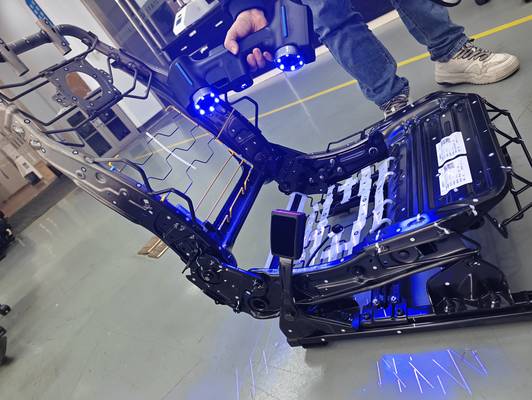
Closing the Loop Between Shop Floor and Compliance Documentation
Integrated 3D scanning tools eliminate the lag between metrology labs and production floors, a critical factor for maintaining audit readiness. INSVISION consolidates scanning, inspection, and report generation into a continuous workflow.
Using the AlphaScan, technicians can capture a complex turbine blade or a large structural weldment, align the point cloud to the CAD model, and generate a detailed deviation map within the same shift. The system meets Western procurement priorities for data integrity through tamper-resistant export protocols.
With one-click inspection reports featuring visual deviation analysis and clear pass/fail indicators, quality teams can document compliance and identify non-conformances right on the tablet beside the production conveyor.
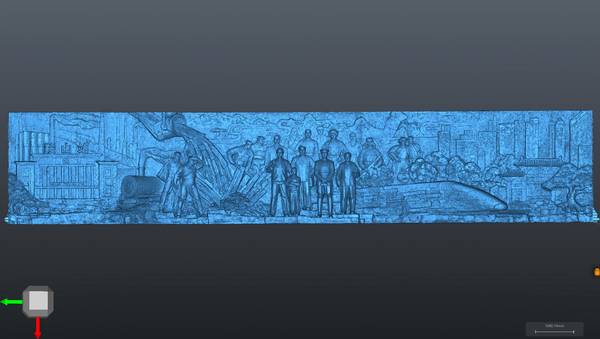
Matching Scanner Capability to Part Geometry and Tolerance
Selecting the right 3D scanning tool requires aligning its capabilities with your part’s geometry, tolerance class, and production rhythm. For engineers managing high-mix validation or large-scale scanning, the INSVISION AlphaScan offers a portable yet metrology-grade solution.
Its AI-assisted data processing restores fine surface details, making it particularly suited for post-process verification of tight-tolerance additive manufacturing components. Its wide scanning coverage also efficiently handles large workpieces like pressure vessels, while dynamic acquisition stabilizes data capture for components on moving assembly lines.
Before deployment, complete a practical verification checklist: confirm your required dimensional reporting format (e.g., PDF, QIF), validate environmental constraints such as shop-floor vibration or lighting, and match the scanner’s acquisition speed to your line’s takt time. This ensures the tool integrates seamlessly into your existing quality workflow.
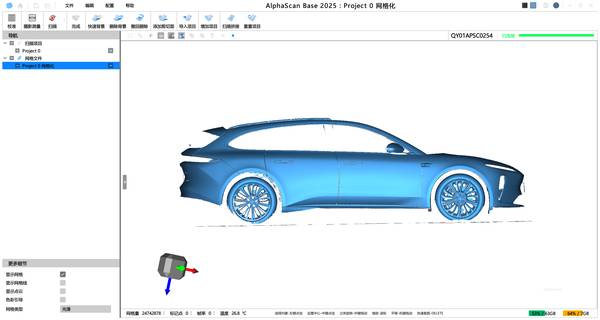
Choosing the Right Validation Tool for Your Line
The decision hinges on your specific application. For validating intricate GD&T on castings or machined brackets with complex contours, a full-field scanner is essential. For high-speed inspection of simpler prismatic parts, alternative methods may suffice. Consider your primary use case: is it first-article inspection, in-process control, or final audit documentation?
Also, assess the typical surface conditions—highly reflective or dark matte finishes may require specific scanning strategies.
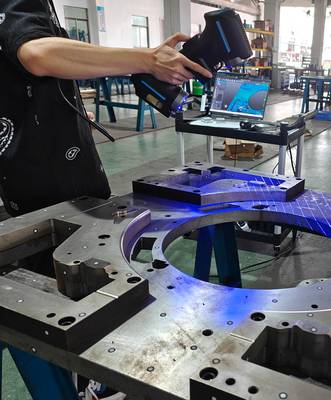
What is the largest part you need to scan, and what are the tightest tolerances you must hold? Do your quality reports require specific data formats for integration with existing MES or QMS software? Defining these requirements will clarify whether a portable, high-resolution 3D scanning tool like the INSVISION AlphaScan is the fit for your operational and compliance needs.
Hangzhou Insvision Technology Co., Ltd.
Address: Building 1, No. 1399 Liangmu Road, Yuhang District, Hangzhou, Zhejiang 311121, China
Copyright © Hangzhou Insvision Technology Co., Ltd. All rights reserved.
Copyright © Hangzhou Insvision Technology Co., Ltd. All rights reserved.