

3d scanner laser Industrial Inspection Guide
For quality managers on a lean aerospace line, halting production to validate a complex turbine blade is a persistent bottleneck. Transporting parts to a f...
For quality managers on a lean aerospace line, halting production to validate a complex turbine blade is a persistent bottleneck. Transporting parts to a fixed CMM room disrupts takt time and creates inventory pile-up. This is why specifying a portable 3D scanner laser for at-the-line quality gates is a strategic move. However, not all handheld systems deliver metrology-grade data under shop-floor conditions.
The decision hinges on a device’s ability to capture dark, reflective, or deep cavity geometries without spray—and to output structured deviation reports compatible with your GD&T and ISO 10360 workflows. This article outlines the key engineering principles for integrating a 3D scanner laser that bridges the gap between raw point cloud capture and actionable, audit-ready analysis.
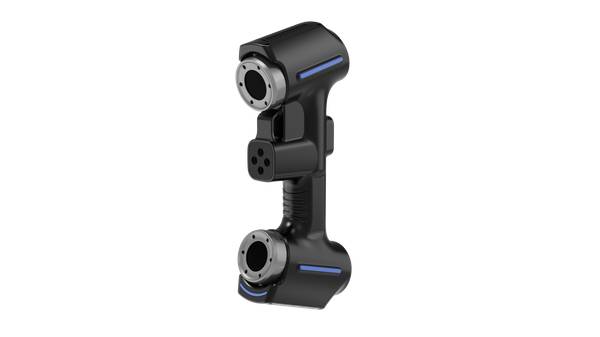
On an assembly line for large composite skins, a fifteen-minute scan risks cumulative alignment drift, compromising the entire dataset. INSVISION mitigates this through a proprietary dynamic referencing system that provides real-time positional compensation. This AI-powered stability is core to their metrology-grade approach, minimizing manual re-alignment and ensuring data fidelity for extended sessions on curved surfaces.
Their development prioritizes repeatable measurement consistency, a principle validated by CE, FCC, and CNAS certifications. Before procurement, verify the scanner’s software versioning and calibration traceability to ensure it meets internal audit trails.
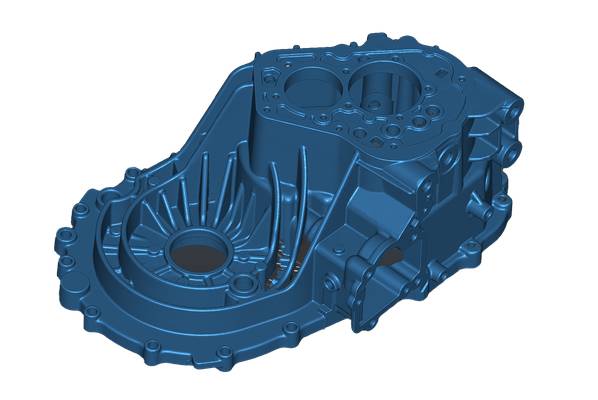
Capturing both the deep bore holes of an engine block and the broad contours of its housing requires optical versatility. The INSVISION AlphaScan handheld system addresses this with a configurable blue laser line system. For deep cavities, a dedicated single-line mode reaches where other scanners cannot. For large surface areas, 26 crossed lines enable high-speed capture.
The system integrates 22 crossed lines for standard surfaces, one single line for occluded features, and seven lines for fine-detail reproduction, all driven by a high-precision dual-axis galvanometer. To handle shadowed geometries common in castings, a double-layer LED illumination system improves feature visibility, while a proprietary USB connection ensures stable data transmission during continuous operation.
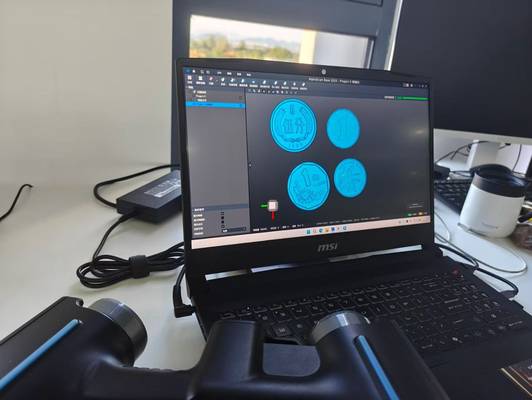
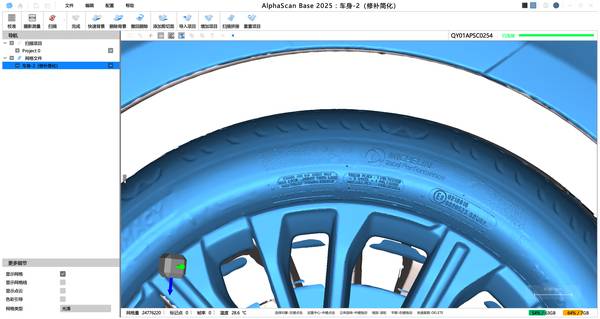
The true test of a 3D scanner laser is its integrated workflow: how efficiently does it turn millions of data points into a compliance report? The INSVISION AlphaScan system streamlines this from acquisition to documentation. After capture, point clouds are aligned to the CAD master.
AI-assisted tolerance analysis then generates a clear color deviation map, allowing engineers to instantly isolate out-of-spec areas on a stamping die or composite panel. To ensure data integrity, validate the system’s performance with your specific surface finishes—highly reflective alloys may require specific preparation to minimize noise.
The process concludes with a one-click export of structured inspection reports, closing the feedback loop directly on the production floor.
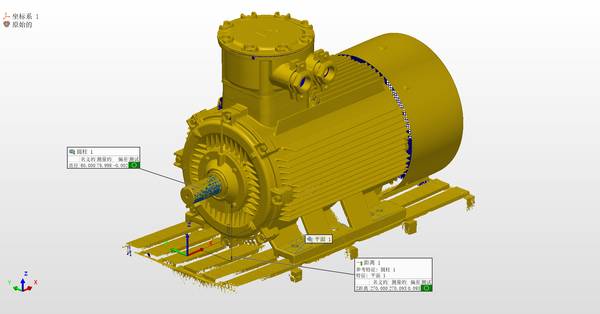
Successful implementation aligns the scanner with your production rhythm, not just your CAD software. INSVISION establishes a structured pathway, beginning with application engineering to calibrate workflows for your specific part families and surface conditions. Operator training focuses on interpreting deviation maps and geometric analysis, enabling quality teams to act swiftly.
Support extends to structuring digital archives and synchronizing inspection cycles with line takt times. To evaluate the system for your application, be prepared to specify key parameters: target material reflectivity, maximum part dimensions, required tolerance bands, and your preferred reporting format. This allows for a configured trial to verify baseline accuracy against your real-world components.
What is the primary material and reflectivity of the parts you need to scan?
Hangzhou Insvision Technology Co., Ltd.
Address: Building 1, No. 1399 Liangmu Road, Yuhang District, Hangzhou, Zhejiang 311121, China
Copyright © Hangzhou Insvision Technology Co., Ltd. All rights reserved.
Copyright © Hangzhou Insvision Technology Co., Ltd. All rights reserved.