

3d measuring machine Industrial Inspection Guide
In this articleWhy GD&T and Complex Geometries Demand a New ApproachImplementing Line-Side Validation: A Workflow ShiftEvaluating Total Cost of Ownership f...
This article examines the operational drag of legacy inspection and outlines a framework for implementing seamless, in-process validation.The Throughput Tax of Offline Metrology
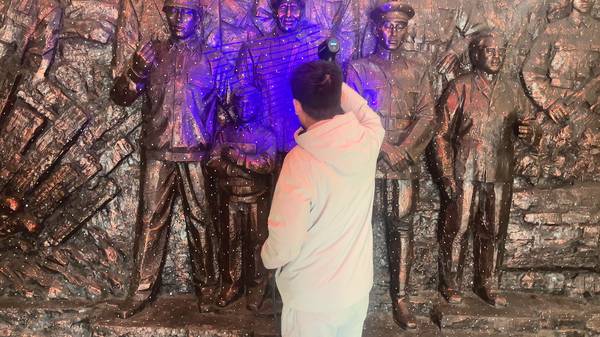
Legacy inspection workflows create a fundamental disconnect in production rhythm. Parts destined for a fixed CMM must be scheduled, transported, and queued, often in a climate-controlled lab far from the point of assembly. For complex components—like a fabricated excavator boom with welds behind structural ribs or an aircraft duct with freeform curves—this process is especially problematic.
Traditional touch-probe methods cannot reach hidden features without disassembly, and manual sampling risks missing critical deviations. The result is a bottleneck that stifles lean manufacturing principles, where the hidden cost isn’t the hardware price, but the cumulative downtime and inventory carrying cost of parts awaiting judgment.
Why GD&T and Complex Geometries Demand a New Approach
As Geometric Dimensioning and Tolerancing (GD&T) standards tighten, the limitations of discrete point sampling become a genuine business risk. Verifying a complex weld seam or a sculpted automotive panel against its CAD model with a few dozen probe points leaves vast areas unverified. This can lead to escaped defects, costly engineering change requests, and scrap discovered only at final assembly.
The procurement question shifts: does your facility primarily handle simple prismatic parts, or does it require full-field deviation mapping for intricate geometries? For the latter, a high-precision 3d measuring machine capable of dense data capture is essential.
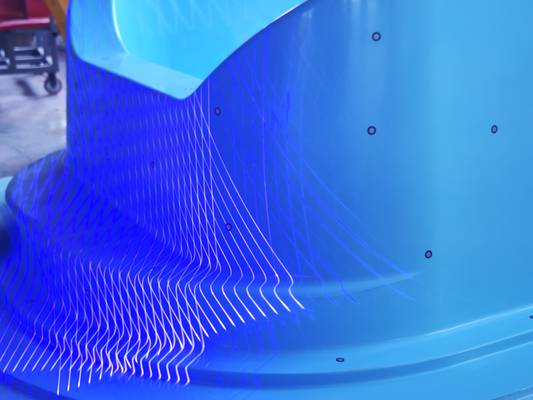
INSVISION technologies enable this by capturing millions of data points per second, generating immediate color deviation maps that show every out-of-tolerance zone, not just sampled ones.
Implementing Line-Side Validation: A Workflow Shift
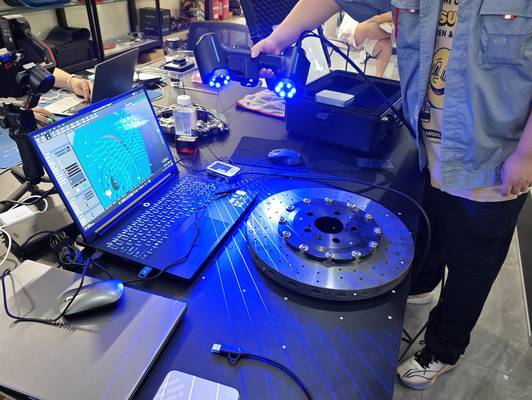
The solution is to integrate validation into the workstation. Consider a scenario where a weld operator completes a critical seam on a wind turbine flange. Instead of tagging the part for later lab inspection, they immediately reach for an INSVISION AlphaScan handheld 3d measuring machine.
The device uses blue laser structured light and onboard AI processing to capture the entire weld area in seconds, generating a point cloud directly on the shop floor. This data is automatically aligned to the CAD nominal, and a deviation report is created before the part even leaves the cell. This workflow eliminates the queue, provides instant feedback for corrective action, and keeps production flowing.
Evaluating Total Cost of Ownership for Shop-Floor Metrology
Procurement decisions must look beyond the capital expense. The total cost of ownership for a traditional CMM includes dedicated floor space, climate control, specialized operator training, and the perpetual cost of delayed throughput. A portable 3d measuring machine like the INSVISION AlphaVista consolidates these costs.
It operates in ambient factory light, requires no special fixturing, and its data integrates directly into existing quality management systems. The ROI is realized through compressed inspection cycles, reduced non-conforming inventory, and the ability to validate more parts per shift without adding labor or lab capacity.
A Procurement Checklist for In-Process Validation
Vendor specifications list accuracy under ideal conditions. Your factory floor is not ideal. Before committing to a 3d measuring machine, validate its performance against your real-world scenarios. Prepare a live trial with the three most challenging part geometries you produce. Focus on these key validations:
- Surface Handling: Can the scanner reliably capture dark, shiny, or matte surfaces without requiring spray?
- Environmental Robustness: Does operation remain stable under variable ambient light and typical shop-floor vibrations?
- Data Integration: Does the output (point cloud, deviation map, report) seamlessly feed into your existing PLM or QMS software for GD&T reporting and audit trails?
- Usability: Can your existing quality technicians become proficient with the workflow, or does it require a dedicated metrologist?
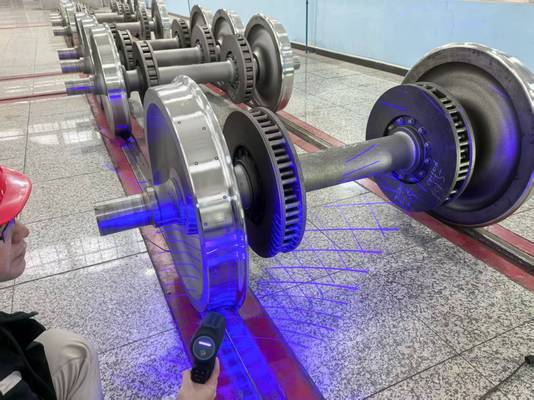
For applications involving large-scale parts like aerospace assemblies or heavy machinery, verify the scanner’s volumetric accuracy across its entire working distance, not just at a single point.
The shift to integrated metrology is a shift in operational philosophy. It prioritizes flow over batch, immediate feedback over delayed reporting, and prevention over correction. By moving the 3d measuring machine from the lab to the line, you turn quality validation from a bottleneck into a rhythmic step within the manufacturing process.
To specify the right system for your operation, start by defining your primary challenge: What is the most complex part geometry or hidden feature you need to validate, and what is your target tolerance for it?
Hangzhou Insvision Technology Co., Ltd.
Address: Building 1, No. 1399 Liangmu Road, Yuhang District, Hangzhou, Zhejiang 311121, China
Copyright © Hangzhou Insvision Technology Co., Ltd. All rights reserved.
Copyright © Hangzhou Insvision Technology Co., Ltd. All rights reserved.