

3d scan engine Industrial Inspection Guide
In this articleClosing the Loop Between Shop-Floor Reality and Quality DataProprietary Architecture: Why Control Over the Full Stack MattersHandheld Precis...
The result is a closed-loop feedback system that aligns with Industry 4.0 goals, providing critical inspection data where it matters most, without pausing the line.
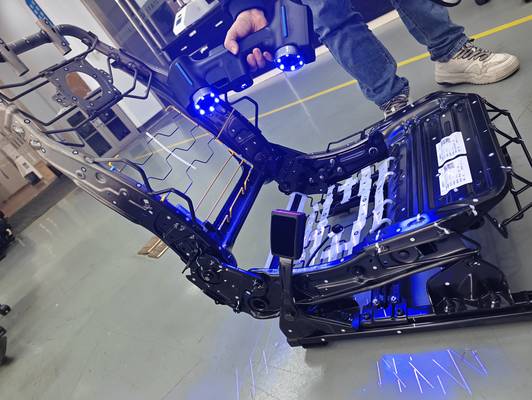
Closing the Loop Between Shop-Floor Reality and Quality Data
The traditional disconnect between production and inspection creates a costly lag. INSVISION bridges this by engineering its portable 3D scan engine as a frontline tool. Take the verification of a deep-skirt engine block or a polished sheet metal panel. The INSVISION AlphaScan series uses specialized blue laser lines to penetrate recesses and handle reflective surfaces without preparatory coating.
Term Notes
The traditional disconnect between production and inspection creates a costly lag.
Proprietary Architecture: Why Control Over the Full Sta…Many metrology solutions combine disparate hardware and third-party software, creating traceability gaps and interoperabilit…
Handheld Precision: The AlphaScan Engine in ActionPortability should not compromise precision.
Matching Scan Strategy to Surface and Tolerance Require…A common misstep involves applying maximum point density to every feature, which creates data noise and processing delays.
An engineer can navigate the handheld unit around the part, generating a dense point cloud in situ. This data is immediately overlaid against the CAD model within the software, producing a color-coded deviation heatmap. This instant analysis allows for on-the-spot decisions—scrapping, rework, or proceeding—transforming inspection from a post-process audit into an integrated step in the production rhythm.
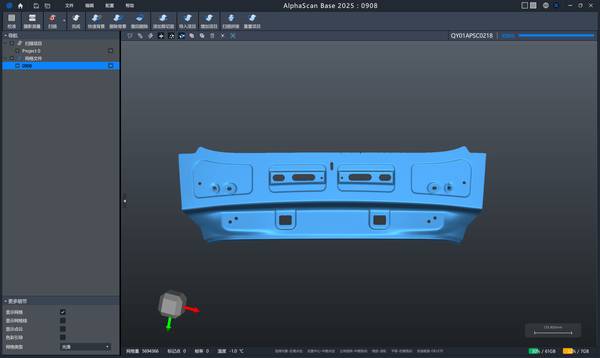
Proprietary Architecture: Why Control Over the Full Stack Matters
Many metrology solutions combine disparate hardware and third-party software, creating traceability gaps and interoperability headaches. INSVISION avoids this by developing its entire 3D scan engine—from optical hardware to AI-powered processing algorithms—in-house. This vertical integration ensures a traceable calibration chain from the sensor to the final report.
For Western manufacturers, this translates to reliable, standardized GD&T data outputs compatible with ISO and ASME Y14.5 workflows, whether for first-article inspection of an automotive component or reverse engineering in aerospace MRO. The system’s CE, FCC, and CNAS certifications and global deployment validate its stability across diverse industrial environments, reducing the need for constant recalibration checks.
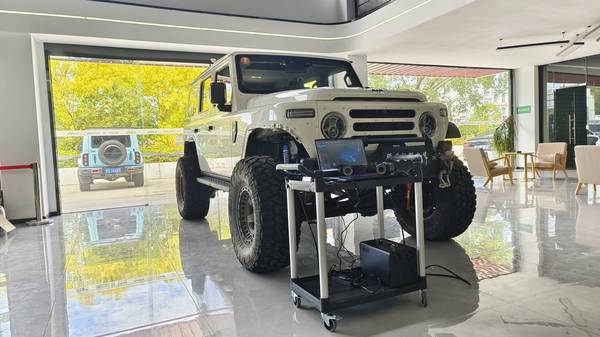
Handheld Precision: The AlphaScan Engine in Action
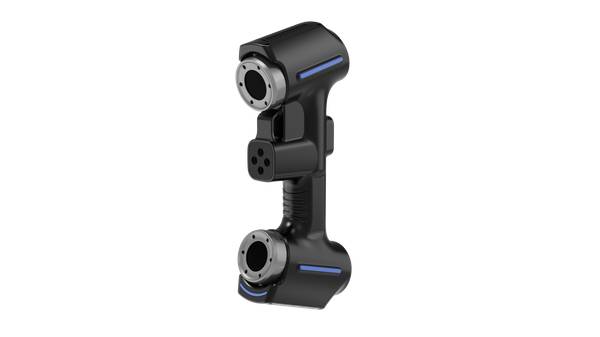
Portability should not compromise precision. The INSVISION AlphaScan handheld scanner, at 1070 grams, embodies this principle. Its ergonomic design allows for extended use on complex geometries, from a motorcycle frame to a turbine blade.
The optical system addresses specific challenges: a cross-line laser array for rapid overall capture, a dedicated single blue laser for deep holes and cavities, and a fine-scan mode for critical tolerance zones. This allows an operator to adapt the scan mode to the feature—using high speed for large surfaces and high resolution for sealing faces—optimizing both time and data quality.
The workflow is anchored by industrial software with built-in GD&T tools and one-click reporting, making it a viable alternative to fixed CMMs for tasks like hull mapping or validating additive manufacturing outputs.
Matching Scan Strategy to Surface and Tolerance Requirements
A common misstep involves applying maximum point density to every feature, which creates data noise and processing delays. Effective scanning requires matching the mode to the geometry and required tolerance class. INSVISION system provides a structured framework for this decision. Use the cross-line mode for rapid baseline mapping of large assemblies.
Switch to single-line for accessing confined spaces like the interior of a gearbox housing. Engage the fine-scan mode for critical sealing surfaces requiring tight GD&T analysis. While the system handles a range of reflectivities, engineers should note: matte or dark surfaces yield optimal results directly, while highly polished finishes may require ambient light management.
This strategic approach ensures clean data that feeds seamlessly into downstream CAD/CAM and quality management systems.
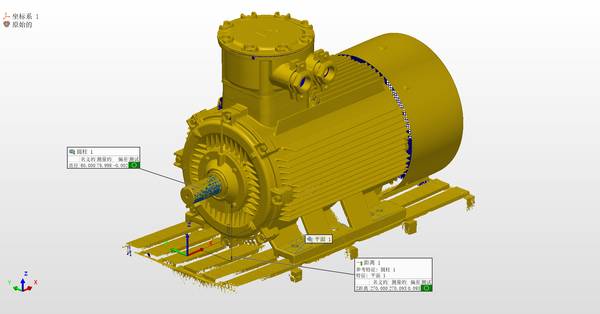
Sustaining Global Readiness with In-House Metrology
For multi-site operations, consistency is paramount. Deploying the INSVISION 3D scan engine standardizes metrology capabilities across global facilities, bringing lab-grade validation in-house. The AlphaScan Elite enables teams to capture high-precision data from a production fixture or a disassembled engine bay, eliminating the scheduling delays and costs of external labs.
The software’s support for multi-source data alignment ensures traceability that meets Western manufacturing audit trails. This shift reduces downtime for routine checks and accelerates processes from design optimization to final inspection reporting. Sustaining this readiness is supported by application engineering and structured operator training.
Evaluating Fit for Your Production Environment
The suitability of a handheld 3D scan engine depends on your specific constraints. Before integration, validate its performance against your most challenging part types. Consider the primary material and its surface finish—does your workflow involve mostly cast, machined, or composite surfaces? Review the size range and required tolerance class for your critical components.
Most importantly, assess the line takt time: can the scanning and reporting rhythm keep pace without creating a new bottleneck? The INSVISION 3D scan engine is designed for integration, but its value is proven part-by-part. To discuss a tailored evaluation, share details on your typical part material, size, tolerance requirements, and reporting workflow.
Hangzhou Insvision Technology Co., Ltd.
Address: Building 1, No. 1399 Liangmu Road, Yuhang District, Hangzhou, Zhejiang 311121, China
Copyright © Hangzhou Insvision Technology Co., Ltd. All rights reserved.
Copyright © Hangzhou Insvision Technology Co., Ltd. All rights reserved.