

3d laserscanner Industrial Inspection Guide
In this articleEngineering for Uncompromising SurfacesThe AlphaScan: Mobility Meets Metrology PrecisionIntegrating Scan Data into Quality WorkflowsEvaluati...
For engineers, the decision hinges on a scanner’s ability to handle real-world surface variability and output ISO/ASME-compliant data for validation. INSVISION systems, for instance, use AI-enhanced algorithms to stabilize scans on challenging materials, from deep-black composites to polished metals, ensuring accurate point cloud generation where traditional optics fail.
Engineering for Uncompromising Surfaces
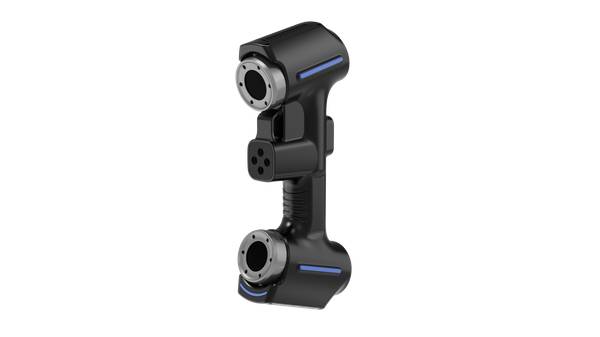
The true test of a handheld 3D scanner is its performance on the geometries that fixed systems cannot access. On an aerospace MRO line, capturing the internal contours of a deep cooling channel or the compound curves of a blade requires a device engineered for complexity. INSVISION addresses this through a hardware and software architecture built for industrial environments.
Proprietary AI-driven processing enhances point cloud reconstruction from difficult surfaces, minimizing the need for manual data cleanup. This allows devices like the AlphaVista to maintain a high measurement rate—processing millions of points per second—while achieving volumetric accuracy verified by CE, FCC, and CNAS certifications.
It’s a toolset designed strictly for industrial metrology and reverse engineering, ensuring robustness in settings ranging from automotive assembly to energy sector fabrication.
The AlphaScan: Mobility Meets Metrology Precision
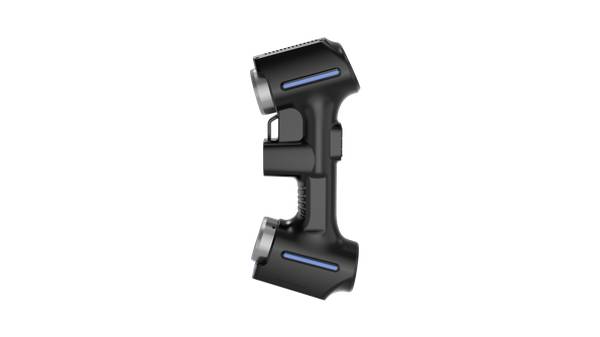
The INSVISION AlphaScan handheld 3D laserscanner bridges the critical gap between flexibility and precision. Its design prioritizes the capture of intricate features, such as wheelset flanges or internal cylindrical bores, in minutes rather than hours. The scanner’s dual-layer LED illumination is specifically optimized for challenging geometries, providing consistent data from deep holes and shadowed areas.
A physically secured high-speed USB connection ensures stable data transmission in active shop-floor conditions. Whether scanning a large composite panel or an intricate casting, the system delivers unrestricted measurement capabilities without sacrificing the detail required for downstream tolerance analysis.
Integrating Scan Data into Quality Workflows
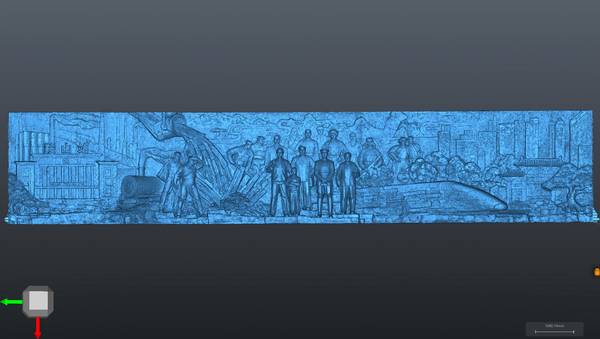
Capturing a point cloud is only the first step. Value is realized when that data seamlessly converts into a validated inspection report. INSVISION software automates the alignment of scan data with reference CAD models, generating immediate color deviation maps that visualize geometric errors on complex parts.
For quality teams, this means rapid identification of out-of-tolerance conditions on a wheelset tread or a turbine blade. The AI-enhanced processing actively cleans noise from reflective surfaces while preserving critical edges. From here, a one-click function generates inspection reports, and 3D models can be exported directly to professional platforms for final verification against ASME Y14.5 and ISO 1101 standards.
The boundary condition is clear: handheld scanning optimizes throughput for large, complex, or difficult-to-fixture components, while fixed CMMs remain the choice for ultra-high-precision datum features on smaller, more accessible parts.
Evaluating Deployment Readiness
Before integrating a 3d laserscanner, engineers should validate its fit for their specific production environment. Start by defining the target geometry: what are the key part types, surface materials (e.g., reflective, dark, textured), and required tolerance bands? Next, verify the scanner’s stated volumetric accuracy—such as the 0.073mm capability of the AlphaVista—against your tolerance classes through on-site validation.
Scan a representative sample part with known CMM data to benchmark the system’s AI-enhanced reconstruction output. Finally, confirm software interoperability: can the inspection software export data and reports compatible with your existing Quality Management System (QMS)? Assess calibration intervals and the system’s stability under your shop-floor’s environmental conditions to ensure long-term reliability.
Next Steps for Implementation
To determine if a metrology-grade handheld 3d laserscanner aligns with your quality assurance strategy, consider your primary constraint. Is it the throughput (takt time) on a production line for large components like fuselage sections or weldments? Is it the need to capture complex geometries like deep internal channels or undercuts without destructive disassembly?
Hangzhou Insvision Technology Co., Ltd.
Address: Building 1, No. 1399 Liangmu Road, Yuhang District, Hangzhou, Zhejiang 311121, China
Copyright © Hangzhou Insvision Technology Co., Ltd. All rights reserved.
Copyright © Hangzhou Insvision Technology Co., Ltd. All rights reserved.