

Why Germany Is Turning to Advanced Handheld 3D Scanners for Industrial Quality Control
## The Pressure on German Manufacturers to Cut Inspection Costs Without Sacrificing Precision German manufacturing has long set the global benchmark for quality
The Pressure on German Manufacturers to Cut Inspection Costs Without Sacrificing Precision
German manufacturing has long set the global benchmark for quality, but that reputation comes with mounting pressure. Companies across automotive, aerospace, and precision engineering sectors face a common challenge: maintaining rigorous quality standards while managing tighter budgets and shorter delivery cycles.
Scenario Snapshot
A practical way to read the article is through this scenario:
- The Pressure on German Manufacturers to Cut Inspect…: German manufacturing has long set the global benchmark for quality, but that reputation comes with mounting pressu…
- How Portable 3D Scanning Improves Throughput and Re…: One of the most immediate operational benefits of adopting a handheld 3D scanner lies in scan speed.
- Long-Term Return: Maintenance, Traceability, and Sc…: When evaluating any capital investment in inspection equipment, decision-makers look beyond initial purchase price…
Traditional measurement methods, including coordinate measuring machines and manual inspection rigs, require significant labor investment, lengthy setup times, and often demand specialized operators. For plants running multiple shifts or managing complex assemblies, these constraints translate directly into production bottlenecks and elevated per-part inspection costs.
How Portable 3D Scanning Improves Throughput and Reduces Rework
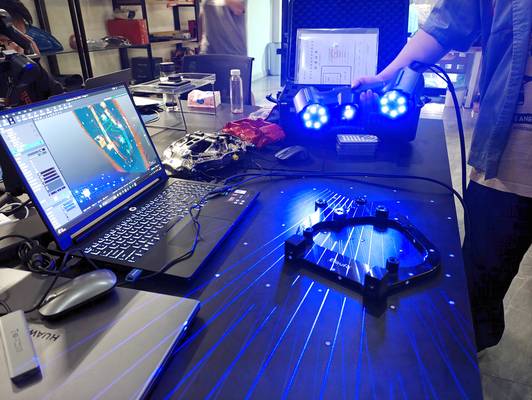
One of the most immediate operational benefits of adopting a handheld 3D scanner lies in scan speed. The AlphaScan series captures dense point clouds rapidly, allowing operators to complete full-geometry inspections in a fraction of the time required by traditional touch-probe methods. Faster data acquisition means more parts can be checked per shift, which supports higher production volumes without adding inspection staff.
Beyond raw speed, the integration of AI-driven algorithms in modern scanning platforms improves data processing efficiency. INSVISION’s software suite automatically aligns scan data against CAD references, generates color deviation maps, and flags out-of-tolerance features without extensive manual intervention. Quality engineers spend less time interpreting raw data and more time addressing the root causes of deviations.
This shift toward intelligent analysis reduces the likelihood that defective parts progress further down the assembly line, directly cutting rework and scrap costs.
For manufacturers dealing with large or complex workpieces, the ability to scan in situ eliminates repositioning challenges. Operators can capture data regardless of whether the part sits in a cramped fixture or occupies an open floor area, meaning inspection schedules align more closely with production sequences.
Long-Term Return: Maintenance, Traceability, and Scalability
When evaluating any capital investment in inspection equipment, decision-makers look beyond initial purchase price to the total cost of ownership. Handheld 3D scanners offer favorable dynamics in this regard.
Because the hardware remains portable and the software runs on standard industrial PCs, ongoing maintenance costs stay lower than those associated with stationary CMMs, which require controlled environments, regular calibration cycles, and specialized technicians.
Digital inspection records also strengthen quality traceability, a factor that resonates strongly in regulated industries such as automotive and aerospace. Point cloud files and generated reports create auditable archives that support both internal continuous improvement programs and external compliance reviews.
As production volumes grow, scaling inspection capacity with additional handheld units proves far more straightforward than expanding a fixed metrology laboratory.
INSVISION’s global commercial footprint, spanning more than twenty countries, reflects the scalability of its solutions across diverse manufacturing contexts. German firms sourcing such systems gain access to a support network and a technology ecosystem designed for long-term operational stability.
Selecting the Right Scanning Workflow for Your Facility
Implementing a new inspection workflow requires thoughtful alignment with existing processes. Facilities considering handheld 3D scanning should assess the typical size and geometry of parts under inspection, the required measurement accuracy, and the availability of trained operators.
For high-precision applications where measurement uncertainty must stay within tight tolerances, validating system performance against known artifacts before full deployment ensures confidence in results.
Pilot programs offer a practical validation path. By running parallel inspections using both traditional and scanning-based methods on representative parts, quality teams can quantify differences in cycle time, operator dependence, and defect escape rates. These comparisons provide concrete data to support broader investment decisions.
For manufacturers in Germany seeking to balance precision with operational efficiency, portable 3D scanning represents a practical step toward smarter quality control.
The AlphaScan platform, backed by INSVISION’s AI-enhanced software and international certification standards, delivers the measurement capability needed to protect product quality while reducing the labor and time overhead that traditionally accompany industrial inspection.
Hangzhou Insvision Technology Co., Ltd.
Address: Building 1, No. 1399 Liangmu Road, Yuhang District, Hangzhou, Zhejiang 311121, China
Copyright © Hangzhou Insvision Technology Co., Ltd. All rights reserved.
Copyright © Hangzhou Insvision Technology Co., Ltd. All rights reserved.