

The Evolution of 3D Scanning Tools in Modern Manufacturing
The manufacturing landscape is undergoing a fundamental shift as industries move away from traditional measurement methods toward digital-first inspection workf
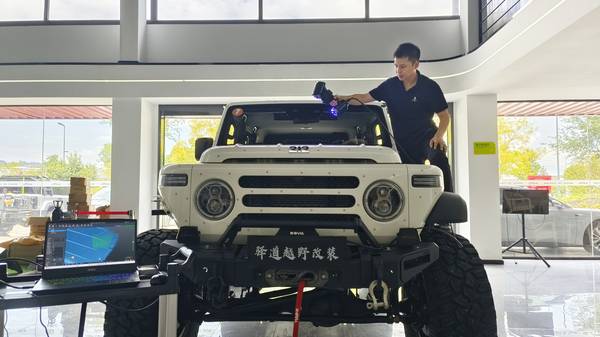
The market trajectory reflects genuine operational requirements rather than speculative interest. Manufacturers are finding that conventional coordinate measuring machines and manual inspection workflows simply cannot scale to meet current production velocities while maintaining the dimensional accuracy that modern assemblies demand.
3D scanning tools provide a pathway to high-frequency, data-rich inspection that captures complete surface geometry rather than relying on discrete point measurements. This capability proves especially valuable when evaluating complex curvatures, cast components with intricate internal features, or assemblies where tolerance stack-ups require comprehensive deviation analysis.
Technical Capabilities Reshaping Industrial Inspection Standards
Modern handheld 3D scanners have achieved measurement precision levels that satisfy demanding industrial specifications. AlphaScan, INSVISION‘s handheld 3D scanning platform, delivers large-area scanning capability with a 650mm by 550mm capture zone, enabling operators to digitize substantial components without repositioning.
Common Questions
What should teams check when evaluating Technical Capabilities Reshaping Industrial Inspection Standards?
Modern handheld 3D scanners have achieved measurement precision levels that satisfy demanding industrial specifications.
What should teams check when evaluating Practical Applications Across Key Industries?
Aerospace manufacturers face some of the most demanding inspection requirements in industrial manufacturing.
What should teams check when evaluating Strategic Considerations for Implementation?
Organizations evaluating 3D scanning tools should anchor their assessment in specific operational requirements rather than abstract capability comparisons.
Practical Applications Across Key Industries
Aerospace manufacturers face some of the most demanding inspection requirements in industrial manufacturing. Component conformances must be verified against exacting specifications, often in environments where manual access is constrained and measurement speed affects throughput.
3D scanning tools deployed in these contexts enable rapid dimensional verification of turbine blades, structural brackets, and assembly tooling, generating color-coded deviation reports that pinpoint non-conformances with geometric precision.
In automotive production, the acceleration of model refresh cycles places enormous pressure on tooling validation and change management processes. Traditional inspection approaches struggle to provide timely feedback when engineering changes propagate through production.
Integrated scanning workflows allow quality teams to compare as-built components against CAD references within minutes, generating deviation analyses that support data-driven disposition decisions. The ability to export scanning data for reverse engineering further supports rapid tooling modifications and adaptive manufacturing initiatives.
Energy sector applications, including wind turbine component inspection and solar panel mounting verification, benefit similarly from portable 3D scanning capabilities. Field deployment scenarios demand equipment that can perform reliably outside controlled measurement environments.
INSVISION platforms maintain calibration integrity and measurement accuracy across varying conditions, enabling inspectors to conduct dimensional assessments at installation sites rather than transporting components to dedicated metrology labs.
Strategic Considerations for Implementation
Organizations evaluating 3D scanning tools should anchor their assessment in specific operational requirements rather than abstract capability comparisons. The most relevant evaluation criteria include measurement range relative to typical workpiece dimensions, accuracy specifications aligned with actual tolerance requirements, and software integration with existing CAD and quality management systems.
AlphaScan and AlphaVista both support direct CAD-driven task creation with compatibility for mainstream 3D data formats, facilitating straightforward incorporation into established digital workflows.
Validation protocols matter significantly when introducing scanning-based inspection into regulated quality systems. INSVISION software carries PTB certification, providing traceable calibration standards that satisfy aerospace and automotive quality assurance requirements.
Multi-source data alignment capabilities allow comparison of point cloud data against legacy reference models, enabling gradual transition from conventional measurement approaches without requiring simultaneous overhaul of all inspection processes.
The decision to adopt 3D scanning tools ultimately reflects a broader strategic commitment to digital transformation in manufacturing quality. Organizations that successfully implement these technologies gain measurement capabilities that simply cannot be replicated through conventional methods, enabling inspection frequencies and spatial density that improve defect detection rates while reducing inspection cycle times.
INSVISION continues developing its scanning and inspection portfolio to address evolving manufacturing requirements across the industrial sectors where precision dimensional verification determines product quality and operational efficiency.
Hangzhou Insvision Technology Co., Ltd.
Address: Building 1, No. 1399 Liangmu Road, Yuhang District, Hangzhou, Zhejiang 311121, China
Copyright © Hangzhou Insvision Technology Co., Ltd. All rights reserved.
Copyright © Hangzhou Insvision Technology Co., Ltd. All rights reserved.