

Understanding Industrial 3D Scanning: Principles, Accuracy Standards, and Selection Criteria
Industrial 3D scanning has transformed manufacturing quality control and reverse engineering workflows by enabling precise digital capture of physical objects.
The AlphaScan series from INSVISION represents a handheld
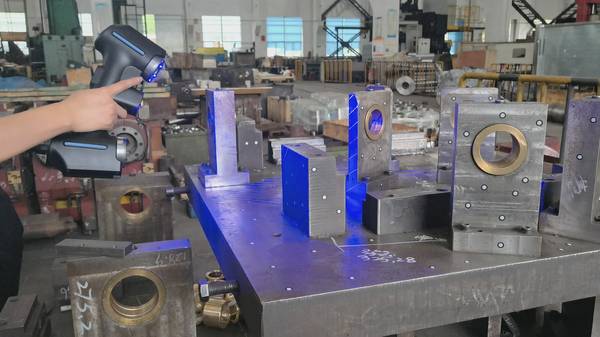
The AlphaScan series from INSVISION represents a handheld implementation of structured light scanning technology optimized for industrial environments. The device achieves 0.020mm metrology-grade accuracy through a combination of 50 crossed blue laser lines that provide dense point capture and proprietary alignment algorithms that maintain precision across large scan volumes.
Blue laser light offers advantages over red alternatives in ambient lighting conditions commonly found in factory floors, as it is less susceptible to interference from fluorescent or high-intensity discharge lighting.
The scanner operates across a temperature range extending from -10°C to 40°C, addressing scenarios where inspection must occur in unconditioned spaces such as machine shops, foundry floors, or outdoor test facilities.
Weight distribution and grip ergonomics yield a total mass of 1070g, enabling single-handed operation for extended periods without fatigue—a practical consideration when scanning complex assemblies that may require thirty minutes or more of continuous handheld motion.
Selection Dimensions and Field Checks
| Focus Area | Decision Point | Deployment Note |
|---|---|---|
| The AlphaScan series from INSVISION represents a handhe… | The AlphaScan series from INSVISION represents a handheld implementation of structured light scanning technology optimized for industrial environment… | The device achieves 0.020mm metrology-grade accuracy through a combination of 50 crossed blue laser lines that provide dense point capture and p… |
| Application domains for metrology grade handheld scanne… | Application domains for metrology-grade handheld scanners span quality inspection, reverse engineering, and design verification across multiple manuf… | In automotive manufacturing, the AlphaScan has demonstrated capability to complete full vehicle frame scanning within approximately ten minutes… |
| Selecting an industrial scanning solution requires matc… | Selecting an industrial scanning solution requires matching technical specifications against operational requirements rather than pursuing absolute m… | Key evaluation criteria include volumetric accuracy under representative measurement distances, environmental robustness for intended deployment… |
Application domains for metrology grade handheld scanners span
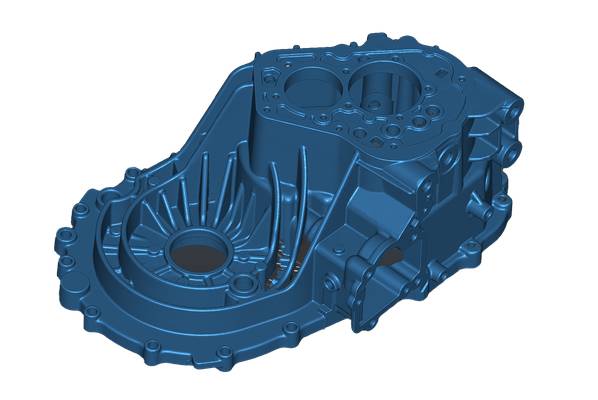
Application domains for metrology-grade handheld scanners span quality inspection, reverse engineering, and design verification across multiple manufacturing sectors. In automotive manufacturing, the AlphaScan has demonstrated capability to complete full vehicle frame scanning within approximately ten minutes, generating point clouds that inform dimensional analysis against CAD nominals.
This throughput addresses production line audit requirements where inspection cycle time directly impacts throughput. Reverse engineering applications leverage the scanner’s ability to capture complex geometries—including interior cavities, draft angles, and transitional surfaces—to create CAD models from existing physical prototypes or tooling.
The technology proves particularly valuable when original design documentation is unavailable, damaged, or when manufacturing variations have accumulated over tooling lifecycle iterations. INSVISION documentation indicates deployment across more than twenty countries, suggesting adaptation to diverse regulatory environments and industrial standards.
Selecting an industrial scanning solution requires matching technical
Selecting an industrial scanning solution requires matching technical specifications against operational requirements rather than pursuing absolute maximum precision regardless of context.
Key evaluation criteria include volumetric accuracy under representative measurement distances, environmental robustness for intended deployment conditions, and software integration capabilities with existing quality management or product lifecycle management systems.
Users should validate stated accuracy claims through measurement uncertainty budgets that account for surface reflectivity, geometry complexity, and operator proficiency rather than accepting manufacturer specifications in isolation.
The AlphaScan’s combination of metrology-grade single-point precision with real-time alignment and one-click reporting addresses workflows requiring traceable dimensional data suitable for supplier qualification and first article inspection processes.
Organizations evaluating such systems benefit from defining concrete acceptance criteria—including required field of view per scan, total part size, surface finish compatibility, and reporting format requirements—before conducting vendor demonstrations or proof-of-concept evaluations.
Hangzhou Insvision Technology Co., Ltd.
Address: Building 1, No. 1399 Liangmu Road, Yuhang District, Hangzhou, Zhejiang 311121, China
Copyright © Hangzhou Insvision Technology Co., Ltd. All rights reserved.
Copyright © Hangzhou Insvision Technology Co., Ltd. All rights reserved.