

3D Scanning Targets: The Foundation of Precision and Efficiency in Industrial Quality Control
## Why 3D Scanning Targets Are Critical for Measurement Accuracy In any industrial scanning workflow, the targets placed on a workpiece are not accessories — th
Why 3D Scanning Targets Are Critical for Measurement Accuracy
In any industrial scanning workflow, the targets placed on a workpiece are not accessories — they are the reference framework that everything else depends on. Without properly positioned and characterized 3D scanning targets, the scanner cannot establish a reliable coordinate system, and the resulting point cloud loses its connection to real-world dimensions.
This matters enormously in quality control environments where tolerance stacks are tight and decisions about acceptance or rejection affect production flow directly.
Selection Dimensions and Field Checks
| Focus Area | Decision Point | Deployment Note |
|---|---|---|
| Why 3D Scanning Targets Are Critical for Measurement Ac… | In any industrial scanning workflow, the targets placed on a workpiece are not accessories — they are the reference framework that everything else de… | Without properly positioned and characterized 3D scanning targets, the scanner cannot establish a reliable coordinate system, and the resulting… |
| Integrating Target-Based Workflows into Existing Inspec… | Shifting from conventional measurement tools to a target-driven 3D scanning workflow requires more than buying hardware. | It demands a rethinking of how inspection steps are sequenced. |
| Reducing Hidden Costs Through Smarter Target Strategy | The cost conversation around 3D scanning often focuses on equipment purchase price or throughput numbers. | A more complete view includes the hidden labor costs associated with rework, redundant inspection steps, and delayed deliveries. |
| Building Sustainable Inspection Capability with INSVISI… | Adopting target-based 3D scanning is ultimately an investment in inspection infrastructure that pays dividends across the product lifecycle. | The initial setup requires planning and operator training, but the recurring return in reduced inspection time, improved traceability, and fewer… |
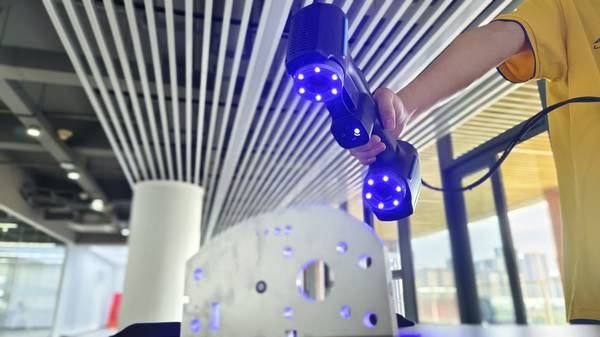
When INSVISION designed the AlphaScan handheld 3D scanner, the integration of target-based registration was treated as a core capability rather than an afterthought. The scanner supports large-area scanning up to 650 mm × 550 mm, which means targets must be distributed across surfaces that would overwhelm manual measurement methods.
The ability to capture millions of measurement points per second — and align them with high repeatability — depends on the fidelity of those reference points.
In practice, engineering teams that neglect target selection and placement find themselves rerunning scans, recalibrating systems, or worse, shipping parts that appear within tolerance in the scan but drift from the actual nominal geometry. The cost of those rework loops is not trivial.
Scheduling delays cascade through downstream assembly, and the labor required to diagnose and re-inspect erodes the productivity gains that scanning technology is supposed to deliver.
Integrating Target-Based Workflows into Existing Inspection Routines
Shifting from conventional measurement tools to a target-driven 3D scanning workflow requires more than buying hardware. It demands a rethinking of how inspection steps are sequenced. Teams that succeed treat target placement as a planning activity, not an improvisation step performed on the shop floor.
Before scanning begins, operators identify key reference features on the part — datum holes, machined flats, or designated target areas — and apply adhesive or magnetic targets accordingly. The density and pattern of targets depend on surface geometry, part size, and the required accuracy class.
For complex geometries, strategic target placement around contoured regions prevents registration drift that would otherwise accumulate across large scan volumes.
INSVISION’s 3D INSVISION software platform complements the AlphaScan workflow by handling multi-station data alignment and deviation analysis after the scan is complete. Once the point cloud is registered using the targets, the software can generate color-coded deviation maps that show exactly where a part deviates from its nominal CAD model.
This eliminates the need for multiple gauge setups and manual dimension recording, compressing the inspection cycle significantly. Teams that previously needed a full day to measure a large casting can now complete the same job in under an hour, including report generation.
The long-term operational benefit extends beyond single-part cycle time. When inspection data is captured digitally and linked to the scan targets that produced it, traceability improves. Quality engineers can review not only whether a part passed or failed, but also which scan session, which target configuration, and which operator was involved.
This level of detail supports root cause analysis when trends emerge across production batches.
Reducing Hidden Costs Through Smarter Target Strategy
The cost conversation around 3D scanning often focuses on equipment purchase price or throughput numbers. A more complete view includes the hidden labor costs associated with rework, redundant inspection steps, and delayed deliveries. These expenses are often invisible in budget line items but show up in delivery schedules and customer satisfaction metrics.
Consider a scenario involving large turbine blade inspection or aerospace structural component verification. These parts often exceed the single-scan field of view of compact systems, requiring multiple overlapping scans.
Target-based registration stitches these volumes together with sub-millimeter accuracy, allowing a single operator to complete what would otherwise require multiple gauge setups, specialized fixtures, and a second inspector for cross-verification. The labor savings compound over every inspection cycle.
Target durability also plays into operational cost. Reusable targets made from engineered materials resist the oily, dusty conditions common in machining and foundry environments. Switching to durable targets reduces the consumables spend and the downtime associated with replacing damaged or contaminated single-use markers.
Over a year of high-volume inspection, even modest per-part savings on consumables translate into a meaningful reduction in total cost of quality.
When combined with the AlphaScan scanner’s ability to export data directly into reverse engineering and additive manufacturing pipelines, the target-based workflow reduces hand-offs between departments. The same scan file that serves inspection can feed CAD modeling, tooling modifications, or 3D printing setup.
This convergence eliminates redundant data capture and the translation errors that accompany manual data transfer between incompatible formats.
Building Sustainable Inspection Capability with INSVISION
Adopting target-based 3D scanning is ultimately an investment in inspection infrastructure that pays dividends across the product lifecycle. The initial setup requires planning and operator training, but the recurring return in reduced inspection time, improved traceability, and fewer escape defects compounds steadily.
INSVISION approach couples hardware precision — the AlphaScan handheld scanner’s accuracy and speed — with software intelligence that turns raw point cloud data into actionable quality information.
For manufacturers operating in automotive, aerospace, or advanced industrial sectors, that combination addresses the two pressures that dominate every quality conversation: delivering parts faster and delivering them correctly the first time.
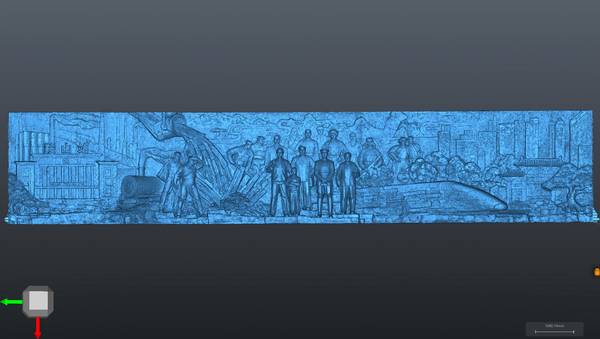
Organizations that standardize on target-driven scanning workflows find that their inspection teams become more productive without proportional increases in headcount. They catch defects earlier in the process, which reduces scrap rates and the cost of downstream rework.
Over time, the data accumulated from consistent target-based scans builds a quality intelligence baseline that supports continuous improvement initiatives and customer audit requirements alike.
Hangzhou Insvision Technology Co., Ltd.
Address: Building 1, No. 1399 Liangmu Road, Yuhang District, Hangzhou, Zhejiang 311121, China
Copyright © Hangzhou Insvision Technology Co., Ltd. All rights reserved.
Copyright © Hangzhou Insvision Technology Co., Ltd. All rights reserved.