

Understanding 3D Scanner Accuracy: Why Measurement Precision Defines Success in Industrial Applications
When engineers evaluate 3D scanning technology for manufacturing environments, measurement accuracy sits at the center of every purchasing decision. A scanner t
How Accuracy Specifications Translate to Real-World Inspection Performance
Volumetric accuracy represents the combined measurement error a scanner introduces across a defined working volume. The AlphaScan Elite delivers a volumetric accuracy specification of 0.015 millimeters plus 0.035 millimeters per meter, a figure that accounts for environmental variables encountered in factory floor conditions.
When paired with optional photogrammetry scale bars, this figure tightens to 0.015 millimeters plus 0.025 millimeters per meter, providing a quantifiable improvement for applications requiring the highest confidence in measurement data.
Selection Dimensions and Field Checks
| Focus Area | Decision Point | Deployment Note |
|---|---|---|
| How Accuracy Specifications Translate to Real-World Ins… | Volumetric accuracy represents the combined measurement error a scanner introduces across a defined working volume. | The AlphaScan Elite delivers a volumetric accuracy specification of 0.015 millimeters plus 0.035 millimeters per meter, a figure that accounts f… |
| Field Deployment: Maintaining Accuracy Under Industrial… | Industrial environments rarely match the controlled conditions of a metrology lab. | Temperature fluctuations, vibration from nearby machinery, and the physical challenges of accessing large-scale components all place stress on m… |
| Integrating Scanning Accuracy into Reverse Engineering… | Reverse engineering workflows depend on accuracy at every stage. | A scanned point cloud that drifts or introduces systematic error produces a CAD model that cannot be reliably machined or 3D printed. |
| Connecting Accuracy to Measurable Operational Value | Measurement precision directly influences throughput and cost. | When inspection accuracy is insufficient, manufacturers either release parts with undetected non-conformances or reject parts that actually fall… |
These specifications matter most during tolerance analysis against reference CAD models. An aerospace manufacturer validating turbine blade repair dimensions, for example, requires measurement uncertainty well below the engineering tolerance band.
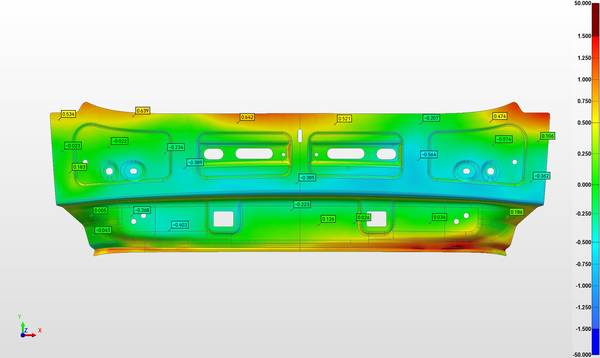
When the AlphaScan platform captures point cloud data and aligns it against nominal geometry, the resulting deviation map reflects true part behavior rather than scanner-induced noise. Quality engineers reviewing these reports can distinguish between acceptable manufacturing variation and out-of-spec conditions with confidence, enabling faster decision-making on the shop floor.
Field Deployment: Maintaining Accuracy Under Industrial Conditions
Industrial environments rarely match the controlled conditions of a metrology lab. Temperature fluctuations, vibration from nearby machinery, and the physical challenges of accessing large-scale components all place stress on measurement systems. The AlphaScan handheld scanner operates across a temperature range from minus five to forty degrees Celsius, accommodating environments where climate control cannot be guaranteed.
A wind energy equipment manufacturer recently deployed the AlphaScan system for in-situ inspection of large casting components. Rather than transporting massive turbine housings to an off-site measurement facility, inspectors positioned the scanner directly at the installation site.
The portable form factor, weighing 9.5 kilograms with dimensions enabling single-operator handling, allowed a technician to capture full-geometry data on components exceeding two meters in diameter. The resulting deviation analysis identified localized wall thickness variations that traditional caliper-based methods would have missed entirely.
This capability illustrates how accuracy specifications become operationally meaningful only when the measurement system can be deployed where parts actually reside.
Integrating Scanning Accuracy into Reverse Engineering Workflows
Reverse engineering workflows depend on accuracy at every stage. A scanned point cloud that drifts or introduces systematic error produces a CAD model that cannot be reliably machined or 3D printed. The AlphaScan platform supports direct export of point cloud and mesh data in IGES, STP, DXF, and DWG formats, ensuring compatibility with downstream CAD and CAM systems without translation losses.
Automotive tooling repair provides a compelling example. When injection mold tooling suffers wear or damage, repair decisions hinge on comparing current tool geometry against the original design intent. The scanning workflow captures the worn surface, software aligns the scan data to the reference model, and engineers generate a color-coded deviation map highlighting areas requiring material addition or removal.
The 0.073-millimeter single-shot scan accuracy of the AlphaVista series, combined with volumetric accuracy reaching 0.1 millimeters plus 0.015 millimeters per meter, supplies sufficient resolution for tooling repair planning.
The AI-driven analysis capabilities built into INSVISION‘s inspection software accelerate this workflow by automating feature recognition and tolerance evaluation, reducing the manual effort required to produce actionable repair documentation.
Connecting Accuracy to Measurable Operational Value
Measurement precision directly influences throughput and cost. When inspection accuracy is insufficient, manufacturers either release parts with undetected non-conformances or reject parts that actually fall within tolerance, both outcomes carrying financial consequences. A photonics equipment producer reduced inspection cycle time by implementing the AlphaScan workflow for small-batch precision components.
Operators captured full-geometry data in minutes rather than the hours previously required for multi-point tactile measurement. The instant generation of color deviation reports enabled engineers to disposition parts immediately, eliminating queue time between measurement and decision.
The practical impact extends beyond single-part inspection. When measurement accuracy is trusted and repeatable, manufacturers can establish statistical process control baselines that would be unreliable with lower-precision systems. Production managers gain visibility into trending deviations across batches, allowing predictive maintenance of machining centers before tool wear produces out-of-spec parts.
This shift from reactive inspection to proactive process control depends entirely on the fidelity of the underlying measurement data, and that fidelity begins with scanner accuracy specifications that hold up under actual production conditions.
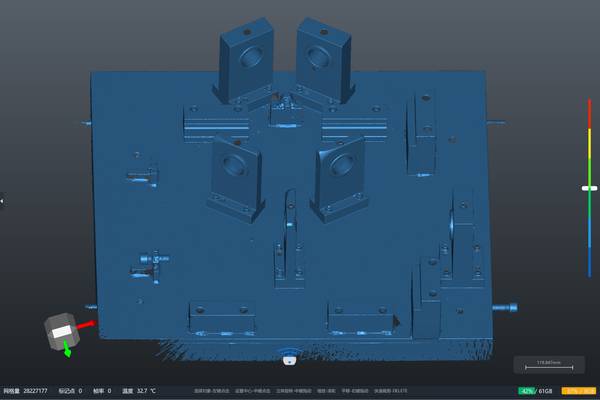
INSVISION’s AlphaScan handheld 3D scanner family provides the combination of verified volumetric accuracy, robust environmental tolerance, and seamless CAD integration that industrial operations require. For organizations evaluating 3D scanning technology, the measurable performance characteristics of the scanner platform determine what becomes possible in inspection, reverse engineering, and process optimization.
Hangzhou Insvision Technology Co., Ltd.
Address: Building 1, No. 1399 Liangmu Road, Yuhang District, Hangzhou, Zhejiang 311121, China
Copyright © Hangzhou Insvision Technology Co., Ltd. All rights reserved.
Copyright © Hangzhou Insvision Technology Co., Ltd. All rights reserved.