

Transforming Industrial Quality Control: How 3D Scanning Technology Reshapes Manufacturing Inspection Workflows
The shift from traditional measurement methods to digital inspection represents one of the most significant operational changes in modern manufacturing. 3D scan
Real-World Inspection Challenges That Drive Adoption
Manufacturing facilities face persistent pressure to reduce inspection cycle times while maintaining or improving measurement confidence. Traditional methods using coordinate measuring machines or hand tools often require dedicated fixtures, lengthy setup procedures, and specialized operator training. When production volumes increase or product variants multiply, these bottlenecks compound quickly.
Engineers report that conventional approaches frequently struggle with complex geometries, particularly components featuring undercuts, deep cavities, or surfaces that present accessibility challenges for tactile measurement devices.
Selection Dimensions and Field Checks
| Focus Area | Decision Point | Deployment Note |
|---|---|---|
| Real-World Inspection Challenges That Drive Adoption | Manufacturing facilities face persistent pressure to reduce inspection cycle times while maintaining or improving measurement confidence. | Traditional methods using coordinate measuring machines or hand tools often require dedicated fixtures, lengthy setup procedures, and specialize… |
| From Physical Parts to Actionable Data | The transition from point cloud capture to meaningful inspection results requires intelligent software capable of aligning scanned data against refer… | INSVISION integrates scanning, comparison, and model generation within a unified workflow using AI-enhanced algorithms that improve reconstructi… |
| Practical Deployment Considerations for Production Envi… | Implementing 3D scanning inspection requires attention to environmental factors, operator procedures, and integration with existing quality managemen… | Industrial facilities benefit from establishing dedicated scanning areas with controlled lighting and reference marks that support consistent po… |
| Measuring the Business Impact | Organizations implementing 3D scanning inspection report improvements across multiple performance indicators. | Inspection cycle time reductions typically range from substantial to transformational depending on component complexity and previous methodology. |
INSVISION designed the AlphaScan to address these workflow limitations through portability and flexible data capture. The scanner generates comprehensive point clouds from physical objects, converting physical inspection targets into digital assets that multiple stakeholders can analyze, compare, and archive without additional physical handling.
Industrial applications in automotive, aerospace, and precision manufacturing have validated that this approach reduces inspection preparation time significantly while expanding the types of features that quality teams can measure reliably.
From Physical Parts to Actionable Data
The transition from point cloud capture to meaningful inspection results requires intelligent software capable of aligning scanned data against reference geometry and extracting dimensional information. INSVISION integrates scanning, comparison, and model generation within a unified workflow using AI-enhanced algorithms that improve reconstruction accuracy and accelerate processing.
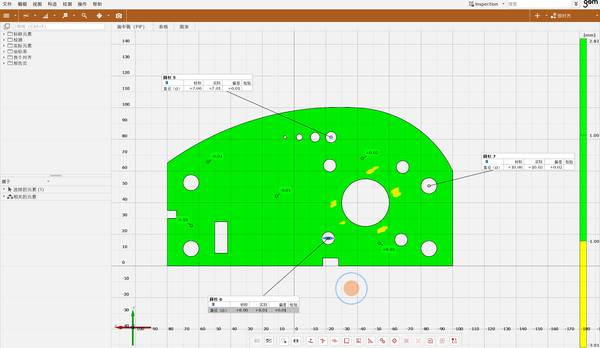
When operators scan a manufactured component, the system aligns captured geometry with CAD reference models, generates color-coded deviation maps highlighting dimensional differences, and produces structured inspection reports suitable for quality records and corrective action documentation.
This workflow proves particularly valuable for manufacturers managing complex assemblies where dimensional relationships between multiple components determine fit, function, and final performance. Rather than isolated single-part measurements, teams can capture and analyze complete assemblies in context, identifying cumulative variation patterns that might escape traditional inspection approaches.
The ability to export data in mainstream 3D formats ensures compatibility with existing PLM systems and enables long-term archival of inspection records for traceability requirements.
Practical Deployment Considerations for Production Environments
Implementing 3D scanning inspection requires attention to environmental factors, operator procedures, and integration with existing quality management practices. Industrial facilities benefit from establishing dedicated scanning areas with controlled lighting and reference marks that support consistent positioning across measurement sessions.
Operators require training on proper scanning technique, including approach angles, coverage patterns, and movement speed that optimize data capture without sacrificing resolution.
INSVISION products carry CE, FCC, and CNAS certifications, supporting deployment in regulated industries where equipment validation and documentation requirements apply. The AlphaScan hardware design emphasizes operational flexibility, allowing teams to perform measurements directly at production locations rather than transporting parts to dedicated inspection laboratories.
This capability proves essential for large components, installed assemblies, or production scenarios where disassembly and transport would introduce additional variability or unacceptable delays.
Measuring the Business Impact
Organizations implementing 3D scanning inspection report improvements across multiple performance indicators. Inspection cycle time reductions typically range from substantial to transformational depending on component complexity and previous methodology. More importantly, the comprehensive data capture enabled by scanning supports statistical process control approaches that traditional point-based measurement cannot provide.
Quality teams gain visibility into variation trends, enabling predictive interventions before defects propagate through production.
INSVISION has established commercial presence across more than twenty countries, with applications spanning automotive quality verification, aerospace component documentation, and industrial equipment maintenance. The combination of hardware precision and integrated software capabilities addresses the core requirements that determine whether 3D inspection delivers sustainable operational value.
For manufacturers evaluating technology adoption, the AlphaScan represents a deployment-ready solution that translates digital measurement capability into concrete quality improvements without requiring extensive infrastructure investment or specialized technical expertise.
The trajectory of industrial manufacturing increasingly depends on digital thread continuity, where physical products and virtual representations remain synchronized throughout design, production, and service lifecycles.
3D scanning technology serves as the primary bridge connecting physical manufacturing operations to digital quality systems, enabling the data-driven inspection approaches that modern competitive manufacturing demands.
Hangzhou Insvision Technology Co., Ltd.
Address: Building 1, No. 1399 Liangmu Road, Yuhang District, Hangzhou, Zhejiang 311121, China
Copyright © Hangzhou Insvision Technology Co., Ltd. All rights reserved.
Copyright © Hangzhou Insvision Technology Co., Ltd. All rights reserved.