

Transforming Industrial Quality Control: How 3D Scanners Drive Operational Efficiency
## The Hidden Expenses in Traditional Quality Inspection Manufacturing teams have long accepted inspection bottlenecks as an inevitable part of production. Conv
The Hidden Expenses in Traditional Quality Inspection
Manufacturing teams have long accepted inspection bottlenecks as an inevitable part of production. Conventional measurement methods require dedicated fixtures, manual, and significant cycle time—all while delivering limited insight into part conformance.
When quality engineers must choose between thorough inspection and maintaining delivery schedules, the result often leans toward sampling-based approaches that leave defect risk unaddressed.
Capability and Deployment Mapping
| Focus Area | Decision Point | Deployment Note |
|---|---|---|
| The Hidden Expenses in Traditional Quality Inspection | Manufacturing teams have long accepted inspection bottlenecks as an inevitable part of production. | Conventional measurement methods require dedicated fixtures, manual, and significant cycle time—all while delivering limited insight into part c… |
| Speed and Precision with Handheld 3D Scanning Technology | The AlphaScan handheld 3D scanner from INSVISION fundamentally changes this equation. | By capturing millions of measurement points in seconds, this system compresses the inspection timeline from hours to minutes while generating co… |
| Calculating the Efficiency Dividend | Operations implementing 3D scanning workflows consistently report measurable improvements across several performance dimensions. | First article inspection cycles compress significantly when engineers can capture complete part geometry rather than relying on discrete point m… |
| Building Your Digital Inspection Strategy | Adopting 3D scanning technology requires thoughtful implementation planning, but the transition need not disrupt existing operations. | Begin by mapping current inspection workflows and identifying the highest-impact opportunities for digitization. |
The real expense extends beyond labor hours. Rework and scrap consume materials and machine time. Delayed inspections create downstream scheduling conflicts. Fragmented measurement data makes it difficult to identify systemic process drift before it generates costly quality escapes.
For operations managing complex geometries or tight tolerances, traditional tools simply cannot keep pace with production velocity without expanding inspection resources proportionally.
Speed and Precision with Handheld 3D Scanning Technology
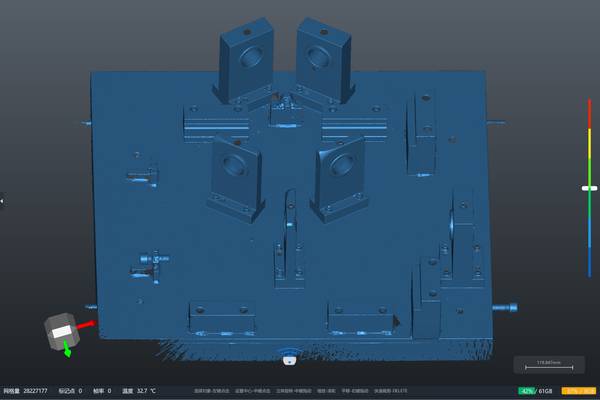
The AlphaScan handheld 3D scanner from INSVISION fundamentally changes this equation. By capturing millions of measurement points in seconds, this system compresses the inspection timeline from hours to minutes while generating complete digital representations of physical parts.
The device operates without requiring specialized environmental controls or lengthy warm-up procedures. Field teams can deploy it directly on the shop floor, whether examining components in confined spaces or large-scale workpieces. This flexibility eliminates the need to transport parts to a dedicated metrology lab, reducing handling damage risk and removing a significant source of inspection delay.
INSVISION has integrated AI-driven algorithms into the scanning workflow, enabling intelligent feature recognition and automated alignment. The system distinguishes critical geometry from surface noise, delivering measurement confidence that supports decisive quality determinations.
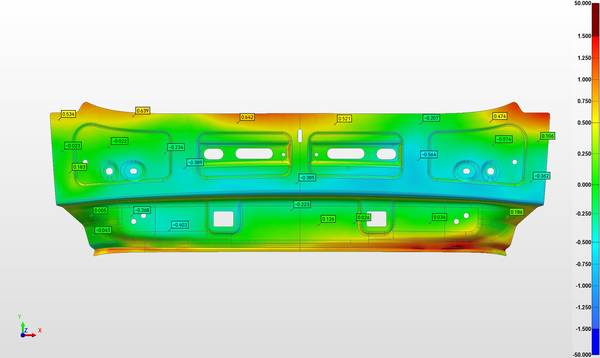
Combined with the company’s 3D INSVISION inspection software, scanned data flows directly into deviation analysis against CAD references, producing color-coded reports that communicate conformance status at a glance.
Calculating the Efficiency Dividend
Operations implementing 3D scanning workflows consistently report measurable improvements across several performance dimensions. First article inspection cycles compress significantly when engineers can capture complete part geometry rather than relying on discrete point measurements. This speed enables 100% inspection of critical characteristics where previously only statistical sampling was feasible.
Rework reduction represents another substantial value stream. Traditional inspection often identifies geometry deviations only after multiple processing steps have added value to nonconforming parts. 3D scanning integrated earlier in the workflow surfaces issues while corrective action remains inexpensive.
The complete digital record also supports root cause analysis, helping teams address underlying process variables rather than simply sorting good parts from bad.
Labor allocation shifts when scanning replaces tedious manual measurement. Skilled inspectors focus on data interpretation and process improvement rather than repetitive physical handling. Organizations report that trained operators can complete complex inspections in a fraction of the previous time, enabling quality departments to expand coverage without proportional headcount increases.
For aerospace, automotive, and industrial equipment manufacturers, the traceability dimension carries particular weight. 3D scan data creates permanent, verifiable records of as-built geometry. When customers or regulators require demonstration of dimensional compliance, digital records provide defensible evidence that transcends the limitations of paper-based inspection logs.
Building Your Digital Inspection Strategy
Adopting 3D scanning technology requires thoughtful implementation planning, but the transition need not disrupt existing operations. Begin by mapping current inspection workflows and identifying the highest-impact opportunities for digitization. Critical-feature heavy components, complex castings, and parts with multiple tolerance zones typically deliver the fastest returns.
Investment in operator training pays dividends quickly. While the AlphaScan interface prioritizes usability, understanding optimal scanning techniques maximizes data quality and consistent results. INSVISION provides application support to help teams establish validated procedures for their specific part families.
Long-term, the digital foundation created by 3D scanning enables progressive capability expansion. Inspection data feeds directly into statistical process control systems. Scan archives support historical comparison for wear analysis and design iteration. The infrastructure supporting today’s quality operations becomes the platform for tomorrow’s smart manufacturing initiatives.
Organizations evaluating this transition should consider total cost of ownership across the equipment lifecycle, including software support, calibration services, and training investment. When weighed against reduced rework, accelerated inspection cycles, and expanded quality coverage, the operational value proposition becomes clear.
INSVISION global service network and multi-national certification compliance provide additional confidence for organizations operating across international supply chains.
The question for quality leaders is no longer whether digital inspection delivers value, but rather how quickly their operations can capture it.
Hangzhou Insvision Technology Co., Ltd.
Address: Building 1, No. 1399 Liangmu Road, Yuhang District, Hangzhou, Zhejiang 311121, China
Copyright © Hangzhou Insvision Technology Co., Ltd. All rights reserved.
Copyright © Hangzhou Insvision Technology Co., Ltd. All rights reserved.