

How INSVISION’s AlphaScan Handheld 3D Scanner Transforms Industrial Quality Control
## Streamlined Reverse Engineering Workflows for Manufacturing Teams Industrial reverse engineering demands precision, speed, and reliability. Manufacturing tea
Streamlined Reverse Engineering Workflows for Manufacturing Teams
Industrial reverse engineering demands precision, speed, and reliability. Manufacturing teams often face the challenge of recreating complex components without accessible CAD documentation, whether working with legacy parts, damaged molds, or supplier-provided designs lacking digital records.
The AlphaScan handheld 3D scanner from INSVISION addresses these pain points by enabling operators to capture physical objects and convert them into accurate digital models within minutes.
Capability and Deployment Mapping
| Focus Area | Decision Point | Deployment Note |
|---|---|---|
| Streamlined Reverse Engineering Workflows for Manufactu… | Industrial reverse engineering demands precision, speed, and reliability. | Manufacturing teams often face the challenge of recreating complex components without accessible CAD documentation, whether working with legacy… |
| Practical Quality Inspection Applications Across Indust… | Quality inspection represents one of the most demanding applications for 3D scanning technology. | Manufacturers must verify that produced components conform to design specifications while maintaining throughput rates that support production s… |
| Deployment Considerations for Manufacturing Operations | Integrating 3D scanning technology into established manufacturing environments requires attention to workflow compatibility and operator training. | Organizations beginning implementation typically establish dedicated scanning stations equipped with computing resources sufficient for processi… |
| Measuring Operational Value Through Implementation Outc… | Organizations implementing the AlphaScan typically evaluate success through multiple performance indicators. | Inspection cycle time reductions often exceed 50% compared to traditional coordinate measuring approaches, particularly for components featuring… |
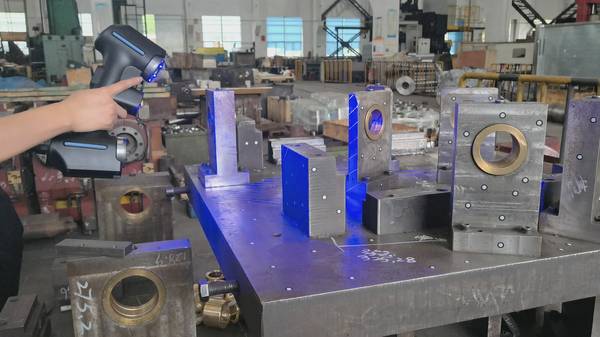
The scanning process begins with positioning the handheld device over the target object. The AlphaScan emits structured laser lines that map surface geometry, capturing millions of data points per second. Operators appreciate the device’s single-handed operation, which proves invaluable when navigating confined spaces or scanning large industrial components that require repositioning around awkward geometries.
Unlike stationary coordinate measuring machines, this portable approach allows quality teams to perform digitizing directly on the production floor, eliminating the need to transport sensitive parts to dedicated measurement labs.
Once scanning completes, the captured point cloud transfers to INSVISION’s 3D inspection software for processing. The integrated workflow supports the full reverse engineering sequence: from mesh generation and surface reconstruction to CAD model output compatible with major file formats.
Manufacturing engineers can then modify the digital model for tooling adjustments, additive manufacturing preparation, or documentation updates. The seamless handoff between hardware capture and software processing removes friction that traditionally slowed reverse engineering projects.
Practical Quality Inspection Applications Across Industrial Sectors
Quality inspection represents one of the most demanding applications for 3D scanning technology. Manufacturers must verify that produced components conform to design specifications while maintaining throughput rates that support production schedules.
Traditional contact measurement methods struggle to balance detail resolution against inspection time, particularly for parts featuring complex geometries or numerous measurement points.
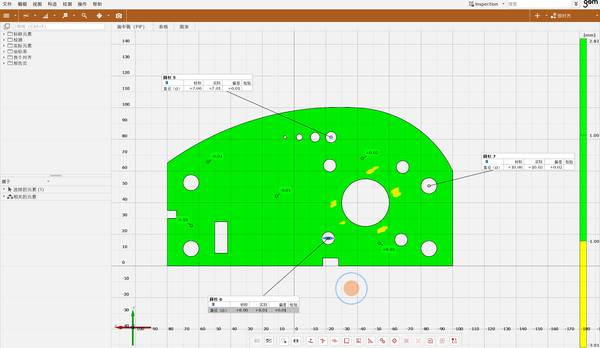
The AlphaScan enables comprehensive part evaluation without the limitations of point-by-point probing. After scanning a production part, operators import the resulting data into INSVISION’s detection software, where alignment algorithms automatically register the scan against reference CAD models.
The system generates color-coded deviation maps that visually communicate where dimensions deviate from nominal values, allowing inspectors to immediately identify areas requiring attention. This visualization approach accelerates root cause analysis when manufacturing processes drift out of tolerance.
INSVISION’s software suite incorporates geometric dimensioning and tolerancing tools that support standardized inspection protocols. The platform accommodates both 2D and 3D model references, enabling facilities to establish inspection routines aligned with existing quality management systems.
Report generation functions compile measurement data, deviation analyses, and Pass/Fail determinations into documentation suitable for engineering reviews, customer submissions, or regulatory compliance records.
Industries ranging from automotive manufacturing to aerospace component production have adopted these inspection workflows. The technology proves particularly valuable for first-article inspection, where newly produced parts must be verified before full production launch, and for ongoing production monitoring where statistical process control requires detailed dimensional data.
The portable nature of the AlphaScan also supports inspection of large-scale components that would exceed the measurement volume of conventional equipment.
Deployment Considerations for Manufacturing Operations
Integrating 3D scanning technology into established manufacturing environments requires attention to workflow compatibility and operator training. Organizations beginning implementation typically establish dedicated scanning stations equipped with computing resources sufficient for processing point cloud data without introducing bottlenecks into production sequences.
The AlphaScan connects via high-speed data transfer, ensuring captured information moves reliably to processing workstations.
Operator proficiency develops through structured training that covers both hardware operation and software workflow management. INSVISION provides documentation and support resources that enable new users to achieve competency within reasonable timeframes.
Most operators report becoming comfortable with basic scanning functions within a few days of practice, while advanced techniques such as optimal scanning path planning and challenging surface handling develop through continued application.
Environmental factors influence scanning success in industrial settings. The AlphaScan’s design accommodates production floor conditions, though extreme lighting, surface reflectivity, or vibration may require procedural adjustments.
Operators learn to evaluate part surface conditions and apply appropriate scanning parameters, including laser power settings and exposure adjustments, to maintain accuracy across varying materials and finishes. The device’s real-time feedback capabilities allow users to monitor data quality during acquisition, reducing the need for time-consuming rescan operations.
Measuring Operational Value Through Implementation Outcomes
Organizations implementing the AlphaScan typically evaluate success through multiple performance indicators. Inspection cycle time reductions often exceed 50% compared to traditional coordinate measuring approaches, particularly for components featuring complex geometries or extensive measurement point requirements.
This efficiency gain translates directly to increased throughput capacity for quality assurance operations without proportional staffing increases.
First-pass yield improvements frequently follow implementation, as more comprehensive dimensional data enables earlier detection of process variations. The detailed deviation information provided by scanning-based inspection supports targeted process adjustments that address root causes rather than symptomatic indicators.
Manufacturing teams report that the visualization capabilities accelerate communication between quality engineers and production operators, reducing the time required to resolve out-of-tolerance conditions.
Documentation quality improves as digital records replace manual measurement logs. The inspection software maintains complete audit trails that support traceability requirements for regulated industries. Report generation functions eliminate transcription errors that occasionally appear in manually compiled documentation.
These improvements in data integrity strengthen overall quality management system effectiveness while reducing the administrative burden associated with compliance documentation.
INSVISION multi-country commercial presence and international certifications including CE, FCC, and CNAS provide assurance of product quality and support infrastructure for organizations operating across global manufacturing networks.
The combination of reliable hardware, integrated software, and established support channels positions the AlphaScan as a practical solution for manufacturers seeking to modernize dimensional measurement capabilities.
Hangzhou Insvision Technology Co., Ltd.
Address: Building 1, No. 1399 Liangmu Road, Yuhang District, Hangzhou, Zhejiang 311121, China
Copyright © Hangzhou Insvision Technology Co., Ltd. All rights reserved.
Copyright © Hangzhou Insvision Technology Co., Ltd. All rights reserved.