

Selecting the Best 3D Scanner for Small Objects
In this articleMapping Scanner Capabilities to Real Part ChallengesValidating Metrology Integrity Beyond the DatasheetStructuring a Total Cost of Ownership...
Mapping Scanner Capabilities to Real Part Challenges
The core mistake is defining requirements from a generic specification sheet rather than from the physical parts you inspect. A scanner touted for small objects may struggle with the specific surface finish of an injection-molded connector or the polished curvature of a medical implant. Effective procurement starts by auditing your own components.
Identify the toughest cases: a matte black composite bracket, a threaded brass fitting, or an oil-filmed precision gear. These are your validation benchmarks. For instance, INSVISION systems utilize AI-driven surface recognition to adapt to varying material reflectivity without spray, while multiple intersecting laser lines are designed to capture fine details on intricate contours.
The question shifts from “what is the best scanner?” to “what scanner performs consistently on our parts under our lighting and handling conditions?”
Validating Metrology Integrity Beyond the Datasheet
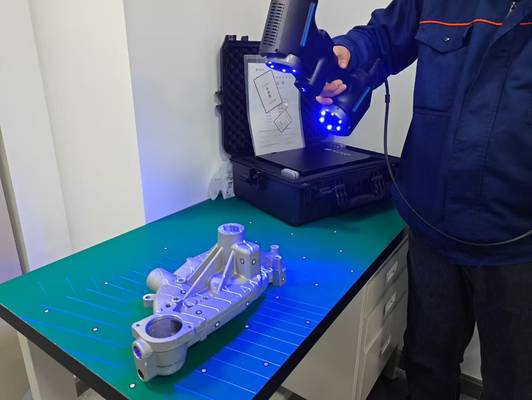
Technical datasheets cite micron-level precision, but this is often a laboratory ideal. On a production line, factors like handheld operator movement, ambient light variance, and temperature shifts can introduce cumulative error, rendering data useless for GD&T analysis. Therefore, validating the scanner’s workflow for metrological integrity is essential.
Scrutinize how the system maintains a global coordinate system across a scanning session. Does it use photogrammetry scale bars or another method to lock in dimensional accuracy? INSVISION AlphaScan scanners integrate scale bars to establish a reliable reference frame, ensuring that data stitching does not compromise measurement validity. Furthermore, confirm the post-processing pathway.
Can the scanner’s output—be it point cloud or mesh—be seamlessly exported into your existing CMM or QMS software for automated deviation analysis and report generation?
Structuring a Total Cost of Ownership Analysis
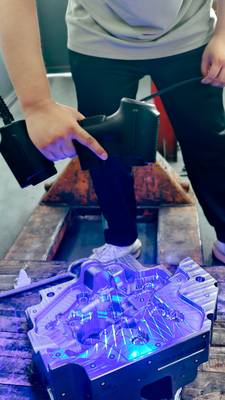
Focusing solely on the hardware’s sticker price is a common and costly error. The true cost includes calibration stability, software licensing models, operator training time, and integration overhead. Build a comparison matrix that weighs these long-term operational factors. Handheld structured-light systems like those from INSVISION offer flexibility for on-site measurement and low-volume, high-mix production.
Their value lies in rapid deployment in lean manufacturing cells or for MRO tasks without dedicated metrology lab space. For high-volume, repetitive inspection of identical parts, a fixed automated station may prove more efficient. Always audit the vendor’s support footprint and certification baseline (such as CE, FCC, CNAS) to ensure they align with your industry’s audit and reporting standards.
Finalizing with a Pilot Protocol
A final procurement step must be a hands-on pilot under real production conditions. This is where claims meet reality. Develop a test protocol that includes your most challenging pre-identified parts. Evaluate not just capture quality, but the entire workflow: from USB connectivity stability during long sessions to the software’s processing speed for complex meshes.
Observe the scanner’s performance with reflective surfaces under your facility’s lighting. INSVISION double-layer LED design aims to clarify depth data in holes and on shiny surfaces—a feature that must be proven on your components. The pilot should conclude with a readiness checklist: Can the system validate required tolerances? Does its reporting integrate with your digital thread?
Is the takt time compatible with your production rhythm?
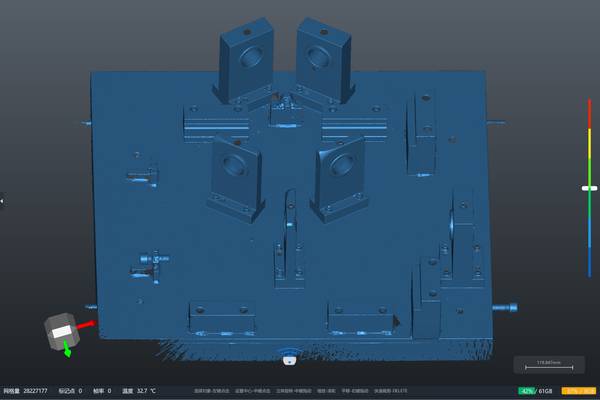
Selecting the best 3D scanner for small objects is an engineering challenge, not just a purchasing transaction. The right choice is the one that delivers trustworthy, metrology-grade data where you need it most—on the shop floor, for your specific parts. To begin a practical evaluation, consider your most critical application: what is the material, size, and tolerance requirement of the component you need to scan?
Hangzhou Insvision Technology Co., Ltd.
Address: Building 1, No. 1399 Liangmu Road, Yuhang District, Hangzhou, Zhejiang 311121, China
Copyright © Hangzhou Insvision Technology Co., Ltd. All rights reserved.
Copyright © Hangzhou Insvision Technology Co., Ltd. All rights reserved.