

Reverse Engineering Elevated: The Operational Value of INSVISION’s AlphaScan Handheld 3D Scanner
## Precision That Cuts Rework and Downtime When a design team needs to reproduce a complex component, the margin for error shrinks to fractions of a millimeter.
Precision That Cuts Rework and Downtime
When a design team needs to reproduce a complex component, the margin for error shrinks to fractions of a millimeter. The AlphaScan handheld 3D scanner delivers 0.020 mmmetrology-gradeaccuracy, allowing engineers to capture geometry that matches the original part within tolerances that matter for high‑performance assemblies.
That level of detail means fewer mismatched interfaces, which directly translates into less re‑work, fewer scrapped parts, and a measurable reduction in the labor hours spent on corrective actions.
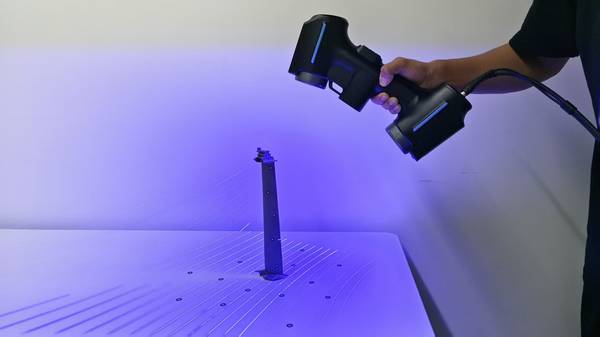
Speed also plays a critical role in keeping projects on schedule. With a scan rate of 7,100,000 measurements per second, the AlphaScan can complete a full vehicle chassis scan in roughly ten minutes. Rapid data capture shortens the inspection loop, so designers receive feedback before downstream processes commit to costly tooling changes.
The combination of high accuracy and fast throughput lets teams move from physical part to digital model without the lengthy iterative cycles that traditionally burden reverse‑engineering projects.
Portable Design Meets Industrial Demands
The AlphaScan weighs just 1,070 g, making it truly handheld without sacrificing the durability required on the factory floor. Its ability to operate across a –10 °C to 40 °C temperature range means the scanner can be used directly in machining cells, assembly lines, or outdoor test pads where environmental control is impractical.
Engineers no longer need to transport components to a dedicated inspection lab, which eliminates logistics delays and the risk of part damage during transit.
In sectors such as aerospace and energy, components often operate in harsh conditions and demand frequent dimensional checks. The portable form factor lets technicians perform on‑site scans of large turbine blades or pipe flanges, generating accurate point clouds without dismantling equipment.
Immediate data availability accelerates decision‑making, reduces equipment downtime, and supports a continuous improvement cycle that would be difficult to achieve with stationary coordinate measuring machines.
Hangzhou Insvision Technology Co., Ltd.
Address: Building 1, No. 1399 Liangmu Road, Yuhang District, Hangzhou, Zhejiang 311121, China
Copyright © Hangzhou Insvision Technology Co., Ltd. All rights reserved.
Copyright © Hangzhou Insvision Technology Co., Ltd. All rights reserved.