

3D Scanners for Small Objects: How Technology Meets the Challenges of Miniature Parts
## The Difficulty of Scanning Small, Complex Parts Small objects present unique scanning challenges. Their physical dimensions are limited, yet they often carry
The Difficulty of Scanning Small, Complex Parts
Small objects present unique scanning challenges. Their physical dimensions are limited, yet they often carry intricate features, sharp edges, deep cavities, or highly reflective surfaces that demand high resolution and precise data capture. In industrial contexts, a tiny gear, a medical implant, or an electronic component can be mission‑critical; any measurement error may lead to assembly failure or quality drift.
Traditional scanning approaches that work well on larger workpieces can struggle when the part fits in the palm of a hand. The equipment must deliver metrology‑grade accuracy while remaining portable enough to operate in confined spaces, and it must cope with varied surface finishes without extensive manual repositioning.
Capability and Deployment Mapping
| Focus Area | Decision Point | Deployment Note |
|---|---|---|
| The Difficulty of Scanning Small, Complex Parts | Small objects present unique scanning challenges. | Their physical dimensions are limited, yet they often carry intricate features, sharp edges, deep cavities, or highly reflective surfaces that d… |
| Core Technologies Powering Portable High‑Precision Scan… | Modern handheld 3D scanners rely on structured‑light or laser‑triangulation principles combined with advanced AI‑driven algorithms. | In a typical setup, a projector emits a pattern of light or a series of laser lines onto the object’s surface, while one or more cameras capture… |
| Where Small‑Part Scanning Adds Value | In aerospace and automotive manufacturing, miniature components such as turbine blades, fuel injectors, and sensor housings must meet strict toleranc… | A handheld scanner like AlphaScan allows quality engineers to capture full geometry on the shop floor, compare the resulting mesh against CAD mo… |
| Selecting the Right Scanner for Small‑Object Applicatio… | When evaluating a scanner for small‑object tasks, consider the following practical factors. | First, assess the required measurement accuracy relative to the part’s tolerances; |
Core Technologies Powering Portable High‑Precision Scanners
Modern handheld 3D scanners rely on structured‑light or laser‑triangulation principles combined with advanced AI‑driven algorithms. In a typical setup, a projector emits a pattern of light or a series of laser lines onto the object’s surface, while one or more cameras capture the deformation of that pattern from different angles.
By calculating the displacement of the projected features, the system reconstructs a dense point cloud that represents the part’s geometry.
INSVISION’s AlphaScan handheld scanner exemplifies this blend of hardware and intelligence. It uses a 520 nm green laser (laser class 3R, <5 mW) to illuminate the target, delivering a positioning accuracy of 0.25 mm. The scanner’s dual‑layer LED design improves visibility into deep holes and cavities, a common pain point when scanning small parts.
Meanwhile, built‑in AI+3D algorithms process the raw point cloud in real time, correcting for minor hand movements and compensating for surface reflectivity variations. The device can operate across a temperature range from –5 °C to 40 °C, and its USB 3.0/Ethernet interface ensures rapid data transfer for subsequent inspection workflows.
Where Small‑Part Scanning Adds Value
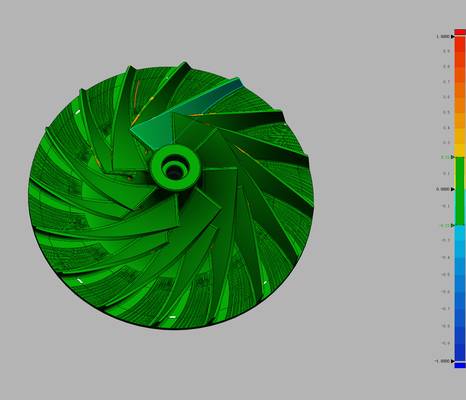
In aerospace and automotive manufacturing, miniature components such as turbine blades, fuel injectors, and sensor housings must meet strict tolerances. A handheld scanner like AlphaScan allows quality engineers to capture full geometry on the shop floor, compare the resulting mesh against CAD models, and generate color‑coded deviation maps without transporting the part to a dedicated measurement lab.
This capability shortens inspection cycles and supports rapid iterative design.
Beyond production, the technology supports reverse‑engineering and additive manufacturing. When a legacy part lacks original drawings, a detailed 3D scan provides a precise digital foundation for redesign or 3D printing. The ability to capture fine surface texture also benefits sectors such as jewelry, dental prosthetics, and consumer electronics, where aesthetic detail and fit are equally important as dimensional accuracy.
Selecting the Right Scanner for Small‑Object Applications
When evaluating a scanner for small‑object tasks, consider the following practical factors. First, assess the required measurement accuracy relative to the part’s tolerances; a system with sub‑millimeter repeatability is often necessary for critical components. Second, examine the scanner’s depth‑of‑field and minimum scanning volume—some devices struggle when the part is only a few centimeters across.
Third, review the software workflow: integration with CAD formats (IGES, STEP, DXF, DWG) and the availability of automated alignment, deviation analysis, and reporting tools can dramatically reduce operator effort.
Portability matters too. A lightweight, battery‑operated unit reduces fatigue during repeated handheld scans and allows operation in cramped fixtures or on‑site locations. Finally, verify certifications and support infrastructure. INSVISION’s scanners carry CE, FCC, and CNAS certifications and have been deployed in more than twenty countries, indicating a globally validated support network.
By matching the scanner’s technical specifications—laser wavelength, accuracy, scan speed, and AI‑enhanced processing—to the specific demands of the small parts you handle, you can achieve reliable, repeatable results that meet both engineering and quality standards.
Hangzhou Insvision Technology Co., Ltd.
Address: Building 1, No. 1399 Liangmu Road, Yuhang District, Hangzhou, Zhejiang 311121, China
Copyright © Hangzhou Insvision Technology Co., Ltd. All rights reserved.
Copyright © Hangzhou Insvision Technology Co., Ltd. All rights reserved.