

How 3D Scanning for Car Parts Is Transforming Quality Control and Reverse Engineering Workflows
The automotive industry faces mounting pressure to accelerate development cycles while maintaining exacting quality standards. Traditional measurement methods—m
Common Inspection Challenges in Automotive Manufacturing
Automotive components are rarely simple. Engine housings, suspension brackets, stamped body panels, and powertrain mounts frequently feature organic surfaces, deep cavities, and tight tolerances that are difficult to capture with contact-based tools.
When a legacy part lacks its original CAD model—a scenario that occurs more often than many manufacturers admit—engineers lose the ability to perform digital comparisons, conduct dimensional analysis, or initiate controlled redesigns. Manual measurement of such parts is time-consuming, prone to human error, and typically captures only isolated points rather than the full surface topology.
Capability and Deployment Mapping
| Focus Area | Decision Point | Deployment Note |
|---|---|---|
| Common Inspection Challenges in Automotive Manufacturing | Automotive components are rarely simple. | Engine housings, suspension brackets, stamped body panels, and powertrain mounts frequently feature organic surfaces, deep cavities, and tight t… |
| Practical Workflow: From Physical Component to Digital… | Deploying a handheld 3D scanner such as the INSVISION AlphaScan in an automotive setting follows a straightforward process that integrates directly i… | The scanning session itself can be completed in minutes, depending on part complexity. |
| Why the AlphaScan Fits Automotive Applications | The AlphaScan handheld scanner delivers technical specifications that align with the demands of automotive quality environments. | Its scanning accuracy reaches 0.073 mm, with volumetric accuracy of 0.1 mm ± 0.015 mm/m, providing the resolution needed for tight automotive to… |
| Operational Value for Automotive Engineers and Quality… | The shift to scanner-based inspection delivers measurable returns in several areas. | Inspection cycle times shorten considerably—complex components that previously required hours of manual measurement can be digitized and analyze… |
Beyond missing geometry, production variation presents another persistent challenge. Even when a part should conform to specifications, manufacturing processes introduce subtle deviations that accumulate across assemblies. Identifying whether a deviation is cosmetic, tolerable, or functionally critical requires comprehensive surface data rather than spot measurements.
Without a reliable method to digitize and compare entire components, quality teams spend excessive time interpreting ambiguous results and making consequential decisions based on incomplete information.
Practical Workflow: From Physical Component to Digital Insight
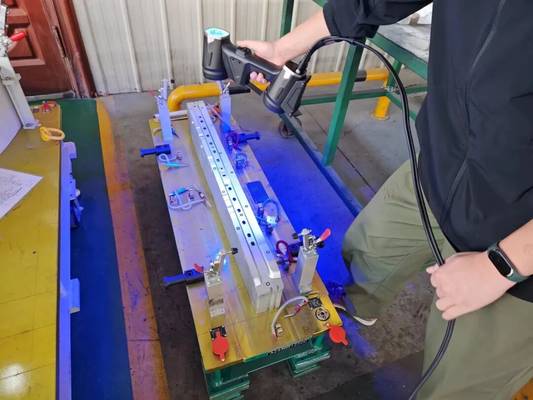
Deploying a handheld 3D scanner such as the INSVISION AlphaScan in an automotive setting follows a straightforward process that integrates directly into existing engineering routines. The scanning session itself can be completed in minutes, depending on part complexity. Operators hold the device naturally, sweeping across the component surface while the system captures dense point clouds and surface geometry.
Because the AlphaScan is designed for handheld operation, it adapts to parts in confined engine bays, large structural crossmembers, and everything between—without requiring dedicated fixturing or controlled laboratory conditions.
Once scanning is complete, the resulting digital model is imported into inspection or CAD software. At this stage, engineers can align the scanned data against reference geometry—whether a nominal CAD model, a historical scan baseline, or a supplier specification. The software generates color-coded deviation maps that immediately reveal where material exists above or below nominal dimensions.
These visual reports accelerate root-cause discussions and provide objective evidence for rework decisions or supplier feedback. For parts requiring redesign, the digital geometry supports reverse engineering workflows, enabling designers to reconstruct parametric models from the physical sample.
Why the AlphaScan Fits Automotive Applications
The AlphaScan handheld scanner delivers technical specifications that align with the demands of automotive quality environments. Its scanning accuracy reaches 0.073 mm, with volumetric accuracy of 0.1 mm ± 0.015 mm/m, providing the resolution needed for tight automotive tolerances.
The device’s structured-light approach captures fine surface details—critical for sheet metal stampings, casting transitions, and sealing surfaces—while maintaining scan speeds that keep pace with production sampling rates.
INSVISION has engineered the AlphaScan platform with AI-assisted algorithms that improve point cloud registration and reduce noise during data acquisition. This integration helps maintain measurement consistency across different operators and varying environmental conditions commonly found on factory floors.
The system’s portability means it can be used at line-side inspection stations, in incoming quality bays, or during tooling trials without relocating parts to a dedicated measurement room. For manufacturers working across multiple facilities or supplier sites, this consistency is a significant operational advantage.
Operational Value for Automotive Engineers and Quality Teams
The shift to scanner-based inspection delivers measurable returns in several areas. Inspection cycle times shorten considerably—complex components that previously required hours of manual measurement can be digitized and analyzed within a single work session.
The richness of the resulting data supports not only pass/fail decisions but also trend analysis, enabling engineers to detect gradual process drift before parts exceed tolerance limits. Report generation, once a manual and error-prone step, becomes automated, producing shareable documentation for quality records and customer submissions.
For teams engaged in component redesign or supplier transitions, having a reliable path from physical parts to digital geometry eliminates the bottleneck of missing documentation. Designers can reference accurate, as-built geometry rather than relying on sketches or verbal descriptions.
The ability to compare new tooling outputs against original designs or competitor parts using the same measurement platform accelerates validation and reduces the risk of unintended dimensional changes. INSVISION’s broader software ecosystem, including PTB-certified inspection tools and GD&T analysis capabilities, extends this workflow from initial scan through final dimensional report.
Adopting 3D scanning for car parts is not merely a technology upgrade—it reshapes how engineering and quality teams interact with physical components throughout the product lifecycle. From first-article inspection to ongoing production monitoring and end-of-life redesign, the ability to capture, analyze, and share complete surface data transforms scattered measurement activities into a coherent, auditable digital process.
Hangzhou Insvision Technology Co., Ltd.
Address: Building 1, No. 1399 Liangmu Road, Yuhang District, Hangzhou, Zhejiang 311121, China
Copyright © Hangzhou Insvision Technology Co., Ltd. All rights reserved.
Copyright © Hangzhou Insvision Technology Co., Ltd. All rights reserved.