

What a Scanning Arm Is in Modern Industrial contexts
A scanning arm refers to a handheld three‑dimensional scanner that users can move freely around an object to capture dense geometry. Unlike stationary coordinat
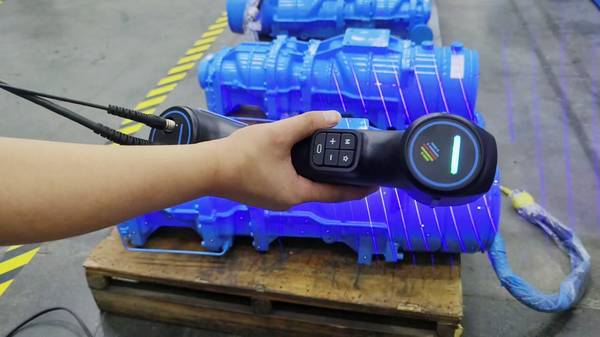
The concept emerged from the need to inspect large assemblies and irregularly shaped workpieces where fixed‑frame equipment would be impractical. By integrating lightweight construction and high‑speed data acquisition, a scanning arm can replace multiple tactile probes or slower laser line systems, delivering a streamlined workflow for quality assurance, reverse engineering, and process monitoring.
Underlying Technologies Powering Handheld Scanning Arms
Modern handheld scanners such as the INSVISION AlphaScan series employ laser triangulation or structured‑light techniques to generate point clouds. In a typical triangulation setup, a laser line projects onto the surface while a sensor records the deformation of the line from multiple viewpoints.
The displacement data, combined with simultaneous pose estimation from inertial measurement units, enables the system to stitch together a complete 3‑D model on the fly.
Key technical parameters dictate performance. The AlphaScan Elite, for example, offers an industrial‑grade accuracy of 0.020 mm and can capture up to 7,100,000 measurements per second. Its large‑area scanning window of 650 mm × 550 mm accommodates sizable components, while a 50‑line configuration ensures fine detail reproduction.
The scanner operates reliably across a temperature span from –10 °C to 40 °C, a critical attribute for shop‑floor environments where thermal fluctuations are common.
Software plays an equally vital role. Integrated AI algorithms perform real‑time point‑cloud registration, auto‑alignment, and deviation analysis. Users can generate dimensional reports with a single click, directly comparing captured geometry against CAD nominals and tolerance specifications. The device’s 1,070 g weight and modular design further support prolonged single‑hand operation without fatigue.
Where Scanning Arms Fit in Industrial Workflows
Quality inspection remains the most frequent application for handheld scanning arms. In automotive manufacturing, engineers use the devices to verify the fit of stamped panels, castings, and sub‑assemblies before final assembly. The ability to scan an entire car frame in roughly ten minutes enables rapid feedback loops, reducing the risk of downstream rework.
Aerospace and heavy‑equipment sectors benefit from the technology’s capacity to handle complex contours and large workpieces. Turbine blades, structural brackets, and hydraulic manifolds often feature intricate surfaces that are difficult to measure with conventional tools.
By providing dense point clouds with sub‑millimeter fidelity, a scanning arm supports both first‑article inspection and in‑process monitoring of wear or deformation.
Reverse engineering and additive manufacturing also rely on high‑resolution scans. Designers capture existing parts, convert the geometry into parametric CAD models, and subsequently produce new components or spare parts.
The combination of rapid acquisition and AI‑driven analysis accelerates the transition from physical prototype to digital record, supporting industries such as energy (e.g., solar panel frames) and general machinery where legacy components often lack digital documentation.
Selecting the Right Scanning Arm for Your Facility
When evaluating a handheld scanner, begin by clarifying the required measurement tolerance relative to your production specifications. For high‑precision assembly tasks—tight‑fit holes, mating surfaces, or critical aerospace features—a system that guarantees 0.020 mm accuracy will reduce measurement uncertainty and costly false‑rejects.
Consider the size and geometry of the parts you intend to scan. Large, continuous surfaces call for a wide scanning envelope and a high line density to avoid gaps. Conversely, intricate details such as thin walls or small radii demand fine laser line resolution and sufficient point‑cloud density.
The INSVISION AlphaScan series provides a scalable range, with the AlphaVista model extending the scan area up to 2,200 mm × 2,200 mm for very large assemblies.
Environmental conditions influence device selection. If the scanner will be used on the shop floor where temperature swings are typical, verify the operational range matches your facility’s conditions. Additionally, ensure the system meets relevant certifications (e.g., CE, FCC, CNAS) to satisfy compliance and interoperability requirements.
Finally, assess the software ecosystem. Look for seamless CAD integration, automated deviation reporting, and support for export formats that fit your downstream processes. Conduct a hands‑on trial with a representative workpiece to validate alignment speed, data fidelity, and the intuitiveness of the user interface.
By grounding your evaluation in concrete performance metrics and practical workflow considerations, you can identify a scanning arm that delivers reliable, high‑quality results for your specific industrial context.
Hangzhou Insvision Technology Co., Ltd.
Address: Building 1, No. 1399 Liangmu Road, Yuhang District, Hangzhou, Zhejiang 311121, China
Copyright © Hangzhou Insvision Technology Co., Ltd. All rights reserved.
Copyright © Hangzhou Insvision Technology Co., Ltd. All rights reserved.