

How 3D Scanners Work in 2025: Core Principles Behind Modern Industrial Scanning
Industrial 3D scanning has matured considerably since its early days of bulky equipment and limited accuracy. Today's scanners, particularly those designed for
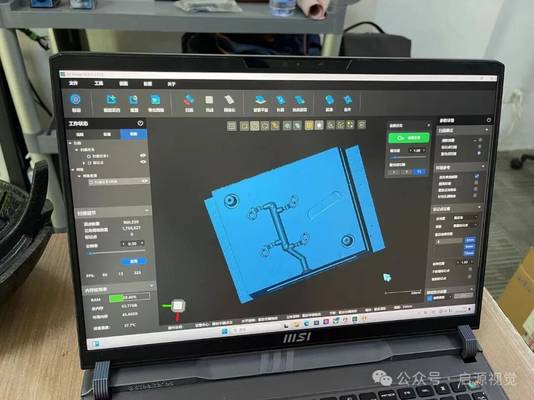
In 2025, the critical advancement lies in how these systems handle real-world complexity. Modern industrial scanners must contend with diverse materials, complex geometries, and demanding environmental conditions. The INSVISION AlphaScan series exemplifies this progress, employing fifty crossed blue laser lines to ensure comprehensive surface coverage.
Blue laser technology offers advantages over traditional red lasers, particularly when scanning reflective or dark-colored surfaces that would confound earlier systems. The scan rate of 7,100,000 measurements per second reflects the computational power now available to process these patterns in near-real-time, enabling operators to capture detailed geometry without prolonged setup times.
Key Performance Specifications: What Actually Matters for Industrial Applications
When evaluating 3D scanning technology for industrial use, certain specifications carry more practical weight than others. Volumetric accuracy—measuring how precisely the scanner captures the overall shape of an object—often matters more than point-level resolution for quality control applications.
The AlphaScan achieves volumetric accuracy of 0.1mm ± 0.015mm/m, meaning the error scales predictably with the size of the object being measured. This specification becomes crucial when inspecting large components where cumulative error could otherwise compromise measurement validity.
Capability and Deployment Mapping
| Focus Area | Decision Point | Deployment Note |
|---|---|---|
| Key Performance Specifications: What Actually Matters f… | When evaluating 3D scanning technology for industrial use, certain specifications carry more practical weight than others. | Volumetric accuracy—measuring how precisely the scanner captures the overall shape of an object—often matters more than point-level resolution f… |
| Industrial Use Cases: Where 2025 Scanners Deliver Measu… | The integration of 3D scanning into manufacturing workflows has progressed beyond prototyping and reverse engineering into core quality assurance pro… | Dimensional verification against CAD models allows manufacturers to confirm that production parts match design intent, with deviation mapping hi… |
| Selecting the Right System: Practical Considerations fo… | Organizations evaluating 3D scanning investments should begin by clarifying their primary use cases. | Inspection-focused applications prioritize accuracy specifications and software integration with existing quality systems. |
Surface adaptation represents another vital capability. Traditional scanning systems struggled with materials ranging from matte plastics to polished metals, requiring operators to apply temporary coatings or adjust settings for each material type. Contemporary AI-enhanced systems address this through machine learning algorithms trained on diverse material signatures.
INSVISION’s approach integrates artificial intelligence directly into the scanning workflow, enabling automatic recognition of different surface properties and dynamic adjustment of scanning parameters. This capability proves especially valuable in manufacturing environments where product batches may include varied materials or surface treatments.
Scan—the effective field of view during capture—determines how efficiently a system handles large components. A scanner optimized for small parts becomes impractical for automotive panels or aerospace structures.
The ability to capture up to 2200mm × 2200mm areas without repositioning significantly impacts workflow efficiency, particularly in quality inspection scenarios involving complete assemblies rather than individual components.
Industrial Use Cases: Where 2025 Scanners Deliver Measurable Value
The integration of 3D scanning into manufacturing workflows has progressed beyond prototyping and reverse engineering into core quality assurance processes. Dimensional verification against CAD models allows manufacturers to confirm that production parts match design intent, with deviation mapping highlighting areas requiring attention.
This approach proves especially valuable for castings, machined components, and formed parts where traditional measurement methods would require extensive setup time across multiple reference points.
Additive manufacturing preparation represents another significant application area. Before printing, designers often need to verify mesh quality, check wall thicknesses, and prepare supports. A portable scanning system enables these checks directly on the production floor, reducing iteration cycles and ensuring parts meet specifications before valuable printer time is consumed.
The ability to capture complex geometries—including internal features and undercuts—makes 3D scanning indispensable for post-print verification as well.
Reverse engineering applications benefit from the improved accuracy and software integration available in current systems. When legacy components require documentation or reproduction, a detailed scan provides the foundation for CAD model reconstruction.
Modern scanning software, such as the 3D INSVISION platform, supports various export formats and offers tools specifically designed for reverse engineering workflows, from mesh editing to feature extraction.
Selecting the Right System: Practical Considerations for 2025 Implementations
Organizations evaluating 3D scanning investments should begin by clarifying their primary use cases. Inspection-focused applications prioritize accuracy specifications and software integration with existing quality systems. Reverse engineering workflows emphasize mesh quality and export flexibility. Portable field inspection needs highlight scanner weight, battery life, and environmental durability.
Integration capabilities deserve particular attention. A scanner’s value multiplies when data flows seamlessly into downstream processes—whether CAD software, manufacturing execution systems, or inspection databases. INSVISION’s software ecosystem supports ten languages and multiple export formats, facilitating adoption across international operations.
The CAD-driven task creation feature enables operators to import reference models and define inspection protocols without specialized training.
Environmental conditions at the point of use influence system selection. Factory floors present different challenges than laboratory environments. Vibration, temperature variation, and ambient lighting all affect scanning performance. Systems with built-in calibration compensation and real-time adjustment algorithms handle these variables more gracefully than those requiring controlled conditions.
Finally, consider the total cost of ownership beyond initial purchase price. Training requirements, software licensing, calibration maintenance, and support responsiveness all factor into long-term value.
Commercial presence across multiple regions—INSVISION serves customers in over twenty countries with both domestic and international support infrastructure—provides peace of mind for organizations with distributed operations or export requirements.
Hangzhou Insvision Technology Co., Ltd.
Address: Building 1, No. 1399 Liangmu Road, Yuhang District, Hangzhou, Zhejiang 311121, China
Copyright © Hangzhou Insvision Technology Co., Ltd. All rights reserved.
Copyright © Hangzhou Insvision Technology Co., Ltd. All rights reserved.