

Elevating Industrial Quality Control with INSVISION’s AlphaScan AI Scanner
Traditional inspection methods often struggle to keep pace with the complexity of modern components. Contact‑based gauges require multiple setups, and each meas
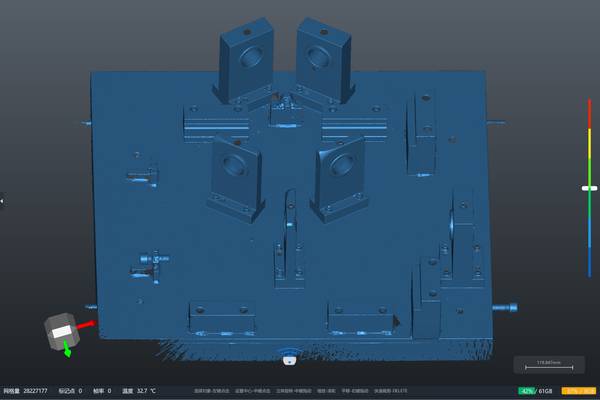
Manufacturers therefore face a choice: accept lower confidence in part conformance or invest in a solution that can capture dense, accurate geometry without the overhead of traditional methods. The shift toward digital inspection is not merely a matter of adopting new hardware; it demands a workflow that aligns measurement with design intent, automates reporting, and integrates seamlessly into existing quality systems.
AI‑Powered 3D Scanning Workflow
The AlphaScan handheld 3D scanner from INSVISION combines a lightweight, ergonomic body with embedded AI algorithms that guide the user through the scanning process. Once the device is positioned over a workpiece, its 50‑beam cross blue‑laser array projects a dense lattice of points, capturing millions of surface coordinates in seconds.
Real‑time alignment algorithms running on the device’s onboard processor instantly register each new frame, ensuring that the model builds up smoothly even when the operator moves around complex features.
Selection Dimensions and Field Checks
| Focus Area | Decision Point | Deployment Note |
|---|---|---|
| AI‑Powered 3D Scanning Workflow | The AlphaScan handheld 3D scanner from INSVISION combines a lightweight, ergonomic body with embedded AI algorithms that guide the user through the s… | Once the device is positioned over a workpiece, its 50‑beam cross blue‑laser array projects a dense lattice of points, capturing millions of sur… |
| Performance Metrics that Matter | The AlphaScan series achieves a single‑point repeatability of 0.02 mm, a figure that meets the stringent requirements of metrology‑grade inspection. | Its cross‑laser configuration delivers up to 7.1 million measurements per second, allowing operators to complete full‑part scans in a fraction o… |
| Application Scenarios Across Key Industries | In automotive manufacturing, the AlphaScan scanner enables rapid verification of stamped body panels and welded assemblies. | Engineers can quickly overlay the captured geometry onto CAD models, visualize localized gaps, and prioritize corrective actions before final as… |
After the raw point cloud is acquired, the integrated software takes over. The AI engine performs intelligent noise filtering, reconstructs the surface using super‑resolution techniques, and automatically compares the result against the original CAD model. Within minutes, the system generates a multi‑dimensional report that includes 3D deviation maps, statistical charts, and tolerance analysis.
This automated pipeline removes the manual data‑entry steps that traditionally introduce errors and shortens the time from scan to decision.
Performance Metrics that Matter
The AlphaScan series achieves a single‑point repeatability of 0.02 mm, a figure that meets the stringent requirements of metrology‑grade inspection. Its cross‑laser configuration delivers up to 7.1 million measurements per second, allowing operators to complete full‑part scans in a fraction of the time required by older technologies.
The device supports scan areas as large as 2 200 × 2 200 mm, making it suitable for large aerospace panels, automotive body structures, and industrial molds, while maintaining a volumetric accuracy of 0.1 mm ± 0.015 mm/m.
Built‑in real‑time calibration compensates for temperature drift and mechanical flex, ensuring consistent performance across varied workshop conditions. The scanner’s robust design has earned certifications including CE, FCC, and CNAS, underscoring its compliance with international safety and quality standards.
The combination of high speed, high fidelity, and automated reporting translates directly into lower inspection costs and faster feedback loops for production teams.
Application Scenarios Across Key Industries
In automotive manufacturing, the AlphaScan scanner enables rapid verification of stamped body panels and welded assemblies. Engineers can quickly overlay the captured geometry onto CAD models, visualize localized gaps, and prioritize corrective actions before final assembly.
The ability to generate deviation heat‑maps helps quality teams pinpoint systematic trends, reducing scrap rates and improving overall equipment effectiveness.
Aerospace and energy sectors benefit from the scanner’s deep‑hole capability and high resolution. Turbine blade roots, complex castings, and fuel‑cell plates often contain features that are inaccessible to conventional gauges.
With a dedicated deep‑hole mode that uses a single blue laser line, the AlphaScan can probe narrow cavities and capture the full internal profile, supporting both first‑article inspection and in‑process monitoring. The resulting digital twin serves as a reliable reference for downstream machining, additive manufacturing, and maintenance planning.
By embedding AI‑driven analysis directly into the scanning workflow, INSVISION’s AlphaScan empowers manufacturers to move from reactive defect detection to proactive process control. The system’s accuracy, speed, and versatility make it a practical choice for facilities that demand reliable, data‑rich inspection without sacrificing throughput.
Hangzhou Insvision Technology Co., Ltd.
Address: Building 1, No. 1399 Liangmu Road, Yuhang District, Hangzhou, Zhejiang 311121, China
Copyright © Hangzhou Insvision Technology Co., Ltd. All rights reserved.
Copyright © Hangzhou Insvision Technology Co., Ltd. All rights reserved.