

3D Laser Triangulation Versus Traditional Contact Metrology Comparison
Comparing 3D laser triangulation versus traditional contact metrology? Discover how portable non-contact scanning improves workflow efficiency and on-site inspection.
Introduction
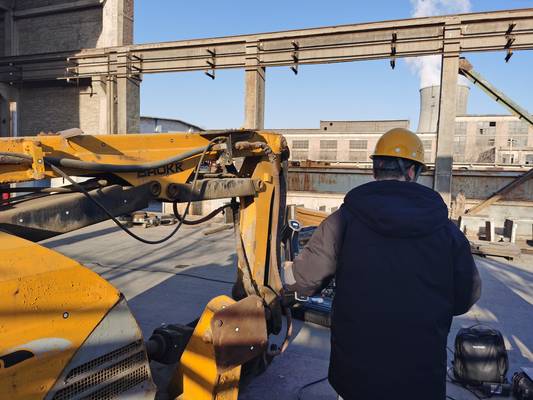
For quality and manufacturing engineers, verifying the geometry of large-scale or hard-to-move components remains a persistent logistical challenge. Traditional methods like stationary coordinate measuring machines (CMMs) require moving the part to a controlled lab, a process that halts production and introduces risk. Portable arm-based systems offer some flexibility but often struggle with speed and complex freeform surfaces.
To resolve this, non-contact 3D laser triangulation enters the workflow, providing a method to bring high-density measurement directly to the part, whether it’s on the shop floor, in a hangar, or at a remote site.
Traditional Contact Metrology Challenges in Common Workflows
The limitations of traditional contact metrology become highly apparent when compared to 3D laser triangulation in specific, common industrial scenarios:
Design Criteria for 3D Laser Triangulation Solutions
When evaluating 3D laser triangulation versus traditional methods, the solution shifts the paradigm from “part-to-machine” to “machine-to-part.” An effective on-site strategy requires a system built for industrial environments, combining portability with metrology-grade data output. The key design pillars are:
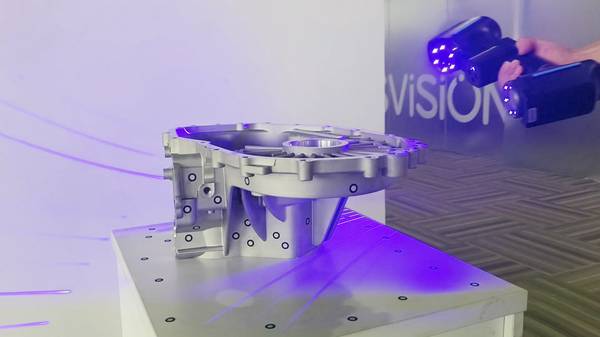
- True Portability: A self-contained, handheld or lightweight system that operates without external trackers or complex setups in confined spaces.
- Robust Data Acquisition: Fast scanning rates to capture millions of points in minutes, handling varied surface finishes and geometries.
- Streamlined Software Workflow: Integrated, certified software that processes point clouds into actionable results—direct GD&T analysis, deviation color maps, and CAD-ready data formats—without requiring multiple specialized programs.
A structured field deployment follows a clear sequence:
- Scene Preparation: Minimal setup is required. The focus is on ensuring adequate ambient lighting and applying a temporary matte spray to highly reflective surfaces to optimize laser capture.
- Data Capture: The operator systematically scans the target area, with the handheld device providing real-time visual feedback to ensure complete coverage. The process is intuitive, akin to using a paint sprayer, allowing complex geometries to be captured in a single session.
- Alignment and Processing: The captured point cloud is instantly aligned to the nominal CAD model within the onboard software. This is where certified algorithms ensure measurement integrity.
- Analysis and Reporting: The software generates a color-mapped deviation report, highlighting areas out of tolerance. Full GD&T analysis can be run, and the clean mesh data is exported in standard formats (IGES, STEP, etc.) for use in any downstream CAD or quality management system.
How INSVISION AlphaScan Outperforms Traditional Methods
For teams evaluating 3D laser triangulation systems, the INSVISION AlphaScan exemplifies the product characteristics that meet field challenges. Its handheld form factor and single-cable connection are designed for use in elevators, gantries, and tight engine bays. The system delivers a positioning accuracy of 0.25 mm, making it suitable for a wide range of industrial inspection tolerances.
The integrated AlphaVista software is PTB-certified, providing traceable measurement results that quality auditors require for ISO 9001 and AS9100 compliance. INSVISION AlphaVista supports direct import of native CAD formats and exports to IGES, STEP, DXF, and DWG, ensuring compatibility with existing digital thread workflows, from design to inspection reporting.
Operational Benefits Versus Traditional Measurement
Adopting a portable 3D laser triangulation approach transforms the inspection timeline. The most significant benefit is the elimination of part disassembly and transportation, which directly reduces downtime compared to fixed CMMs. Measurement cycles are condensed from shifts to hours, enabling faster decision-making for rework or release.
Engineers gain a complete digital record—a high-density deviation map—offering far more insight than discrete point checks, aligning with Industry 4.0 digital thread initiatives and leading to more informed root-cause analysis for quality issues.
Broader Industrial Applicability Versus Fixed CMMs
The use case for this methodology extends beyond the examples above. Any industry dealing with large, fixed, or complex assets can leverage 3D laser triangulation:
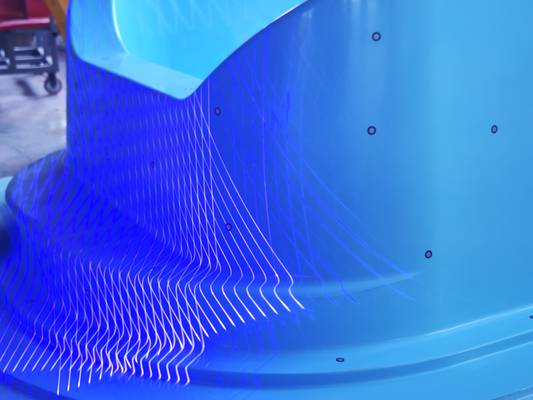
- Power & Energy: Scanning turbine components, heat exchangers, and piping for corrosion mapping or as-built documentation.
- Heavy Equipment & Automotive: Dimensional analysis of vehicle frames, cab assemblies, and large weldments directly on the production line.
- Civil Engineering & Construction: Documenting structural elements, prefabricated modules, and architectural features for quality assurance and progress tracking.
Final Comparison Verdict
The choice between traditional and mobile metrology is no longer just about accuracy—it is about workflow efficiency and data comprehensiveness. For applications where the part cannot come to the lab, 3D laser triangulation provides a viable, production-ready alternative.
It closes the loop between physical measurement and digital analysis on-site, providing the dense data set needed for modern quality control and accelerating the pace of manufacturing and maintenance operations.
Hangzhou Insvision Technology Co., Ltd.
Address: Building 1, No. 1399 Liangmu Road, Yuhang District, Hangzhou, Zhejiang 311121, China
Copyright © Hangzhou Insvision Technology Co., Ltd. All rights reserved.
Copyright © Hangzhou Insvision Technology Co., Ltd. All rights reserved.