

Transforming Industrial Quality Control: How INSVISION AlphaScan 3D Scanning Delivers Precision in Challenging Production Environments
## The Inspection Bottleneck: Why Traditional Methods Fall Short In precision manufacturing, verifying component geometry against design specifications remains
The Inspection Bottleneck: Why Traditional Methods Fall Short
In precision manufacturing, verifying component geometry against design specifications remains one of the most time-consuming steps in quality assurance workflows.
Conventional measurement techniques—coordinate measuring machines, manual gauges, and templating—require extensive setup time, are limited to discrete point data, and struggle with complex geometries that feature undercuts, deep cavities, or intricate surface contours. These constraints create a significant operational friction point.
Quality teams find themselves balancing inspection throughput against measurement comprehensiveness, often compromising one for the other. The inability to capture complete surface data in a single operation means that subtle form deviations or localized wear patterns frequently go undetected until later assembly stages, when correction costs multiply.
Selection Dimensions and Field Checks
| Focus Area | Decision Point | Deployment Note |
|---|---|---|
| The Inspection Bottleneck: Why Traditional Methods Fall… | In precision manufacturing, verifying component geometry against design specifications remains one of the most time-consuming steps in quality assura… | Conventional measurement techniques—coordinate measuring machines, manual gauges, and templating—require extensive setup time, are limited to di… |
| Faster, Fuller Data Capture with AlphaScan Handheld 3D… | The INSVISION AlphaScan handheld scanner addresses these limitations by combining structured light technology with intelligent alignment algorithms t… | The system operates within a temperature range of -10 to 40 degrees Celsius, maintaining 0.020mm measurement accuracy throughout its scan volume. |
| Real-World Deployment: From Prototype Validation to Pro… | In heavy equipment manufacturing, AlphaScan has demonstrated value across multiple workflow stages. | During prototype development, engineers capture full-surface geometry of cast or fabricated components, comparing the resulting mesh directly ag… |
| Quantifying Operational Impact: From Data to Decision | The transition from point-based inspection to full-surface scanning generates measurable improvements in quality visibility. | Organizations implementing AlphaScan workflows report earlier detection of form deviations, more complete documentation of as-built geometry, an… |
Faster, Fuller Data Capture with AlphaScan Handheld 3D Scanning
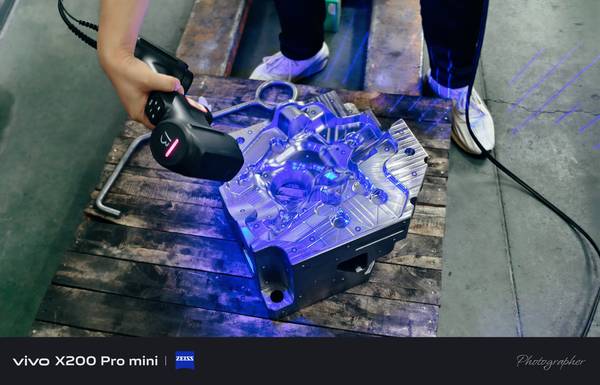
The INSVISION AlphaScan handheld scanner addresses these limitations by combining structured light technology with intelligent alignment algorithms to capture dense point clouds across complex surfaces. The system operates within a temperature range of -10 to 40 degrees Celsius, maintaining 0.020mm measurement accuracy throughout its scan volume.
This stability enables deployment directly on production floors rather than requiring climate-controlled inspection laboratories. The device’s single blue laser line mode proves particularly effective when scanning deep holes or recessed features where optical access is restricted. Operators guide the scanner along target surfaces, and real-time visualization provides immediate feedback on coverage completeness.
Once sufficient data is acquired, the scanner automatically aligns individual capture volumes into a unified coordinate system, eliminating the manual registration steps that slowed earlier generations of portable scanning equipment.
Real-World Deployment: From Prototype Validation to Production Monitoring
In heavy equipment manufacturing, AlphaScan has demonstrated value across multiple workflow stages. During prototype development, engineers capture full-surface geometry of cast or fabricated components, comparing the resulting mesh directly against original CAD models. This capability accelerates design iteration by providing quantified deviation data rather than subjective visual assessment.
Production environments present different challenges—ambient lighting variation, surface finish diversity, and throughput pressure. AlphaScan’s handling characteristics support rapid acquisition cycles; users report completing full-frame scanning of vehicle chassis structures in approximately 10 minutes.
The resulting point clouds integrate seamlessly with inspection software, enabling automated GD&T analysis and tolerance verification against engineering specifications. The scanner’s effectiveness extends to challenging materials frequently encountered in industrial settings. High-contrast scanning modes handle both glossy and matte finishes without requiring surface preparation such as anti-glare sprays.
This flexibility reduces workflow interruptions and enables consistent measurement protocols across diverse part families.
Quantifying Operational Impact: From Data to Decision
The transition from point-based inspection to full-surface scanning generates measurable improvements in quality visibility. Organizations implementing AlphaScan workflows report earlier detection of form deviations, more complete documentation of as-built geometry, and improved traceability between manufacturing processes and final assembly outcomes.
Beyond defect detection, the dimensional data acquired through scanning supports downstream applications including tool path generation for CNC machining, reverse engineering of legacy components, and wear analysis for predictive maintenance programs. The 3D model library developed through systematic scanning creates an institutional asset that supports multiple engineering functions beyond the original inspection use case.
For operations considering adoption, the practical path involves selecting representative components that capture the range of geometries and materials in current production, establishing scanning protocols that balance speed against detail requirements, and training operators on systematic coverage techniques.
These implementation steps lay the foundation for sustained quality improvement as the organization builds experience with full-surface metrology.
Hangzhou Insvision Technology Co., Ltd.
Address: Building 1, No. 1399 Liangmu Road, Yuhang District, Hangzhou, Zhejiang 311121, China
Copyright © Hangzhou Insvision Technology Co., Ltd. All rights reserved.
Copyright © Hangzhou Insvision Technology Co., Ltd. All rights reserved.