

Understanding the Handheld 3D Scanner Wand: Principles and Operation
A handheld 3D scanner wand represents a significant advancement in portable metrology, combining optical sensing technology with ergonomic design to capture thr
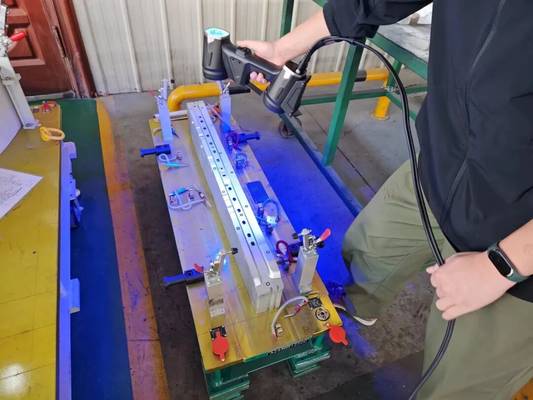
The “wand” designation refers specifically to the handheld form factor, where the scanning head contains both projection and capture mechanisms in a single, operator-controlled unit. Unlike stationary coordinate measuring machines or large-scale scanning rigs, these devices give technicians the freedom to adapt their scanning path to complex geometries.
Modern handheld scanners, such as the AlphaScan series, incorporate real-time tracking systems that maintain coordinate registration as the operator moves around a workpiece, eliminating the need for rigid reference fixtures.
Critical Specifications That Define Scanner Performance
Evaluating a handheld 3D scanner wand requires understanding several interconnected performance parameters. Scanning accuracy, typically expressed in millimeters, describes how closely the captured geometry matches the true dimensions of the measured object.
The AlphaScan scanner achieves accuracy levels down to 0.073 millimeters, making it suitable for quality control applications where tolerance bands are measured in hundredths of a millimeter.
Selection Dimensions and Field Checks
| Focus Area | Decision Point | Deployment Note |
|---|---|---|
| Critical Specifications That Define Scanner Performance | Evaluating a handheld 3D scanner wand requires understanding several interconnected performance parameters. | Scanning accuracy, typically expressed in millimeters, describes how closely the captured geometry matches the true dimensions of the measured o… |
| Where Handheld 3D Scanner Wands Fit in Industrial Workf… | The versatility of handheld 3D scanning technology makes it valuable across numerous industrial sectors. | In manufacturing quality assurance, these devices enable inspectors to verify machined components against CAD nominal models, generating color-c… |
| Practical Considerations for Implementing Handheld Scan… | Organizations evaluating handheld 3D scanner wands should first clarify the primary use case and measurement environment. | Indoor metrology labs offer controlled conditions, while field inspections may expose the system to temperature variations, vibration, and varia… |
Scan speed, measured in points or measurements per second, determines how quickly the device can capture a complete surface. Higher speeds reduce operator fatigue and decrease overall inspection cycle times, particularly beneficial when scanning large components or multiple identical parts.
Another important specification is volumetric accuracy, which accounts for cumulative error that can develop across larger scanning volumes. The AlphaScan system maintains volumetric accuracy of 0.1 millimeters plus 0.015 millimeters per meter, providing confidence in measurements across extended workspaces.
Resolution describes the smallest detail the scanner can distinguish, while the maximum single-capture field of view determines how large an area can be recorded in one position. Professional handheld scanners balance these specifications against portability, ensuring the device remains light enough for extended handheld operation without sacrificing the precision required for industrial applications.
Where Handheld 3D Scanner Wands Fit in Industrial Workflows
The versatility of handheld 3D scanning technology makes it valuable across numerous industrial sectors. In manufacturing quality assurance, these devices enable inspectors to verify machined components against CAD nominal models, generating color-coded deviation maps that immediately identify areas requiring attention.
This capability proves particularly useful for complex parts where traditional measurement tools would require multiple setups and specialized fixtures.
Reverse engineering applications benefit substantially from portable scanning wands, as technicians can capture geometry from existing parts without disassembly or transportation to a metrology lab. The scanned point cloud can then be processed to generate parametric CAD models suitable for modification or reproduction.
Aerospace and automotive manufacturers use handheld scanners for tooling verification, wear analysis, and-first article inspection, where the ability to bring the measurement system to large workpieces in situ eliminates costly logistics.
Energy sector applications include inspection of turbine components, pressure vessels, and pipeline systems, where the portability of handheld devices allows measurements in constrained environments or at elevated locations that would be impractical for coordinate measuring machines.
The AlphaScan platform specifically targets industrial applications requiring metrology-grade accuracy combined with field portability, supporting workflows in manufacturing, maintenance, and quality verification.
Practical Considerations for Implementing Handheld Scanning Technology
Organizations evaluating handheld 3D scanner wands should first clarify the primary use case and measurement environment. Indoor metrology labs offer controlled conditions, while field inspections may expose the system to temperature variations, vibration, and variable lighting that affect both scanner performance and operator comfort.
The choice between different scanner models depends on factors including required accuracy, part size range, and the complexity of geometries to be captured.
Software integration represents another critical factor. The AlphaScan system includes dedicated inspection software capable of CAD comparison, deviation analysis, and report generation, though interoperability with existing quality management systems should be verified before purchase.
Training requirements vary based on operator experience and the complexity of intended applications, with basic operation typically achievable within a few days while advanced inspection techniques may require more extensive development.
Workflow integration also warrants consideration. Handheld scanners excel when measurement tasks involve irregular geometries, large parts, or situations requiring in-situ inspection without part disassembly. However, for high-volume production screening of simple, rigid components, alternative automated scanning solutions might offer higher throughput.
The decision ultimately depends on balancing measurement requirements against operational constraints, with handheld 3D scanner wands offering an optimal solution when flexibility and portability take priority over maximum throughput.
INSVISION develops handheld 3D scanning solutions that address these practical implementation considerations, with the AlphaScan product line designed to meet the demands of industrial metrology professionals seeking portable, high-accuracy measurement capabilities.
Hangzhou Insvision Technology Co., Ltd.
Address: Building 1, No. 1399 Liangmu Road, Yuhang District, Hangzhou, Zhejiang 311121, China
Copyright © Hangzhou Insvision Technology Co., Ltd. All rights reserved.
Copyright © Hangzhou Insvision Technology Co., Ltd. All rights reserved.