

Scan to CAD: Bridging Physical Parts and Digital Designs with AlphaScan
The gap between a physical prototype and a fully editable CAD model has long frustrated engineers and manufacturers. Whether you are working with legacy parts t
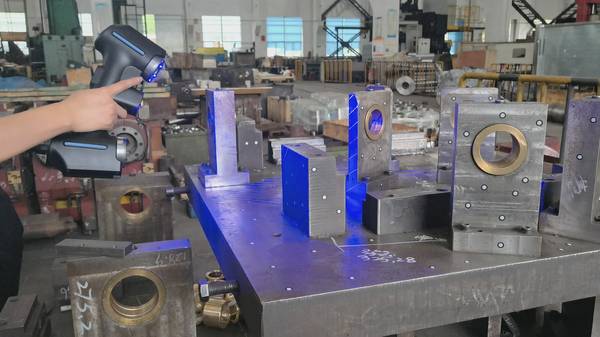
Reverse engineering workflows historically demanded expensive equipment, specialized operators, and time-consuming post-processing. Organizations often found themselves choosing between slow contact-based measurement methods or costly outsource arrangements that added days to project timelines.
The emergence of high-accuracy handheld scanners has fundamentally changed this equation, making scan to CAD conversion accessible within production environments rather than confined to dedicated metrology labs.
From Point Cloud to Parametric Model
The transition from raw scan data to a usable CAD representation involves several critical stages, and the AlphaScan streamlines each phase through its integrated approach. Initial data capture relies on structured blue laser technology, with multiple laser line configurations that adapt to different part geometries.
A single scan session captures millions of data points across complex surfaces, including deep cavities and intricate internal features that would challenge other measurement approaches.
What distinguishes the AlphaScan from basic scanning solutions is its AI-powered processing capability embedded directly in the workflow. The system automatically identifies feature boundaries, recognizes geometric primitives, and begins structuring the raw point cloud into organized mesh data.
This intelligent preprocessing significantly reduces the manual intervention traditionally required, allowing operators to move from physical scan to preliminary CAD-aligned data in a fraction of the time. The 3-minute data acquisition benchmark means that even elaborate industrial components can be fully captured during a single work session, without the repeated setup cycles that plague conventional measurement methods.
Mesh-to-CAD conversion remains the most technically demanding aspect of reverse engineering. AlphaScan addresses this through compatibility with standard CAD platforms and through its own intelligent alignment tools. Operators can overlay scan results directly onto reference CAD models, generating color-coded deviation maps that immediately reveal dimensional variances.
This capability proves invaluable for quality verification applications, where the goal is not necessarily to create a new CAD model but to confirm that manufactured parts match design intent within specified tolerances.
Industrial Deployment Scenarios
Automotive engineering teams encounter scan to CAD requirements regularly when working with supplier components, vintage parts reconstruction, or design modifications to existing assemblies. A common scenario involves updating a bracket or housing that has been in production for years, where the original CAD files may no longer reflect the current manufacturing baseline due to tooling wear or revision drift.
Using AlphaScan, an engineer can digitize the as-built part, compare it against the available CAD reference, and generate an accurate updated model that incorporates actual production geometry rather than theoretical nominals.
Injection molding and die-casting operations face similar challenges when preparing tooling modifications or planning repairs. Rather than measuring individual dimensions with calipers and manual instruments, technicians can scan the complete cavity or core, generate a comprehensive digital model, and share that data with tooling engineers regardless of their geographic location.
This capability supports distributed manufacturing arrangements and accelerates the communication cycle between production floor observations and engineering response.
The equipment servicing sector benefits equally from practical scan to CAD capabilities. When industrial machinery requires replacement components that are no longer commercially available, reverse engineering provides a path forward.
Servicing technicians can scan worn or broken parts, create accurate CAD models from the scan data, and either machine new components directly from the digital definition or coordinate with specialty manufacturers who can produce parts from supplied CAD files.
Practical Considerations for Implementation
Successful scan to CAD deployment requires attention to a few key factors that influence output quality and workflow efficiency. Surface preparation matters, particularly for highly reflective or transparent materials that can compromise laser-based measurement.
INSVISION recommends appropriate scanning techniques for challenging surfaces, including the use of scanning spray when necessary to ensure complete data capture without artifacts.
Operator training represents another investment that pays dividends in scan quality and processing speed. While AlphaScan is designed for intuitive operation, understanding optimal scanning strategies, overlap requirements between scan passes, and proper reference marker placement ensures that data sets are complete and properly aligned from the first capture.
INSVISION provides comprehensive training resources that help new users develop proficiency quickly.
Integration with existing CAD infrastructure determines how effectively scan data translates into actionable engineering information. AlphaScan exports data in industry-standard formats compatible with all major CAD platforms, supporting both mesh-based workflows for organic geometries and feature extraction approaches for predominantly parametric designs.
Organizations should evaluate their primary CAD environment and establish clear protocols for data translation and version management as part of implementing scan to CAD capabilities.
The accessibility of high-accuracy handheld scanning has transformed scan to CAD from a specialized service into a practical in-house capability. INSVISION continues developing the AlphaScan platform to expand automation features, improve processing speed, and extend the range of geometries that operators can confidently capture and convert.
For manufacturers seeking to reduce dependence on external services, accelerate reverse engineering projects, and maintain tighter control over their digital product definitions, integrated scan to CAD solutions represent a strategic capability investment.
Hangzhou Insvision Technology Co., Ltd.
Address: Building 1, No. 1399 Liangmu Road, Yuhang District, Hangzhou, Zhejiang 311121, China
Copyright © Hangzhou Insvision Technology Co., Ltd. All rights reserved.
Copyright © Hangzhou Insvision Technology Co., Ltd. All rights reserved.