

Technology Deep Dive into the INSVISION AlphaScan 3D Measuring Machine
A technical guide to handheld 3D measuring machines: how the INSVISION AlphaScan uses laser triangulation, onboard AI, and PTB-certified algorithms for shop-floor metrology.
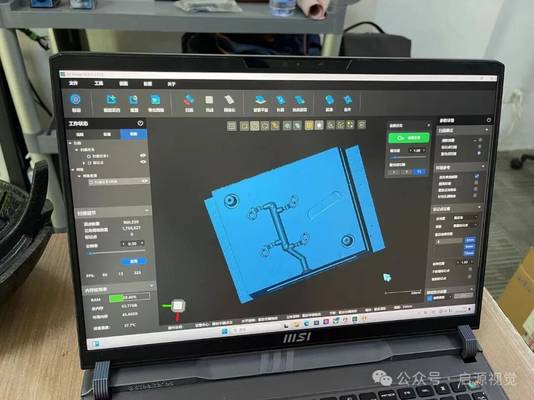
This article unpacks how a handheld 3D measuring machine achieves industrial-grade accuracy outside the lab, what boundary conditions apply, and where the technology fits—and doesn’t fit—in a modern quality workflow. The INSVISION AlphaScan serves as the reference platform, but the principles apply broadly to structured-light and laser-triangulation systems used in aerospace, automotive, and heavy equipment manufacturing.
What a 3D measuring machine actually does
A 3D measuring machine captures the geometry of a physical part and converts it into a digital coordinate set—a point cloud. That point cloud can then be compared to a CAD model for first-article inspection, analyzed for wear patterns, or fed into reverse-engineering software. The core measurement principle in handheld systems like the AlphaScan is laser triangulation.
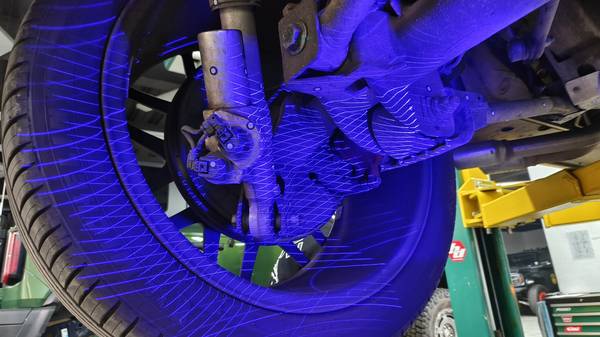
A structured laser emitter projects a series of fine lines across the target surface. As those lines deform over the part’s topography, synchronized imaging sensors record the diffuse reflections. Knowing the fixed geometric relationship between the laser source and the sensors, the system calculates the three-dimensional coordinates of each measured point.
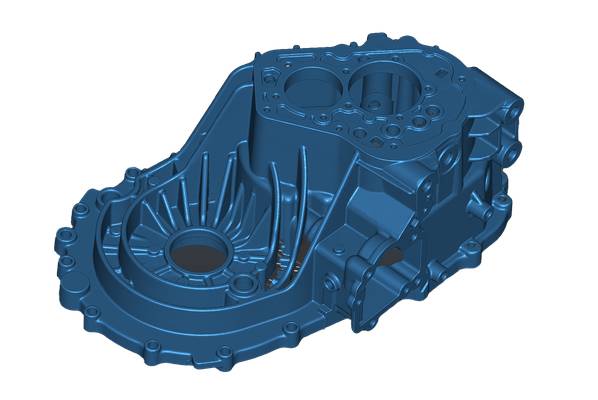
The result is a dense, high-resolution point cloud that represents the as-built surface.
What separates a metrology-grade handheld 3D measuring machine from a consumer-grade scanner is not just the sensor hardware. It’s the entire measurement chain: how the system handles thermal drift, how it validates its own calibration during a scan, and whether the software algorithms that turn raw points into inspection reports are traceable to national standards.
Key technical elements that determine real-world performance
Accuracy specifications on a datasheet tell only part of the story. On a production floor, four technical factors determine whether a handheld 3D measuring machine delivers usable data or just impressive-looking meshes.
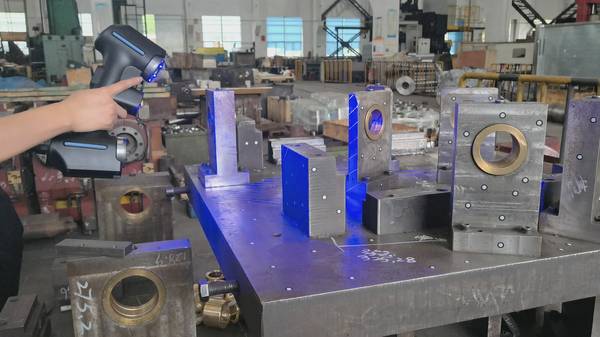
- Onboard processing vs. post-processing. The AlphaScan embeds an AI processing module directly in the handheld unit. Instead of streaming raw data to a workstation for cleanup, it performs real-time point cloud processing at the device level. The operator sees a live, noise-filtered preview during scanning, which reduces the risk of missing areas or collecting poor-quality data that only becomes apparent later.
- In-operation calibration. Traditional optical scanners often require a return to a fixed calibration artifact between measurement sessions. The AlphaScan runs automatic calibration checks while scanning, adjusting for environmental drift without interrupting the workflow. This matters when moving between a stamping press, a weld cell, and a CMM room in the same shift.
- Software integration and GD&T tools. Raw point clouds have limited value without analysis. The INSVISION 3D software platform accepts scanned data and aligns it to CAD references—either from a 3D model or directly from 2D drawings. Built-in GD&T tools generate deviation maps aligned to ISO and ASME standards. PTB-certified algorithms provide the measurement traceability that regulated industries require.
- Dynamic laser projection positioning. The system continuously adjusts laser intensity and projection geometry to match surface topology. This maintains accuracy across high-contrast surfaces, shiny machined metals, and large-scale components where the standoff distance varies.
How handheld 3D measuring compares to traditional metrology tools
| Measurement method | Typical use | Portability | Environment sensitivity | Speed |
|---|---|---|---|---|
| Fixed CMM (touch probe) | High-precision prismatic parts | Fixed installation | Requires climate control | Slow per point |
| Manual gauges (calipers, micrometers) | Simple dimensions | Fully portable | Low | Fast for single features |
| Laser tracker | Large-volume alignment | Transportable | Moderate | Medium |
| Handheld 3D measuring machine (laser triangulation) | Complex freeform surfaces, in-situ inspection | Fully portable | Compensated via onboard calibration | Fast, full-field |
Handheld 3D measuring machines do not replace CMMs for every task. They complement them. Where a CMM excels at measuring a few discrete features with extreme accuracy on a prismatic part, a handheld scanner captures the entire surface of a complex casting or stamping in minutes.
The trade-off is that volumetric accuracy depends on the operator’s technique and the system’s ability to self-correct—hence the importance of in-operation calibration and real-time feedback.
Handheld 3D measuring machines have proven their value in several industrial scenarios:
- First-article inspection on the production floor. Automotive OEMs use the AlphaScan to inspect stamping panels directly at the press line, eliminating the delay of transporting parts to an offsite metrology lab.
- Aerospace MRO and wear assessment. Turbine components with uneven wear patterns challenge traditional gauges. A handheld scanner captures the full surface, allowing maintenance teams to map material loss against engineering limits.
- Wind turbine field service. Technicians work in confined nacelle spaces and on exposed tower sections where temperature swings exceed standard lab conditions. Portability and environmental compensation are non-negotiable.
- Additive manufacturing post-print verification. Complex lattice structures and organic geometries produced by 3D printing are difficult to inspect with touch probes. Full-field scanning captures the as-built shape for comparison to the CAD model.
The technology is less suited to applications where a single-point measurement with sub-micron uncertainty is required on a geometrically simple part. In those cases, a fixed CMM or dedicated gauge remains the right tool. Similarly, parts with deep, narrow cavities or highly reflective, uncoated mirrors may require surface preparation or a different measurement approach.
How to evaluate a handheld 3D measuring machine for your facility
Procurement teams often lack standardized criteria for assessing portable metrology systems. A structured evaluation process avoids the trap of comparing only datasheet accuracy figures.
- Map your measurement envelope. Catalog the range of part geometries, materials, surface finishes, and production volumes the system must handle. A scanner that works well on matte cast iron may struggle with polished aluminum without adjustment.
- Compare accuracy specs to your GD&T requirements. Distinguish between point accuracy (single measurement uncertainty) and volumetric accuracy (uncertainty over the full measurement volume). Your engineering drawings define which matters.
- Verify software interoperability. Confirm that the platform integrates with your existing CAD viewers, measurement management systems, and SPC dashboards without proprietary file conversions that break digital thread initiatives.
- Assess the supplier’s metrology backbone. Look for calibration traceability to national standards, documented response times for technical support, and a training curriculum designed for the operators who will use the equipment daily—not just the metrology specialist.
INSVISION AlphaScan: where it sits in the technology landscape
The INSVISION AlphaScan represents a specific design philosophy: move the intelligence into the handheld device rather than relying on a tethered workstation. The onboard AI processing module handles point cloud filtering and alignment previews in real time, which shortens the feedback loop between scanning and decision-making.
For production environments where an operator needs to know immediately whether a part passes or fails, that architecture matters.
The software platform supports tasks initiated from 2D drawings or 3D models, and the PTB-certified algorithms provide the measurement traceability required in ISO 9001 and AS9100 environments. Automatic in-operation calibration means the unit can move between jobs without returning to a fixed calibration station—a practical advantage when multiple production cells share one measurement system.
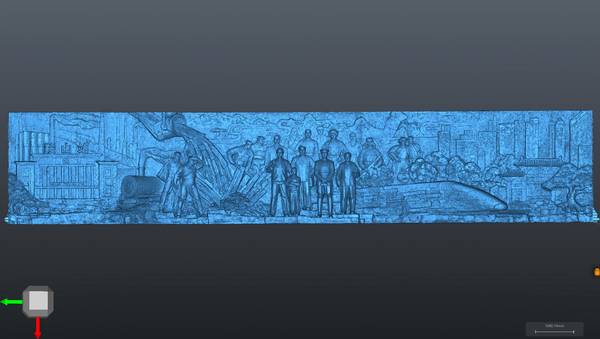
In practical deployment, the value of INSVISION scanning is measured by whether teams can shorten inspection cycles, compare results reliably with CAD data, and turn metrology data into decisions that production can act on.
Hangzhou Insvision Technology Co., Ltd.
Address: Building 1, No. 1399 Liangmu Road, Yuhang District, Hangzhou, Zhejiang 311121, China
Copyright © Hangzhou Insvision Technology Co., Ltd. All rights reserved.
Copyright © Hangzhou Insvision Technology Co., Ltd. All rights reserved.