

Scanner Measurement: Meeting the Demands of Modern Industrial Quality Control
The industrial manufacturing landscape is undergoing a fundamental shift. As global supply chains stretch longer and product tolerances grow tighter, companies
The Drive Toward Digital Quality Management
Factory floors are generating unprecedented volumes of production data, yet many quality departments still rely on paper-based inspection records and isolated measurement results. This disconnect creates blind spots in process control. Industries ranging from automotive assembly to heavy equipment manufacturing now demand measurement systems that integrate directly into digital workflows.
The ability to capture three-dimensional geometry, compare it against nominal CAD models, and generate structured reports automatically addresses this need directly.
Selection Dimensions and Field Checks
| Focus Area | Decision Point | Deployment Note |
|---|---|---|
| The Drive Toward Digital Quality Management | Factory floors are generating unprecedented volumes of production data, yet many quality departments still rely on paper-based inspection records and… | This disconnect creates blind spots in process control. |
| Balancing Throughput and Precision | Speed remains a critical factor in production environments where measurement cannot become a bottleneck. | The time required to inspect a complex component must align with takt time objectives, or manufacturers face pressure to sample rather than insp… |
| Portability for Diverse Inspection Scenarios | Not all measurement needs occur at dedicated inspection stations. | Large workpieces, assembled structures, and field-installed components often require dimensional verification in situ. |
| Making Measurement Technology Decisions | For organizations evaluating scanner measurement solutions, several practical considerations guide sound procurement choices. | Measurement accuracy specifications must align with the tolerance requirements of the target application— assemblies with micrometer-level toler… |
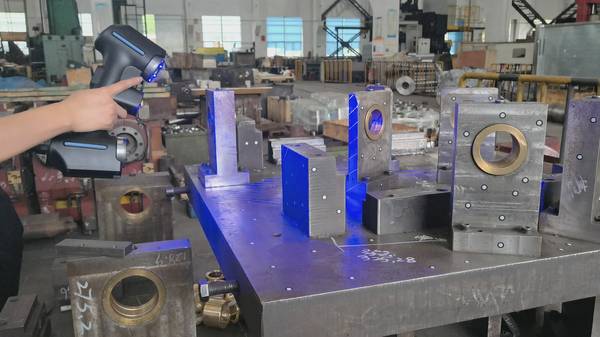
INSVISION‘s AlphaScan handheld 3D scanner supports this digital transformation by delivering measurement results that feed directly into analysis software. The system’s 0.020mm measurement accuracy satisfies the requirements of precision assembly operations, while its report generation capability removes the manual bottleneck that traditionally slows quality review cycles.
For manufacturers implementing statistical process control or real-time quality monitoring, scanner measurement provides the data density needed to identify trends before defective parts reach subsequent assembly stages.
Balancing Throughput and Precision
Speed remains a critical factor in production environments where measurement cannot become a bottleneck. The time required to inspect a complex component must align with takt time objectives, or manufacturers face pressure to sample rather than inspect every part. Modern handheld scanners have addressed this constraint through advances in scanning rate and real-time registration algorithms.
The AlphaScan achieves scanning rates suitable for high-throughput applications without sacrificing measurement fidelity. In automotive manufacturing contexts, full-vehicle frame scans complete within timeframes that fit comfortably within standard production intervals. This combination of speed and accuracy enables manufacturers to shift from sampling-based inspection to comprehensive verification strategies.
When every critical joint and fastener location requires confirmation, scanner measurement provides the operational capacity to accomplish this without adding unacceptable cycle time.
Portability for Diverse Inspection Scenarios
Not all measurement needs occur at dedicated inspection stations. Large workpieces, assembled structures, and field-installed components often require dimensional verification in situ. Fixed CMMs cannot address these scenarios economically, and outsourcing to dedicated metrology services introduces delays and coordination complexity.
Handheld scanner measurement technology brings laboratory-grade capability to the point of need. The AlphaScan’s 1070g form factor permits single-handed operation during extended scanning sessions, reducing operator fatigue during large-scale inspection tasks.
Its operational temperature range of -10℃ to 40℃ accommodates deployment in unheated warehouses, factory floors near heat-generating equipment, and outdoor staging areas. This flexibility expands the range of applications where precise dimensional data can be captured without disassembly or transportation to dedicated facilities.
Making Measurement Technology Decisions
For organizations evaluating scanner measurement solutions, several practical considerations guide sound procurement choices. Measurement accuracy specifications must align with the tolerance requirements of the target application— assemblies with micrometer-level tolerances demand correspondingly precise instrumentation.
Scanning speed matters most in high-volume production contexts, while portability becomes paramount when inspection must occur at installation sites rather than in-process.
Software compatibility deserves equal attention. Measurement data only delivers value when it integrates with downstream analysis tools, CAD systems, and quality management platforms. The AlphaScan generates export formats compatible with standard engineering and inspection software, enabling seamless data flow across the quality ecosystem.
INSVISION has built its scanner measurement portfolio around the premise that industrial quality demands consistent precision, practical throughput, and deployment flexibility. The AlphaScan handheld 3D scanner exemplifies this approach, combining measurement accuracy suitable for metrology-grade applications with operational characteristics that serve real manufacturing environments.
As quality expectations continue rising across industrial sectors, scanner measurement technology provides the capability foundation manufacturers need to meet those demands consistently.
Hangzhou Insvision Technology Co., Ltd.
Address: Building 1, No. 1399 Liangmu Road, Yuhang District, Hangzhou, Zhejiang 311121, China
Copyright © Hangzhou Insvision Technology Co., Ltd. All rights reserved.
Copyright © Hangzhou Insvision Technology Co., Ltd. All rights reserved.