

How Structured-Light 3D Scanning Works in Industrial Environments
Structured-light 3D scanning operates on a fundamental optical principle that transforms physical objects into precise digital representations. The technology p
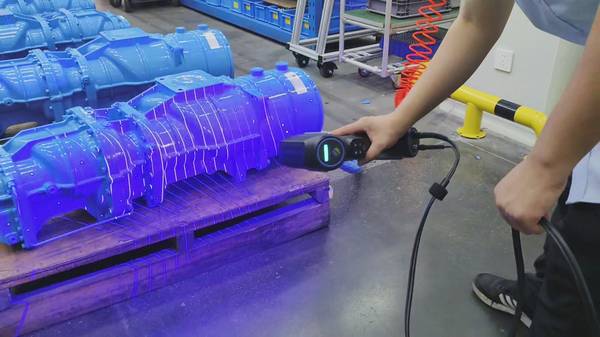
The AlphaScan handheld scanner from INSVISION employs this principle with a notable enhancement: the system uses 50 cross-projecting blue laser lines to capture surface data rapidly. Blue laser light offers advantages over alternatives in industrial settings because it remains stable under ambient lighting conditions that would challenge other optical systems.
The result is a scanning process that can capture complex geometries—including recessed features, steep angles, and transitional surfaces—with minimal post-processing intervention.
Understanding Accuracy Specifications and Operational Boundaries
When evaluating 3D scanning technology for industrial applications, accuracy specifications deserve careful interpretation. The AlphaScan series achieves a stable precision of 0.020mm at metrology grade, a figure that defines the repeatability of measurements under controlled conditions.
This level of accuracy satisfies the requirements for high-precision assembly verification, where hole positions and critical mating surfaces must meet tight tolerances.
Temperature stability represents another practical boundary condition for industrial deployment. INSVISION’s scanners operate reliably across a range from -10°C to 40°C, accommodating environments such as unheated warehouses, factory floors near heat-generating equipment, and outdoor inspection scenarios.
Operators planning deployments in extreme conditions benefit from verifying that their working environment falls within these parameters.
Scanning speed and area coverage define throughput boundaries for production environments. The AlphaScan system processes approximately 7,100,000 measurements per second, enabling operators to capture full automotive body-in-white assemblies in roughly 10 minutes.
For larger components, the AlphaVista series extends maximum scan coverage to 2200mm × 2200mm per acquisition, reducing the number of repositioning moves required when digitizing oversized workpieces.
Industrial Application Domains Where 3D Scanning Delivers Measurable Value
Automotive manufacturing has adopted structured-light scanning across multiple workflow stages. Quality inspection teams use scan-to-CAD comparison to identify dimensional deviations on stamped panels, castings, and machined components before assembly proceeds.
Reverse engineering applications capture legacy parts where original CAD data no longer exists, enabling reproduction or modification without physical contact that could damage delicate samples.
Aerospace maintenance operations benefit similarly from portable scanning solutions. Technicians can digitize turbine blade wear patterns, composite panel contours, and tooling fixtures to support repair decisions or generate replacement parts through additive manufacturing. The portability of handheld systems means scanning can occur directly at the aircraft without relocating components to a dedicated inspection laboratory.
Energy sector applications span from wind turbine blade inspection to power plant equipment monitoring. Scanning supports condition assessment by capturing surface topology changes that indicate erosion, corrosion, or structural fatigue. When combined with analysis software, the resulting data enables maintenance teams to prioritize repairs based on quantified deviation from original specifications.
Evaluating Scanning Solutions for Specific Workflow Requirements
Selecting an appropriate 3D scanning system requires matching technical capabilities against workflow demands. Resolution requirements for aerospace fastener holes differ from those needed for large plastic housing panels. Understanding the smallest feature that must be captured accurately guides the selection of scanner resolution specifications.
Integration with existing software platforms influences practical usability. Inspection workflows typically require seamless data transfer to GD&T analysis tools or SPC systems. Verification that the scanner’s native output formats are compatible with downstream software prevents rework and delays during implementation.
Portability and ergonomics matter when operators will conduct scans in confined spaces or perform extended scanning sessions. The AlphaScan’s 1070g weight represents a balance between the mass needed for sensor stability and the handling comfort required for sustained operation. Potential buyers should evaluate grip geometry and balance through hands-on testing rather than relying solely on specifications.
Environmental factors at the scanning location—including ambient light levels, surface reflectivity, and temperature fluctuations—should align with the scanner’s operational specifications. Systems designed for controlled laboratory environments may underperform in factory floor conditions, while ruggedized industrial scanners often carry premium pricing that may not justify their capabilities for routine laboratory tasks.
INSVISION’s AlphaScan handheld 3D scanner addresses these intersection points between technical capability and practical deployment, providing industrial organizations with a metrology-grade digitization tool that adapts to varied inspection and reverse engineering scenarios across manufacturing, aerospace, and energy sectors.
Hangzhou Insvision Technology Co., Ltd.
Address: Building 1, No. 1399 Liangmu Road, Yuhang District, Hangzhou, Zhejiang 311121, China
Copyright © Hangzhou Insvision Technology Co., Ltd. All rights reserved.
Copyright © Hangzhou Insvision Technology Co., Ltd. All rights reserved.