

Reducing Rework and Accelerating Delivery with an Industrial 3D Measurement Tool
Discover how an industrial 3D measurement tool reduces rework, accelerates delivery, and lowers inspection costs. Explore the operational value of INSVISION 3D scanners.
This article examines how an industrial 3D measurement
This article examines how an industrial 3D measurement tool can shift the economics of dimensional inspection from a bottleneck to a lean enabler.
Rather than a deep dive into optics or algorithms, the focus is on the operational levers that matter to plant managers, quality directors, and finance teams: inspection throughput, rework reduction, labor flexibility, delivery cadence, and the long-term value of digital process data.
Throughout, we reference the engineering approach of INSVISION, a brand that has refined handheld 3D scanning to address the real-world constraints of factory floors and field service.
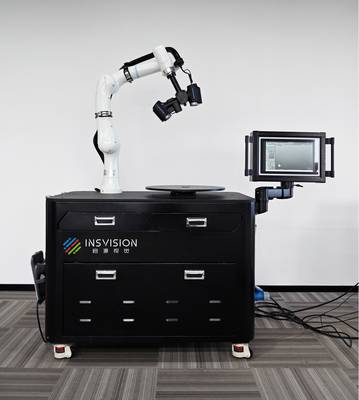
Capability and Deployment Mapping
| Focus Area | Decision Point | Deployment Note |
|---|---|---|
| This article examines how an industrial 3D measurement | This article examines how an industrial 3D measurement tool can shift the economics of dimensional inspection from a bottleneck to a lean enabler. | Rather than a deep dive into optics or algorithms, the focus is on the operational levers that matter to plant managers, quality directors, and… |
| Many factories still rely on a mix of | Many factories still rely on a mix of hand tools, dedicated CMMs, and gauge-based checks. | While each method has its place, failing to adopt a modern 3D measurement tool introduces friction that shows up in the P&L: |
| These pain points surface in every sector where | These pain points surface in every sector where dimensional accuracy is tied to function, safety, or assembly fit—from automotive powertrain componen… | Confirm against part conditions, inspection tempo, and data-output requirements. |
| An industrial 3D measurement tool particularly a handhe… | An industrial 3D measurement tool—particularly a handheld, metrology-grade scanner—addresses these cost drivers by compressing the time from part to… | Inspection throughput. |
Where Traditional Measurement Creates Hidden Cost
Many factories still rely on a mix of
Many factories still rely on a mix of hand tools, dedicated CMMs, and gauge-based checks. While each method has its place, failing to adopt a modern 3D measurement tool introduces friction that shows up in the P&L:
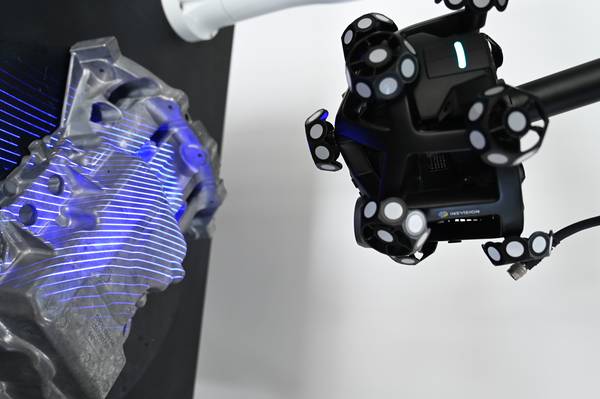
- Inspection cycle time. CMM programming and fixturing can consume hours before the first data point is collected. Hand-tool checks on large or freeform surfaces are slow and sample only a fraction of the geometry.
- Rework and scrap latency. When dimensional issues are detected late—after machining, welding, or assembly—the cost of correction multiplies. Scrapped material, machine time, and labor are sunk.
- Skilled labor dependency. CMM programming and manual layout inspection demand experienced metrology specialists. When those individuals are unavailable, inspection queues grow.
- Delivery uncertainty. Delayed inspection sign-offs push shipment dates, eroding on-time delivery performance and customer trust.
- Thin digital records. Paper check sheets or isolated CMM reports make it difficult to trace a dimension back to a specific batch, shift, or tool condition. Root cause analysis slows, and audit readiness suffers.
These pain points surface in every sector where
These pain points surface in every sector where dimensional accuracy is tied to function, safety, or assembly fit—from automotive powertrain components to heavy equipment fabrications and medical device housings.
An industrial 3D measurement tool particularly a handheld
An industrial 3D measurement tool—particularly a handheld, metrology-grade scanner—addresses these cost drivers by compressing the time from part to actionable data and making comprehensive surface data accessible to a broader range of operators.
Inspection throughput. A handheld 3D scanner captures millions of points across a complex surface in minutes, without the need for dedicated fixturing. First-article inspections that once occupied a CMM for an entire morning can be completed directly on the shop floor, freeing the CMM for other tasks or eliminating the bottleneck entirely.
The result is a faster feedback loop to production: machinists and welders receive deviation maps while the setup is still fresh, enabling immediate correction.
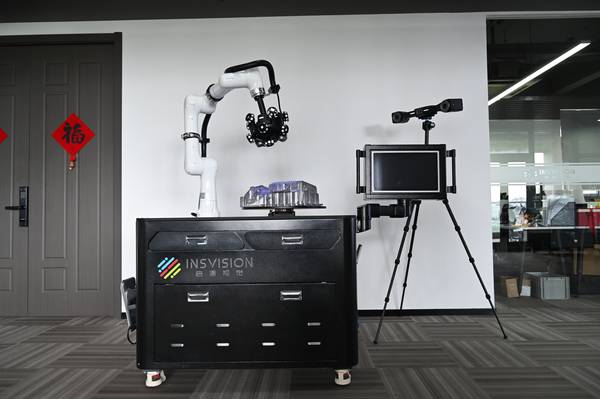
Rework and scrap containment
Rework and scrap containment. By moving inspection closer to the point of manufacture, teams can identify deviations while the process is still adjustable, reduce late-stage sorting, and prevent the same defect pattern from repeating across a batch. The practical gain is not only faster measurement, but earlier corrective action and more predictable delivery.
Hangzhou Insvision Technology Co., Ltd.
Address: Building 1, No. 1399 Liangmu Road, Yuhang District, Hangzhou, Zhejiang 311121, China
Copyright © Hangzhou Insvision Technology Co., Ltd. All rights reserved.
Copyright © Hangzhou Insvision Technology Co., Ltd. All rights reserved.