

AlphaScan Handheld 3D Scanner for Reverse Engineering in Industrial Manufacturing
Discover how the INSVISION AlphaScan handheld 3D scanner for reverse engineering delivers metrology-grade accuracy in harsh industrial environments.
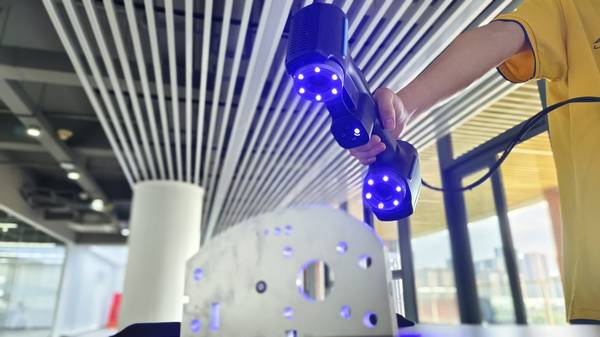
A handheld 3D scanner for reverse engineering changes that equation. It brings measurement to the part, capturing dense point clouds directly on the shop floor, in a hangar, or at a remote field site. The INSVISION AlphaScan platform was engineered specifically for these in-situ workflows, combining metrology-grade accuracy with the portability and environmental resilience that industrial reverse engineering demands.
Typical Industrial Conditions and Core Pain Points
Reverse engineering in manufacturing rarely takes place under ideal conditions. The part may be installed in a confined space, surrounded by auxiliary equipment, or exposed to ambient temperatures well outside the comfort zone of conventional metrology tools. Traditional workflows often require disassembly, transport to a temperature-controlled lab, and lengthy setup on a CMM or a stationary scanner.
Each step adds hours or days to a project that is already under schedule pressure.
Capability and Deployment Mapping
| Focus Area | Decision Point | Deployment Note |
|---|---|---|
| Typical Industrial Conditions and Core Pain Points | Reverse engineering in manufacturing rarely takes place under ideal conditions. | The part may be installed in a confined space, surrounded by auxiliary equipment, or exposed to ambient temperatures well outside the comfort zo… |
| Solution Design: A Field-Ready Handheld 3D Scanner for… | INSVISION designed the AlphaScan handheld scanner to address these constraints directly. | The platform weighs 9.5 kg and features an optimized center of gravity with an extended grip geometry. |
| Implementation Process: From Physical Part to Usable CA… | A typical reverse engineering project with the AlphaScan follows a structured, repeatable workflow that can be executed entirely at the part’s locati… | Confirm against part conditions, inspection tempo, and data-output requirements. |
| How the AlphaScan Matches the Reverse Engineering Scena… | The AlphaScan’s capabilities align with the specific challenges of industrial reverse engineering. | Its field-deployable form factor eliminates the need to transport heavy or fixed components. |
Several pain points recur across industries:
- Immobile components. Large castings, turbine housings, and structural weldments cannot be moved without risking damage or incurring crane costs. Measurement must happen in situ.
- Harsh environments. Unheated tool rooms in energy sector facilities can drop below freezing in winter, while outdoor scanning on a refinery turnaround may push 40°C in direct sun. Instruments that require thermal stabilization delay the start of work.
- Single-operator constraints. Tight layouts and remote sites often mean only one technician is available. The scanner must be manageable for a single user over sustained scanning sessions.
- Multi-site standardization. Global manufacturers need consistent reverse engineering workflows across plants in Europe, North America, and Asia. Equipment must carry certifications that avoid re-validation at each location.
Solution Design: A Field-Ready Handheld 3D Scanner for Reverse Engineering
INSVISION designed the AlphaScan handheld scanner to address these constraints directly. The platform weighs 9.5 kg and features an optimized center of gravity with an extended grip geometry. This distributes mass evenly during long scanning passes, allowing a single operator to capture complex geometries—such as a stamped die with multiple registration targets—without fatigue-induced instability.
The scanner’s operational temperature range spans -5°C to 40°C. That envelope covers unheated warehouses common in pipeline and power generation operations, as well as outdoor deployment scenarios where seasonal swings exceed typical lab instrument specifications. There is no waiting for thermal conditioning; the system is ready to scan shortly after power-up.
Global certification coverage (CE, FCC, CNAS) supports deployment across EU, North American, and international facilities without additional re-validation cycles. This is particularly valuable for organizations that maintain standardized reverse engineering procedures at distributed manufacturing sites.
The 0.25 mm positioning accuracy meets ISO and ASME GD&T requirements, ensuring that the captured data can feed directly into tolerance analysis and CAD reconstruction.
Implementation Process: From Physical Part to Usable CAD Model
A typical reverse engineering project with the AlphaScan follows a structured, repeatable workflow that can be executed entirely at the part’s location.
- Preparation. The operator positions the part or clears access around an installed component. Reference targets are placed on or around the object to aid automatic alignment. The scanner is calibrated using the onboard routine, which takes less than two minutes.
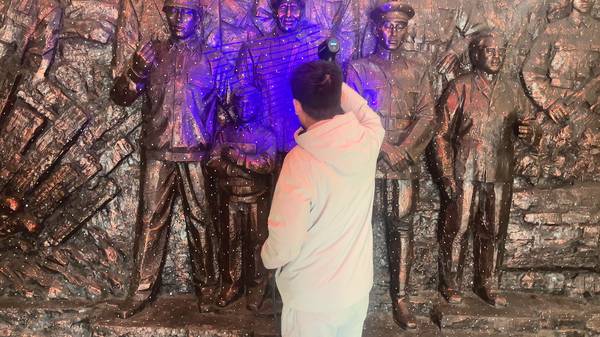
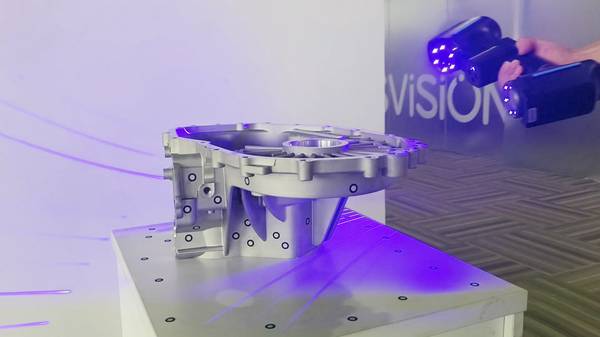
- Scanning. Using the handheld unit, the operator captures the surface geometry in multiple passes. The scanner’s laser lines project onto the part, and the integrated cameras record millions of points per second. The lightweight chassis and balanced grip allow smooth, continuous movement even when scanning overhead or in cramped spaces. Live preview on the connected workstation shows coverage in real time, so the operator can fill any gaps before moving to the next area.
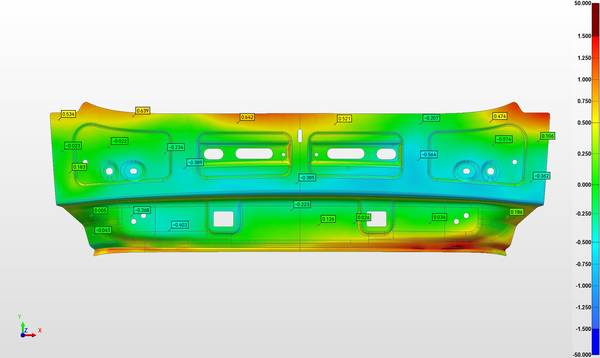
- Data Processing. The acquired point clouds are aligned automatically using the reference targets and surface features. The INSVISION 3D software suite handles multi-source data alignment, noise filtering, and mesh generation. Deviation analysis tools compare the scan data against any existing reference geometry or check for symmetry and surface continuity. GD&T functionalities extract critical dimensions directly from the mesh.
- CAD Model Generation. The clean mesh is exported to the user’s preferred CAD environment. For prismatic parts, feature extraction tools accelerate the creation of parametric solid models. For organic shapes, the mesh serves as the foundation for surface modeling or direct CAM toolpath generation. The entire process, from first scan to CAD-ready output, can often be completed within a single shift.
How the AlphaScan Matches the Reverse Engineering Scenario
The AlphaScan’s capabilities align with the specific challenges of industrial reverse engineering. Its field-deployable form factor eliminates the need to transport heavy or fixed components. The wide temperature tolerance removes environmental barriers that would delay a CMM-based workflow.
Single-operator ergonomics make it practical for remote sites and confined production floors where sending a two-person team is not feasible.
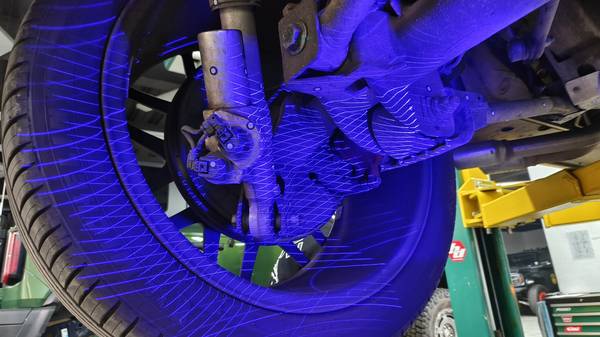
The scanner’s accuracy and software integration ensure that the output meets engineering standards, not just visualization needs. When a replacement impeller must match the original’s mounting flange within 0.25 mm, the AlphaScan provides the data fidelity required to machine a drop-in part.
The global certifications mean a procedure validated at a German plant can be replicated at a facility in Texas or Singapore without re-qualifying the measurement system.
Observable Effects on Reverse Engineering Workflows
While specific cycle-time reductions depend on part complexity and site conditions, users consistently report qualitative improvements. The ability to scan in situ eliminates rigging and transport delays. Measurement can begin within minutes of arriving at the asset, rather than after hours of thermal stabilization. The single-operator design reduces labor costs and simplifies scheduling.
Data quality is uniform across sites, supporting centralized engineering teams that process scans from multiple locations.
The shift from contact probing to full-field optical capture also changes the nature of the deliverable. Instead of a sparse set of discrete points, the engineering team receives a dense point cloud that captures freeform surfaces, blend radii, and worn areas that may need restoration. This richer dataset reduces the guesswork in CAD reconstruction and helps identify deviations from the original design intent.
Similar Applications and Industry Extension
The same workflow applies wherever a physical part must be digitized for reproduction, modification, or analysis. In aerospace MRO, technicians scan landing gear components and engine nacelle panels directly in the hangar. In automotive tooling, stamping dies and checking fixtures are captured on the press line to create digital twins for wear monitoring and spare part machining.
Energy sector operators use the scanner on valve bodies, pump casings, and turbine blades during planned outages, feeding data to both reverse engineering and fitness-for-service assessments.
Organizations evaluating a 3D scanner for reverse engineering can assess fit by examining their own most challenging measurement scenarios. If a significant portion of work involves parts that cannot be moved, environments with temperature extremes, or single-operator field deployments, a handheld system with the AlphaScan’s environmental specifications and ergonomic design merits close evaluation.
The key is to test the scanner on a representative component using the actual software tools and quality standards that will govern production work.
Summary
Reverse engineering in industrial settings demands more than just accuracy. It requires a measurement system that adapts to the physical and environmental realities of the shop floor, the hangar, and the field.
The INSVISION AlphaScan handheld 3D scanner brings metrology-grade data capture to the point of use, enabling faster, more flexible reverse engineering workflows without compromising the dimensional integrity that downstream manufacturing depends on. For teams that regularly face immobile parts, harsh conditions, and distributed operations, this approach turns a logistical challenge into a routine, repeatable process.
References
- AlphaScan Handheld 3D Scanner Product Brochure
- 3D Software Suite Technical Specification Document
- Industrial 3D Scanning Application Guidelines
Hangzhou Insvision Technology Co., Ltd.
Address: Building 1, No. 1399 Liangmu Road, Yuhang District, Hangzhou, Zhejiang 311121, China
Copyright © Hangzhou Insvision Technology Co., Ltd. All rights reserved.
Copyright © Hangzhou Insvision Technology Co., Ltd. All rights reserved.