

Practical Guide to 3D Scanning in Automotive Industry for 2026
Discover the practical applications and technical boundaries of 3D scanning in automotive industry workflows. Learn how metrology-grade scanners optimize QA.
Introduction
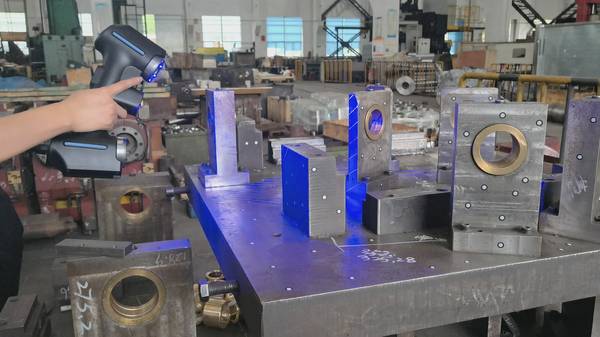
In the push for lighter, more complex vehicle architectures and compressed launch cycles, automotive quality assurance is hitting a bottleneck. Traditional coordinate measuring machines (CMMs) and hand tools, while precise, often lack the speed and data density required for modern model-based definition workflows. This gap has driven interest in 3D scanning in automotive industry applications as a complementary metrology tool.
Yet, misconceptions about its role—seeing it as either a silver bullet or a niche gadget—can derail effective implementation. This guide clarifies the core principles, practical boundaries, and optimal use cases for 3D scanning in automotive environments, providing a foundation for informed technology evaluation.
What is 3D Scanning in the Automotive Context?
Fundamentally, 3D scanning is a non-contact method of capturing the physical geometry of an object to create a digital twin—a dense “point cloud.” In automotive applications, this technology moves beyond simple digitization to become a comparative metrology tool.
The scanner projects a pattern of light onto a part’s surface, and its sensors calculate the precise three-dimensional coordinates of millions of points by analyzing the distortion of this pattern. This resultant dataset allows for direct, full-field comparison against the original CAD nominal model, visualizing deviations through color-coded maps.
Key Technical Capabilities: Beyond Resolution
Evaluating a scanner requires looking past basic specifications. For automotive-grade work, several interdependent factors define capability.
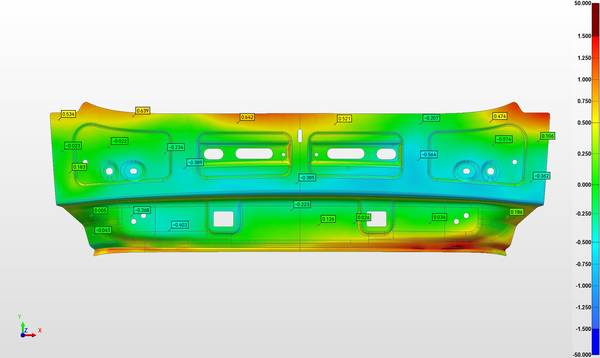
- Accuracy & Repeatability: This forms the baseline requirement. Metrology-grade scanning must deliver consistent, traceable results, often within microns (±0.05 mm or better for critical fits). This depends on the scanner’s optical engine, calibration stability, and software algorithms.
- Speed & Effective Field of View: Throughput is not just about points per second. A large field of view that maintains accuracy—say, 650 mm x 550 mm—allows an operator to capture large panels or complex assemblies in fewer setups, drastically reducing total inspection time.
- Data Integrity in Harsh Conditions: The shop floor is not a lab. Algorithms must compensate for ambient light variation, reflective surfaces (like bare metal), and subtle part movement to generate a clean, usable point cloud without post-processing.
- Software Workflow Integration: The hardware is only half the system. The software must enable rapid alignment to CAD, automated GD&T analysis, and the generation of standardized reports (e.g., PPAP) with minimal manual intervention.
How It Differs from Traditional Metrology
Mapping 3D scanning alongside existing tools defines effective metrology strategies.
| Feature | Traditional CMM / Hand Tools | 3D Scanning (Metrology-Grade) |
|---|---|---|
| Data Type | Discrete point measurements | Full-surface, dense point cloud |
| Speed | Slower, point-by-point | High-speed, area-based capture |
| Output | Numerical deviation report | Visual deviation map & numerical report |
| Best For | Validating known, critical dimensions | Mapping unknown form errors, complex surfaces, reverse engineering |
| Setup | Often requires precise fixturing | Typically more flexible, handheld or portable |
The technologies are complementary. Scanning excels at rapid, comprehensive form analysis and first-article inspection, while CMMs provide ultimate traceable accuracy for specific, controlled measurements.
Well-Suited Scenarios for 3D Scanning in Automotive Industry:
- First-Article & In-Line Inspection: Rapidly validate entire part geometry against CAD, especially for complex stampings, castings, and body-in-white assemblies.
- Tooling & Fixture Wear Assessment: Periodically scan production tools to compare against master geometry and predict maintenance needs via wear trend analysis.
- Reverse Engineering for Aftermarket/Service: Digitize legacy components for which CAD data no longer exists to facilitate reproduction or redesign.
- Dimensional Root Cause Analysis: Use full-field deviation maps to visually identify warpage, springback, or assembly clash issues that discrete points might miss.
Less Optimal Scenarios:
- Measuring internal, hidden, or deeply recessed features without optical access.
- Applications requiring the highest possible level of accredited, single-point traceability (where a CMM remains the standard).
- Measuring simple, prismatic features where a hand caliper or gauge is sufficient and faster.
Before investing, teams should assess their specific needs:
- Tolerance Requirements: What is the tightest tolerance you need to verify? Your scanner’s accuracy must be a fraction of this.
- Part Size & Complexity: Do you primarily scan small brackets or large body panels? This dictates the required field of view and portability.
- Environment: Is the unit for a controlled quality lab or a busy production floor? Look for robustness and ambient light immunity.
- Workflow Integration: Can the system output the specific reports (e.g., ISO 10360) your quality management system requires? Does it integrate with your existing CAD/PLM software?
- Skill Floor: How quickly can your existing quality inspectors become proficient? Intuitive software is as important as hardware specs.
The INSVISION AlphaScan for Automotive Workflows
For environments demanding shop-floor agility without sacrificing metrology-grade data, the INSVISION AlphaScan handheld 3D scanner addresses the gap between lab precision and production speed. Its design prioritizes the realities of automotive manufacturing: a large scan volume handles components from brake calipers to sub-panels in a single pass, minimizing repositioning.
The integrated processing engine uses AI-assisted reconstruction to maintain point cloud clarity despite fluctuating ambient light common in final assembly areas.
The operational value lies in closed-loop quality control. The tolerance comparison function flags GD&T deviations in real time on the scanner’s screen, allowing for immediate corrective action. A one-click inspection report can be generated and dispatched before the operator moves to the next station.
For tooling engineers, the ability to overlay time-series scans of a mold or die directly onto the CAD model provides a clear visual and quantitative wear curve, enabling predictive maintenance. This same platform can be directly applied to reverse engineering or supplier part validation without additional software modules, consolidating multiple metrology tasks onto a single, portable device.
Common Misconceptions and Technical Questions
Q: Can a 3D scanner replace our CMM?
A: Generally, no. They serve different primary functions. Think of a scanner as a complement that handles rapid, full-surface inspections and root-cause analysis, freeing up the CMM for high-precision, accredited measurement of master fixtures and critical internal features.
Q: Is the data from a handheld scanner accurate enough for PPAP documentation?
A: Metrology-grade handheld scanners like the INSVISION AlphaScan are designed for this purpose. Verification requires checking the system’s volumetric accuracy specification against your part tolerances and following a controlled, repeatable measurement procedure. The software should generate the standardized reports required for PPAP submissions.
Q: How long does it take to train an operator?
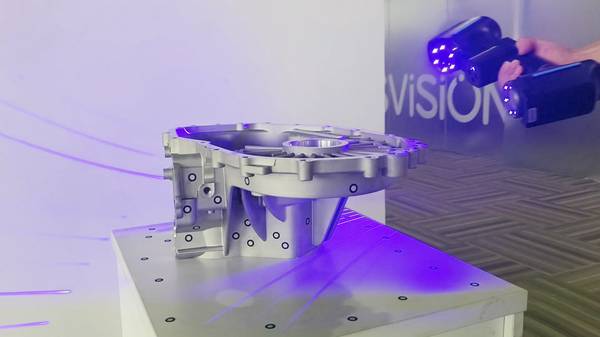
A: For basic part scanning and report generation, proficiency can often be achieved in a few days. Mastering advanced alignment techniques and complex GD&T analysis for intricate assemblies requires more experience, but modern, intuitive software significantly shortens this learning curve compared to earlier generations of technology.
Q: We have shiny, reflective parts. Is that a problem?
A: Highly reflective surfaces like polished metal or clear coat can challenge any optical system. Effective strategies include applying a temporary matte spray (engineered for metrology), using scanner settings optimized for high dynamic range, or leveraging software filters designed to handle such reflections. A capable system will have proven methods for managing these materials.
Conclusion
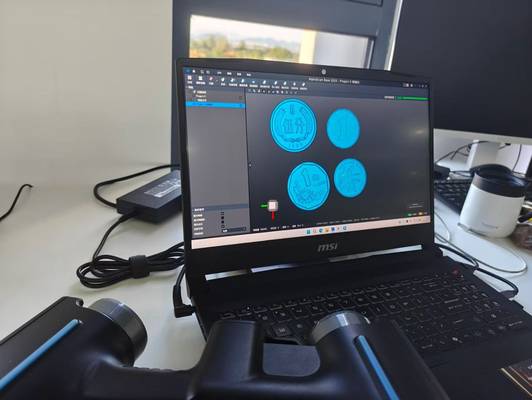
Implementing 3D scanning in automotive industry workflows is not a wholesale replacement for established metrology but a powerful evolution of it. For automotive engineers and quality managers, its value is unlocked by understanding its strengths in speed, data density, and visual analysis.
Successful adoption hinges on matching the technology’s specific capabilities—particularly in accuracy, environmental robustness, and workflow integration—to well-defined use cases like first-article inspection, tooling management, and dimensional troubleshooting.
When implemented with clear objectives, it transforms quality data from a series of sample points into a comprehensive digital narrative of the manufacturing process.
Hangzhou Insvision Technology Co.,Ltd.
Address: Building 1, No. 1399 Liangmu Road, Yuhang District, Hangzhou, Zhejiang 311121, China