

Practical 3D Scanning Car Guide for Quality Control and Reverse Engineering
Discover how 3D scanning car components with INSVISION AlphaScan streamlines quality control and reverse engineering, replacing CMM bottlenecks with portable metrology.
Automotive Quality Control Challenges
Consider a common scenario: a Tier 1 supplier receives a first-off production sample of a new bumper assembly. The component must be validated against the original CAD model for geometric dimensioning and tolerancing (GD&T) compliance before full-scale production can be approved. The traditional workflow might involve a coordinate measuring machine (CMM). The core pain points are immediate:
Practical Workflow
- Automotive Quality Control Challenges — Consider a common scenario: a Tier 1 supplier receives a first-off production sample of a new bumper assembly.
- Shifting to Portable Metrology — The solution is a shift from discrete-point to full-field, portable metrology.
- The 3D Scanning Car Workflow — Implementing a 3D scanning car workflow for these tasks follows a streamlined, repeatable process:
- INSVISION AlphaScan for Automotive Environments — For professionals executing 3D scanning car inspections, scanner selection criteria are specific: accuracy, portability, and robu…
Shifting to Portable Metrology
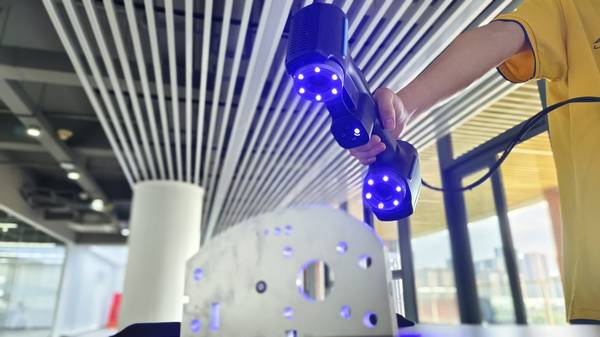
The solution is a shift from discrete-point to full-field, portable metrology. The goal is to capture a complete, high-density digital twin of the physical component directly where it resides—whether on an assembly jig, a vehicle frame, or a workbench. This approach hinges on a handheld 3D scanner that delivers metrology-grade accuracy without the constraints of a fixed platform.
The resulting dense point cloud or mesh can then be instantly compared to the nominal CAD model for a comprehensive deviation analysis or used to create new, accurate CAD data for legacy parts.
The 3D Scanning Car Workflow
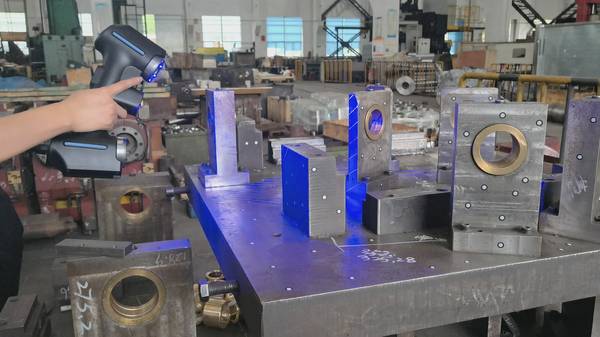
Implementing a 3D scanning car workflow for these tasks follows a streamlined, repeatable process:
- Scene Preparation: Minimal setup is required. For most automotive surfaces, applying a temporary matte spray ensures optimal laser line capture. No photogrammetry targets or complex reference frame assembly is needed.
- Data Capture: The operator uses the handheld scanner to freely move around the part—a door, engine bay, or entire quarter panel. The device, like the INSVISION AlphaScan, projects a structured blue laser line. Its dual-camera system and onboard processing capture high-density coordinated points per second, building the 3D model in real-time on the connected tablet or laptop.
- Registration & Processing: As the scan progresses, proprietary software algorithms automatically align individual scan passes into a unified, accurate model. Intelligent filtering removes ambient environmental noise common in workshop settings.
- Analysis & Delivery: The final processed scan data is imported into inspection software. Here, it is aligned to the CAD nominal for a color-mapped deviation report aligned to ASME Y14.5 standards, or processed for CAD-to-part analysis. For reverse engineering, the clean mesh is exported for use in CAD software to create a manufacturable model.
INSVISION AlphaScan for Automotive Environments
For professionals executing 3D scanning car inspections, scanner selection criteria are specific: accuracy, portability, and robustness in non-lab conditions. The INSVISION AlphaScan is engineered for this environment. Its use of blue laser technology provides better performance on shiny or dark automotive surfaces compared to standard red lasers.
The system’s stated volumetric accuracy is maintained dynamically, which is critical when scanning large parts where error accumulation can occur.
The key differentiator is its integrated intelligence. The system actively distinguishes between true surface geometry and irrelevant background noise from tooling, lights, or other shop floor elements. This results in a cleaner dataset that requires less post-processing time.
The handheld form factor and lack of external trackers mean a single technician can capture complex underbody structures or full vehicle sections that would be logistically impossible for a fixed CMM.
Measurable Workflow Improvements
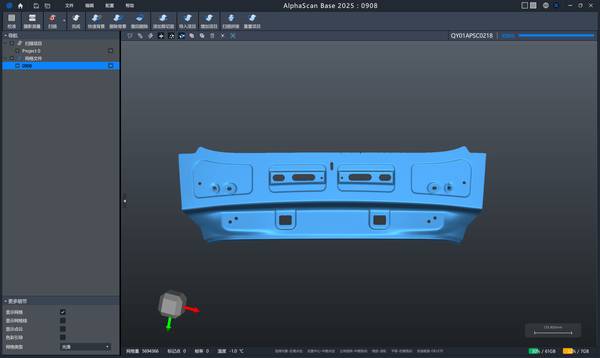
Facilities integrating this approach report a fundamental change in workflow velocity and insight quality. The most significant observable outcome is the dramatic reduction in the time from part-to-data. What was a multi-hour process of fixturing, programming, and measuring becomes a task measured in minutes.
Engineers and quality managers gain a comprehensive visual understanding of part conformity through full-field deviation maps, rather than relying on a sparse set of measurement points. This often reveals previously undetectable trends in springback or fitment. For reverse engineering and legacy part reproduction, the path from physical asset to manufacturable CAD model is significantly shortened and de-risked.
Applications Beyond Automotive Body Panels
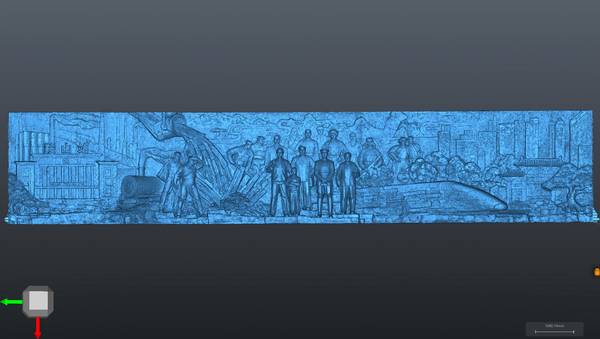
The core workflow—capturing a high-accuracy digital twin of a complex physical asset in its native environment—extends far beyond automotive body panels.
- Aerospace & Defense: Verifying composite layup tooling, inspecting large airframe components, or documenting as-built conditions for maintenance.
- Heavy Machinery & Industrial Equipment: Reverse engineering large, worn components for replacement, conducting wear analysis, or capturing plant layouts for clash detection in retrofit projects.
- Consumer Goods & Mold Making: Inspecting injection molds for wear and tear, first-article inspection of complex consumer product assemblies, and accelerating product development cycles.
Any scenario where large size, complex geometry, or location constraints make traditional measurement impractical is a candidate for this portable 3D scanning methodology.
Conclusion
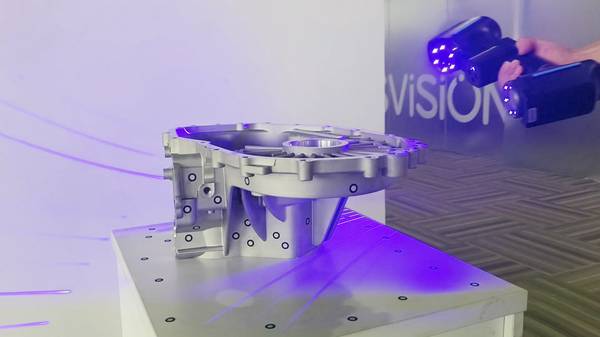
The evolution of 3D scanning car methodologies has moved it firmly into the realm of production-ready metrology. For automotive engineers and quality professionals, it solves the persistent conflict between the need for speed and the uncompromising demand for accuracy.
By enabling metrology-grade inspection and reverse engineering directly on the shop floor, tools like the INSVISION AlphaScan are not just measuring parts—they are removing bottlenecks, providing deeper insight, and accelerating the entire product lifecycle from development through to aftermarket support.
Hangzhou Insvision Technology Co., Ltd.
Address: Building 1, No. 1399 Liangmu Road, Yuhang District, Hangzhou, Zhejiang 311121, China
Copyright © Hangzhou Insvision Technology Co., Ltd. All rights reserved.
Copyright © Hangzhou Insvision Technology Co., Ltd. All rights reserved.