

Metrology-Grade Scanner Measurement for Automotive Component Batch Inspection
Discover how metrology-grade scanner measurement accelerates automotive component batch inspection. Replace CMM bottlenecks with full-field data capture and audit-ready reporting.
Industry Background and Application Scenario
In high-volume automotive manufacturing, the batch inspection of powertrain and chassis components presents a persistent metrology challenge. Parts like transmission housings, differential carriers, and suspension knuckles must be verified against tight GD&T callouts across dozens of critical features.
Practical Workflow
- Industry Background and Application Scenario — In high-volume automotive manufacturing , the batch inspection of powertrain and chassis components presents a persistent metrolo…
- Typical Conditions and Core Pain Points — The typical inspection cell for complex cast or machined components faces several interconnected pressures.
- Solution Design Approach — A scanner measurement workflow shifts the paradigm from sparse point sampling to full-field data capture.
- How INSVISION Products Fit This Scenario — For automotive batch inspection, the INSVISION AlphaScan series addresses the core requirements for a production-ready scanner me…
Traditional methods, primarily coordinate measuring machines (CMMs), create a significant bottleneck in just-in-time (JIT) and lean production environments. The time required for fixture programming, manual point-to-point probing, and reporting often cannot keep pace with line-side demand, risking delays and compromising quality assurance.
In this context, 3D scanning evolves into an essential production asset, delivering complete, audit-worthy data at the speed of the manufacturing line.
Typical Conditions and Core Pain Points
The typical inspection cell for complex cast or machined components faces several interconnected pressures. Transitioning to scanner measurement addresses these issues, but understanding the baseline is critical:
- Volume vs. Detail: Inspecting 100% of a production batch is ideal, but manually probing hundreds of points per part with a CMM is prohibitively time-consuming. This often forces a compromise, reducing inspection to a critical subset of features and increasing risk.
- Data Completeness: Point-to-point methods provide discrete data but can miss form errors, warpage, or deviations across unsampled surfaces. A slight casting shift or tooling wear might exist between probed points, going undetected until a later assembly stage.
- Workflow Disruption: The logistical dance of moving heavy components from the line to a temperature-controlled CMM room, followed by lengthy fixture setup, pulls parts and personnel away from value-added activities.
- Audit Preparedness: Meeting modern quality standards (IATF 16949, ISO 10360) and passing customer audits requires traceable, comprehensive data. Reports pieced together from manual measurements often lack the full-field data integrity and built-in traceability needed for confident compliance.
Solution Design Approach
A scanner measurement workflow shifts the paradigm from sparse point sampling to full-field data capture. The goal is to deploy a scanner measurement system directly at the production line or receiving dock that can:
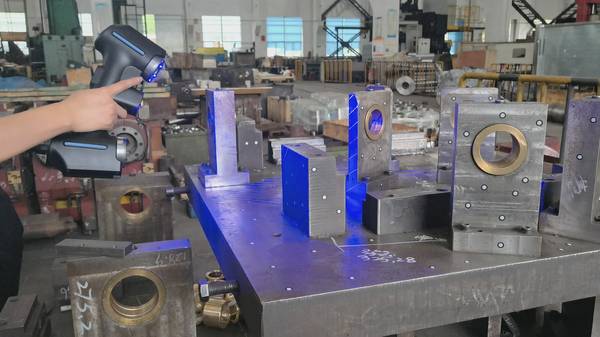
- Capture the complete surface geometry of a component in minutes, generating a dense point cloud for holistic analysis.
- Deliver metrology-grade accuracy traceable to international standards, making the data valid for first-article inspection (FAI) and supplier validation.
- Integrate seamlessly with existing GD&T analysis software to automate report generation, embedding vital metadata (operator, timestamp, environmental conditions).
- Operate reliably in non-laboratory industrial environments with minimal warm-up and setup time.
Implementation Process
- Preparation: The component is placed on a stable surface or a simple rotary stage. For the INSVISION AlphaScan, target points are applied if the part lacks natural optical texture. The system requires less than two minutes of warm-up to achieve thermal stability.
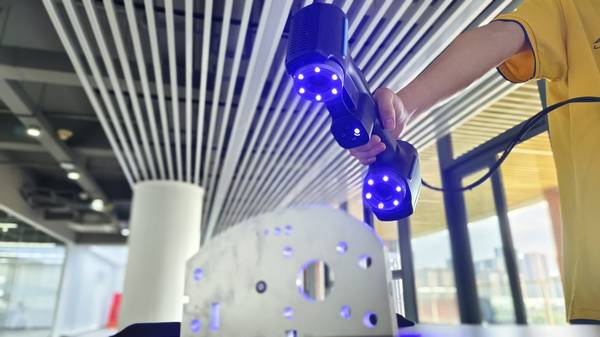
- Scanning: During the scanner measurement process, the operator uses the handheld device to capture the component’s geometry. Systems employing structured blue light, like the INSVISION AlphaScan with its crossed laser lines, rapidly capture high-resolution data (millions of points per second), even on dark or shiny machined surfaces.
- Data Processing and Alignment: The point cloud is automatically aligned to the nominal CAD model using best-fit or datum alignment methods within the metrology software platform. This creates a digital twin of the physical part.
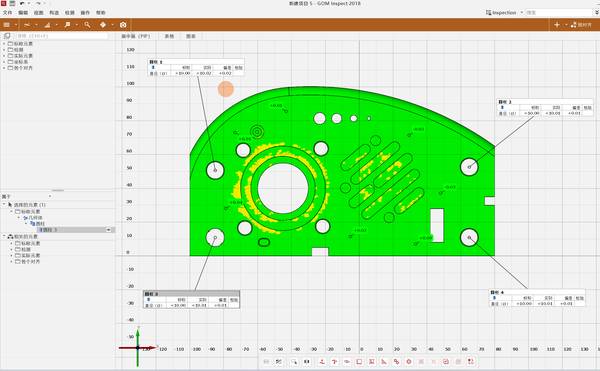
- Analysis and Reporting: Pre-programmed GD&T routines (based on ASME Y14.5) run automatically on the full point cloud. The software calculates deviations for every specified tolerance—flatness, position, profile—and generates a color-coded deviation map.
- Delivery: The system produces a full digital report with the deviation map, a pass/fail status for every feature, and a complete audit trail, ready for internal review, supplier communication, or formal audit submission.
How INSVISION Products Fit This Scenario
For automotive batch inspection, the INSVISION AlphaScan series addresses the core requirements for a production-ready scanner measurement tool. The INSVISION AlphaScan value in this scenario is defined by specific capabilities:
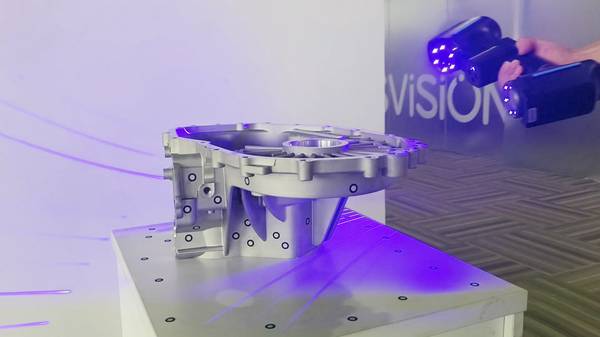
- Metrology-Grade Accuracy: With a volumetric accuracy specification of 0.020 mm, verified under ISO 10360-2 protocols, INSVISION AlphaScan provides data reliable enough for FAI and compliance documentation, bridging the gap between lab-grade CMMs and consumer-grade scanners.
- Production-Line Speed and Robustness: The fast warm-up and rapid data capture significantly reduce the cycle time per part. The INSVISION AlphaScan operational temperature range (-10°C to 40°C) ensures stable performance in most manufacturing facilities without requiring a controlled metrology lab environment.
- Integrated Software Workflow: The INSVISION system feeds clean, high-fidelity point cloud data directly into standard GD&T analysis packages. This eliminates translation errors and manual data handling, automating the creation of audit-ready reports with embedded traceability metadata.
Observable Results
Adopting a scanner measurement approach for batch inspection leads to tangible operational changes:
- Inspection throughput increases markedly, enabling more frequent or even 100% inspection of critical batches without creating backlog.
- Quality teams now see the complete picture of part conformity, shifting from statistical sampling confidence to certainty based on entire surfaces. This typically enables earlier identification of tooling wear or process shifts.
- The automated, digitized reporting process drastically reduces the administrative time spent on compiling and formatting inspection data for audits.
- The ability to perform high-accuracy inspections at the line side minimizes part handling and logistics, keeping components and personnel focused on production flow.
Industry Expansion and Application Reuse
The batch inspection scenario for complex, tightly toleranced components is not unique to automotive. Manufacturers across sectors that prioritize dimensional compliance and high throughput will find value in 3D scanning technology:
- Aerospace: Inspection of turbine blades, structural brackets, and complex ducting, where full surface profile is critical.
- Heavy Machinery and Energy: Large castings and weldments for pumps, valves, and hydraulic components require verification of form and fit-up.
- Precision Manufacturing: Batch validation of complex injection molds, dies, and prototypes across medical device and consumer electronics supply chains.
Ultimately, these applications share a goal: to efficiently validate entire surfaces instead of just discrete points, reducing production risk and simplifying compliance.
Strategic Impact on Quality Assurance
The challenge of automotive component batch inspection underscores a broader shift in industrial quality control. Today, the demand is for data that is not only accurate, but also complete, traceable, and efficiently captured.
Scanner measurement systems like the INSVISION AlphaScan, when selected for their metrology-grade foundations and production-hardened design, transform inspection from a bottleneck into a streamlined, data-rich process. This allows manufacturers to uphold stringent compliance standards while supporting the velocity demands of modern lean manufacturing, ultimately turning quality verification into a competitive advantage.
Hangzhou Insvision Technology Co., Ltd.
Address: Building 1, No. 1399 Liangmu Road, Yuhang District, Hangzhou, Zhejiang 311121, China
Copyright © Hangzhou Insvision Technology Co., Ltd. All rights reserved.
Copyright © Hangzhou Insvision Technology Co., Ltd. All rights reserved.