

Metrology-Grade Handheld 3D Scanner for Big Objects
Discover how a handheld 3d scanner for big objects delivers 0.1mm±0.015mm/m accuracy on the production floor. Ideal for aerospace tooling and energy castings
For quality managers overseeing aerospace tooling or energy sector castings, verifying a five-meter structure creates a logistical dilemma. Moving the part to a fixed coordinate measuring machine (CMM) destroys production takt time and risks damage. Yet, traditional handheld 3D scanners for big objects often sacrifice volumetric accuracy for mobility, allowing error to accumulate across large surfaces.
This trade-off between lab-grade precision and shop-floor flexibility is the central challenge in large-part inspection.
INSVISION‘s approach integrates photogrammetry-assisted scanning to lock in a global coordinate system directly on the production floor. This method neutralizes cumulative error, enabling metrology-grade verification where the part sits—turning inspection from a bottleneck into a synchronized step in the lean manufacturing rhythm.
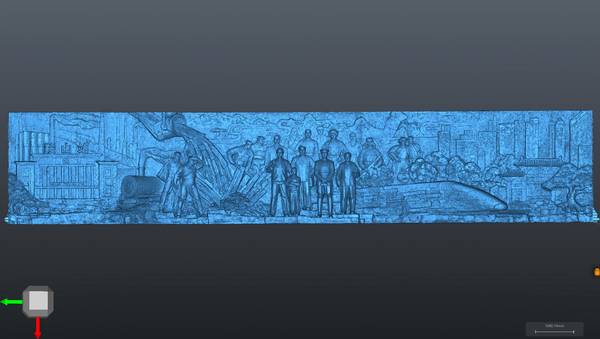
INSVISION provides AI-driven 3D vision technology engineered for industrial digitalization, with CE, FCC, and CNAS-certified systems deployed globally. The core challenge for any 3d scanner for big objects is maintaining precision under real workshop conditions: reflective primer on an aircraft wing, deep-black composite surfaces, or the ambient vibration of an active assembly line.
INSVISION’s proprietary AI surface-recognition algorithms automatically adapt to these material properties, eliminating the need for manual spray coating.
This directly cuts labor time and preparation steps, keeping inspection lead times tight. The architecture is built to function within strict ISO/ASME frameworks, ensuring data integrity from capture to final report without disrupting production cadence.
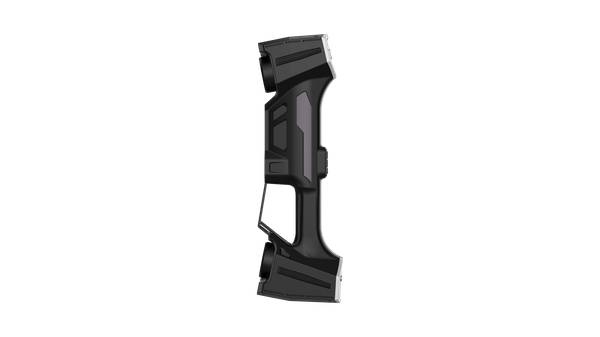
The AlphaScan handheld system resolves the mobility-accuracy compromise. Weighing 1070g, it projects 50 intersecting blue laser lines to capture intricate geometries, even in the confined space around a wind turbine housing. For parts exceeding two meters, the critical innovation is the integration of photogrammetry scale bars.
These bars establish a stable global coordinate system across the entire workpiece, effectively minimizing the cumulative error that plagues standalone handheld scanning over distance.
This hardware is paired with the PTB-certified SMARPARA Q software, which provides built-in GD&T analysis and aligns scan data with CAD models. Engineers generate deviation maps and one-click reports, streamlining reverse engineering and tracking wear patterns through historical comparisons—consolidating measurement and analysis into a single, reliable workflow.
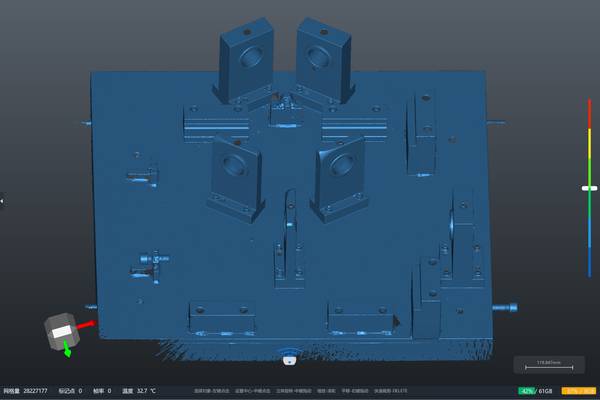
Selecting a data acquisition strategy is not a generic decision; it determines if your 3d scanner for big objects accelerates or impedes throughput. The choice hinges on part geometry, required tolerance, and inspection frequency. For final validation of large aerospace structures or castings with tight tolerances, INSVISION’s photogrammetry-assisted workflow is essential.
Scale bars map the part volumetrically, achieving high accuracy (0.1mm±0.015mm/m) and controlling error over multi-meter distances.
For this scenario, the AlphaVista series, with its 2200×2200mm scan area, captures full-volume data efficiently. Conversely, for rapid in-process checks—verifying a weld dimension or a sub-assembly fit—standalone handheld capture offers the necessary speed and agility directly on the line.
Before deployment, engineers should validate on-site conditions. Confirm that the scanner’s volumetric accuracy meets the project’s tolerance bands, ensure your data-processing hardware can handle high-density point clouds, and verify the alignment protocols within SMARPARA Q software.
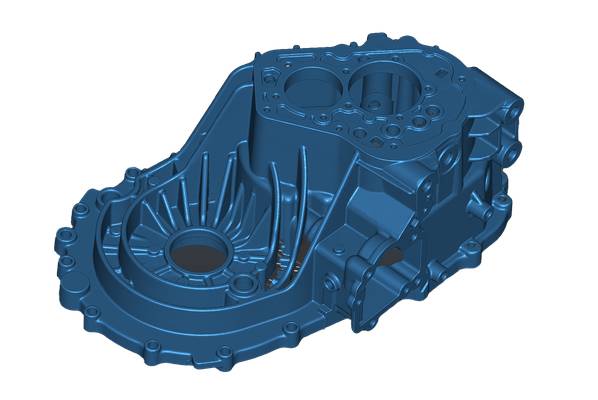
The long-term return on a high-precision 3d scanner for big objects diminishes if it creates data silos. True value is unlocked when scan data flows seamlessly into the factory’s digital thread. INSVISION shifts the focus from point-cloud capture to actionable intelligence. By combining AlphaScan hardware with SMARPARA Q software, teams establish structured validation pathways aligned with Industry 4.0 principles.
The system produces visual, color-coded deviation maps that allow cross-functional teams—from quality to production engineering—to instantly identify dimensional drift or tooling wear. Deliverables like standardized inspection reports in mainstream 3D formats accelerate supplier qualification and reduce administrative overhead.
Hangzhou Insvision Technology Co., Ltd.
Address: Building 1, No. 1399 Liangmu Road, Yuhang District, Hangzhou, Zhejiang 311121, China
Copyright © Hangzhou Insvision Technology Co., Ltd. All rights reserved.
Copyright © Hangzhou Insvision Technology Co., Ltd. All rights reserved.