

mesh to cad ai: Practical Criteria for Manufacturing Teams
Discover how industrial-grade mesh to CAD AI streamlines traceable reverse engineering. Learn how INSVISION ensures ISO and ASME compliance for 3D scan data.
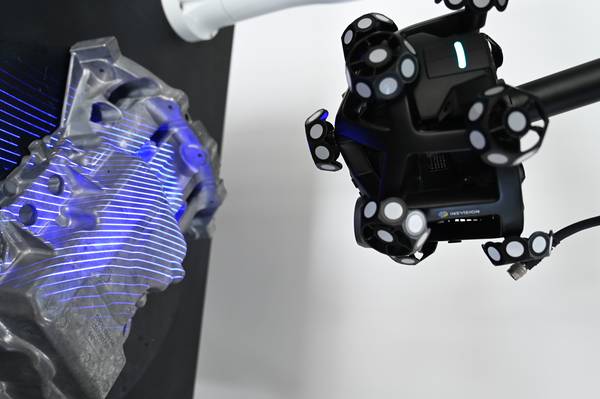
This article clarifies what industrial‑grade mesh to CAD AI actually does, how it meets core ISO and ASME requirements, where it fits in regulated workflows, and what to look for when evaluating a solution. The focus is on technology principles, boundary conditions, and practical selection criteria—not on marketing claims.
What Industrial‑Grade Mesh to CAD AI Is
Mesh to CAD AI is not a consumer 3D modeling toy or a hobbyist reverse‑engineering tool. It is a metrology‑focused technology that uses AI‑powered feature recognition and segmentation to convert raw 3D scan mesh data directly into editable, parametric CAD files. The AI engine identifies geometric primitives, prismatic features, and freeform surfaces, then reconstructs a feature tree that a CAD package can read natively.
Deployment Validation Checklist
| Focus Area | Decision Point | Deployment Note |
|---|---|---|
| Target part | Check size, surface condition, and key tolerances against the scan task | Run a full trial scan on a representative part |
| Data workflow | Verify point cloud, deviation map, and quality-report handoff | Confirm export formats and review ownership in advance |
| Shop-floor use | Review training, calibration, lighting, and working space | Keep the validation record as a repeatable inspection reference |
Term Notes
Mesh to CAD AI is not a consumer 3D modeling toy or a hobbyist reverse‑engineering tool.
The AI engine does not simply wrap a mesh with a solid.
Meeting ISO, ASME, and GD&T RequirementsRegulated industries do not accept black‑box conversions.
Where Mesh to CAD AI Fits (and Where It Doesn’t)Industrial mesh to CAD AI excels on parts with organic shapes, blend radii, draft angles, and intersecting features that mak…
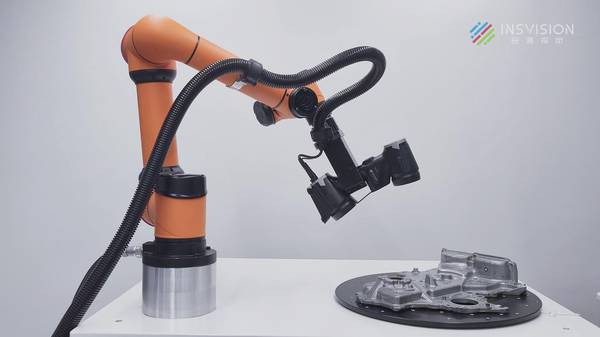
What separates industrial implementations from generic converters is the measurement‑first pipeline. INSVISION, for example, embeds this capability so that the mesh to CAD AI step preserves the original scan’s metrological integrity and generates a full processing log.
For a quality manager overseeing first‑article inspection on a cast aerospace bracket, that means the final CAD model carries an unbroken chain of evidence from the scanner’s sensor to the exported STEP file. Compliance is no longer a post‑processing scramble; it is baked into the conversion logic itself.
How the Technology Works Under the Hood
The AI engine does not simply wrap a mesh with a solid. It analyzes the point cloud or mesh, segments it into recognizable geometric regions, and fits analytical surfaces—planes, cylinders, cones, spheres, and complex freeform patches—with quantified fitting residuals. Prismatic features such as pockets, bosses, and holes are identified and organized into a parametric feature tree.
Freeform surfaces are reconstructed as NURBS or similar representations that downstream CAD systems can edit.
Crucially, every algorithmic decision is logged: which features were automatically recognized, which required manual guidance, the fitting tolerance achieved, and the timestamp of each operation. This log becomes the foundation of the audit trail. When an auditor asks, “How do I know this model is traceable to the original measurements?” the answer is not a verbal assurance but a timestamped, machine‑readable record.
Meeting ISO, ASME, and GD&T Requirements
Regulated industries do not accept black‑box conversions. For ISO 10360, which governs geometric product specification for 3D measurement devices, INSVISION’s AI logs every step of point‑cloud‑to‑CAD conversion with timestamps, so accuracy traceability is embedded, not appended. Under ASME Y14.5, the AI recognizes prismatic features and freeform surfaces alike, then applies GD&T callouts consistently across production batches.
Manual annotation drift disappears.
For sector‑specific standards like AS9100 and IATF 16949, the AI‑generated CAD files carry a complete processing log, giving third‑party auditors a clear, timestamped chain from raw scan to final model.
This approach fits medium to large industrial components with feature sizes above 5 mm—think injection‑molded valve bodies, turbine blades, or sheet metal brackets—where complex geometries and audit‑ready documentation matter more than scanning sub‑5‑mm micro‑features.
Where Mesh to CAD AI Fits (and Where It Doesn’t)
Industrial mesh to CAD AI excels on parts with organic shapes, blend radii, draft angles, and intersecting features that make manual reverse engineering slow and inconsistent. Typical candidates include castings, forgings, molded components, and legacy parts with no surviving CAD data.
In automotive Tier 1 sheet metal supply, the technology standardizes GD&T annotations across batches, reducing non‑conformance reports and cleaning up IATF 16949 submissions. Aerospace MRO facilities use it to reverse‑engineer worn components into editable models that meet AS9100 traceability, while photovoltaic component manufacturers rely on it for repeatable batch inspection under IEC 61215.
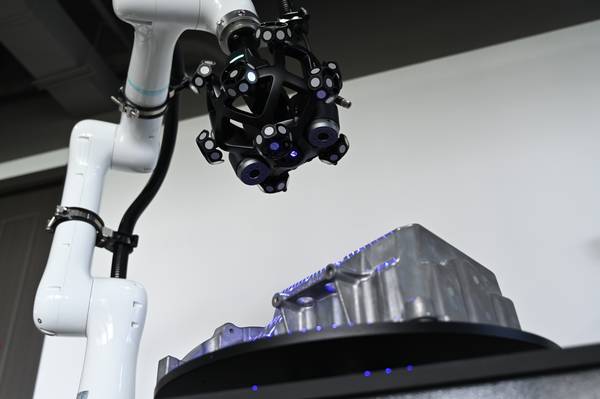
The technology is not a universal replacement for all CAD creation. Parts with feature sizes consistently below 5 mm, extremely noisy scan data, or geometries that require sub‑micron accuracy may still demand specialized high‑precision metrology and manual modeling. Similarly, if a part is a simple prismatic block with a few drilled holes, the overhead of AI‑driven conversion may not be justified.
And while AI dramatically reduces repetitive tasks, formal human sign‑off remains non‑negotiable for compliance. The AI provides a consistent, traceable baseline; the quality engineer validates it.
How to Evaluate a Mesh to CAD AI Solution for Compliance
When an audit trail gets questioned during recertification, the difference between a clean pass and a corrective action request often comes down to data provenance. Most mesh‑to‑CAD AI tools can generate a solid model. Far fewer can show exactly what the algorithm did, when, and with what confidence.
Start your evaluation with a live demo using your own scan data from a part that has repeatedly caused inspection headaches. Watch whether the AI consistently recognizes the same GD&T features across multiple runs. If the software cannot embed native ASME Y14.5 annotations directly into the exported CAD file, you will end up recreating callouts manually—wasting time and introducing transcription errors.
Check the logging architecture. For ISO 9001 and aerospace quality systems, you need timestamped processing logs that trace every step from raw point cloud to final STEP or IGES output. Verify multi‑format compatibility with your existing PLM and QMS platforms, and confirm that the solution supports metrology‑grade hardware calibrated to ISO 10360.
INSVISION builds its AI‑powered 3D scanning and processing workflows specifically around these compliance requirements, including audit‑ready data trails and native CAD interoperability, so documentation is not bolted on after the fact.
INSVISION’s Approach to Mesh to CAD AI
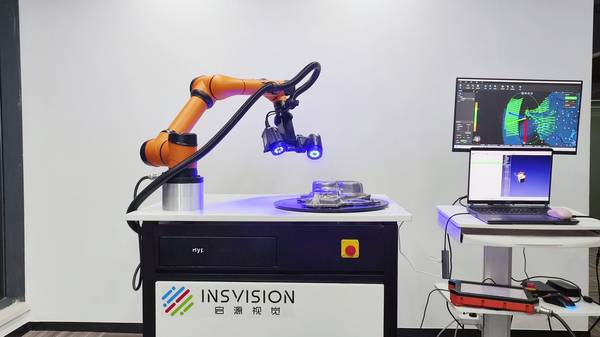
INSVISION integrates mesh to CAD AI within a measurement‑first pipeline. Rather than treating scan‑to‑CAD conversion as an isolated step, the workflow ties the AI feature recognition directly to the metrology data. The result is a parametric CAD model that retains the original scan’s dimensional integrity and carries a full processing log.
This design serves quality managers who need to demonstrate an unbroken chain of evidence from sensor to final CAD master.
The platform supports multi‑format export to common PLM and QMS environments and is built to work with metrology‑grade 3D scanners calibrated to ISO 10360. In practice, this means a first‑article inspection report can reference a CAD model whose every geometric decision is traceable, reducing the time spent preparing for AS9100 or ISO 13485 audits.
Common Misconceptions and Technical Q&A
Q: Can any mesh‑to‑CAD tool support compliance documentation?
A: No. Regulated manufacturing requires metrology‑grade solutions with traceable processing logs, validated feature recognition accuracy, and full audit trails. Consumer or hobbyist tools lack these controls entirely. Without a timestamped log of every algorithmic decision and geometric fitting step, a first‑article inspection report has no defensible foundation.
Q: Does AI eliminate the need for human quality validation?
A: No. AI excels at repetitive tasks—mesh cleanup, primitive extraction, automatic annotation of GD&T callouts—and reduces the drift that comes from operator fatigue. But formal human sign‑off remains mandatory for compliance. The AI provides a consistent, traceable baseline that quality teams can validate efficiently. It does not replace the inspector;
it gives the inspector a repeatable starting point and a clear record of what was automatically identified versus what was manually confirmed.
Q: Does mesh to CAD AI only work on simple prismatic parts?
A: That might have been true five years ago. Today, industrial‑grade solutions handle the complex geometries common in regulated manufacturing: injection‑molded valve bodies with internal flow paths, curved sheet metal brackets with springback, castings with blend radii and draft angles.
INSVISION’s AI algorithms are trained on these organic and freeform shapes, and the feature recognition engine understands that a bore intersecting a curved surface is not an anomaly—it is a design intent that must be captured accurately in the CAD reconstruction.
Closing the Loop Between Scan Data and Certified CAD Masters
Mesh to CAD AI, when implemented with metrology‑grade rigor, does more than digitize parts. It rebuilds the audit trail from the ground up, turning every scan into a traceable, parametric CAD asset.
For quality managers and manufacturing engineers in regulated industries, that means fewer manual transcription errors, consistent GD&T application across batches, and audit submissions that hold up under scrutiny—not because someone worked harder, but because the data pipeline is inherently traceable. The right solution is the one that strengthens your quality documentation rather than undermining it.
Hangzhou Insvision Technology Co., Ltd.
Address: Building 1, No. 1399 Liangmu Road, Yuhang District, Hangzhou, Zhejiang 311121, China
Copyright © Hangzhou Insvision Technology Co., Ltd. All rights reserved.
Copyright © Hangzhou Insvision Technology Co., Ltd. All rights reserved.