

How Laser Scanner Technology Is Transforming Industrial Quality Control
Industrial manufacturing has long relied on manual measurement techniques that are time-consuming and prone to human error. The emergence of laser scanner techn
Laser scanning belongs to a broader category known
Laser scanning belongs to a broader category known as structured light or triangulation-based 3D capture systems. The core principle involves projecting a laser line or pattern onto an object’s surface while one or more cameras record the deformation of that pattern from different angles.
Because the geometry of the projection and imaging systems is precisely calibrated, software can calculate the three-dimensional coordinates of each point where the laser intersects the surface. This process repeats across the entire field of view, building a point cloud that describes the object’s shape with remarkable fidelity.
Selection Dimensions and Field Checks
| Focus Area | Decision Point | Deployment Note |
|---|---|---|
| Laser scanning belongs to a broader category known | Laser scanning belongs to a broader category known as structured light or triangulation-based 3D capture systems. | The core principle involves projecting a laser line or pattern onto an object’s surface while one or more cameras record the deformation of that… |
| Understanding the technical specifications that disting… | Understanding the technical specifications that distinguish industrial-grade instruments from consumer alternatives helps procurement teams and engin… | Resolution refers to the smallest feature a scanner can reliably detect, while accuracy describes how closely the measured dimensions match true… |
| The selection of laser wavelength influences both penet… | The selection of laser wavelength influences both penetration capability and material compatibility. | Blue laser technology has gained preference in precision metrology applications because it offers better reflectivity characteristics on certain… |
| The INSVISION AlphaScan integrates these capabilities w… | The INSVISION AlphaScan integrates these capabilities within a handheld form factor weighing approximately 1070 grams, allowing operators to scan lar… | Software workflows guide users through alignment, registration, and reporting steps, producing documentation that satisfies quality system requi… |
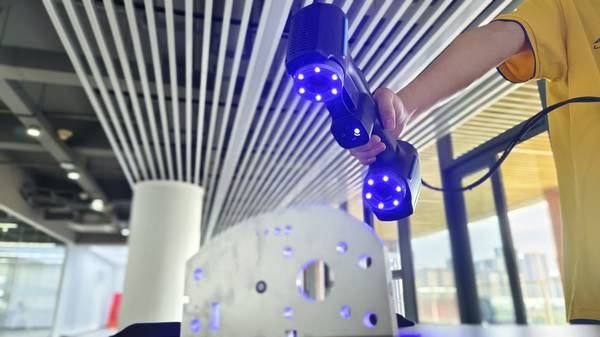
Handheld laser scanners like the INSVISION AlphaScan represent a significant evolution in this technology. By eliminating the need for bulky tripods or motorized translation stages, manufacturers have made high-precision 3D capture accessible for field inspection, assembly line integration, and workshop environments.
The transition from stationary laboratory equipment to portable instruments has expanded the scope of applications considerably, allowing quality teams to verify dimensions directly where parts are manufactured or assembled rather than requiring samples to be transported to dedicated metrology rooms.
Understanding the technical specifications that distinguish industrial grade
Understanding the technical specifications that distinguish industrial-grade instruments from consumer alternatives helps procurement teams and engineers make informed decisions. Resolution refers to the smallest feature a scanner can reliably detect, while accuracy describes how closely the measured dimensions match true values.
The INSVISION AlphaScan delivers metrology-grade performance with 0.020mm stable accuracy, placing it in a class suitable for aerospace components, automotive assembly, and precision machinery where tolerances fall within hundredths of a millimeter. Scanning speed, measured in measurements per second, determines how quickly large parts can be captured before thermal drift or environmental vibration compromises data quality.
The AlphaScan achieves scan rates reaching 7,100,000 measurements per second in certain configurations, enabling full vehicle frames to be digitized within approximately ten minutes.
Temperature stability represents another practical consideration for shop-floor deployment. Many industrial environments experience significant thermal variations between morning and afternoon shifts, or between heated production areas and outdoor staging zones.
Equipment rated for operation across a -10℃ to 40℃ range accommodates these real-world conditions without requiring climate-controlled staging areas or causing measurement drift during scanning sessions.
The selection of laser wavelength influences both penetration
The selection of laser wavelength influences both penetration capability and material compatibility. Blue laser technology has gained preference in precision metrology applications because it offers better reflectivity characteristics on certain surface finishes common in machined components and castings.
The AlphaScan employs 50 cross-pattern blue laser lines to maximize detail capture across complex geometries including deep cavities, bore holes, and transitional surfaces that challenge single-line systems.
When evaluating whether laser scanning technology fits a particular workflow, teams should consider the nature of the parts being inspected, the required measurement frequency, and the downstream use of the captured data. High-volume production scenarios benefit from rapid capture rates and automated alignment algorithms, while low-volume custom fabrication may prioritize flexibility and ease of use.
Reverse engineering workflows require point cloud processing capabilities that export clean geometry suitable for CAD modeling, while inspection workflows demand integrated comparison tools that highlight deviations from nominal dimensions and generate tolerance-compliant reports.
The INSVISION AlphaScan integrates these capabilities within a
The INSVISION AlphaScan integrates these capabilities within a handheld form factor weighing approximately 1070 grams, allowing operators to scan large components without fatigue while maintaining the positional stability necessary for accurate data acquisition.
Software workflows guide users through alignment, registration, and reporting steps, producing documentation that satisfies quality system requirements without extensive training or specialized metrology expertise.
For organizations transitioning from manual inspection methods adopting
For organizations transitioning from manual inspection methods, adopting laser scanning technology requires investment in equipment calibration protocols, operator training, and integration with existing quality management systems.
However, the operational benefits often justify these initial costs through reduced inspection cycle times, improved measurement repeatability, and the ability to capture complete surface geometry rather than sampling discrete points along a part’s profile.
Hangzhou Insvision Technology Co., Ltd.
Address: Building 1, No. 1399 Liangmu Road, Yuhang District, Hangzhou, Zhejiang 311121, China
Copyright © Hangzhou Insvision Technology Co., Ltd. All rights reserved.
Copyright © Hangzhou Insvision Technology Co., Ltd. All rights reserved.