

Deploying a 3D Scanner for Big Objects in Heavy Industry
See how a 3d scanner for big objects supports shop-floor inspection of large automotive, aerospace, and wind energy parts with INSVISION AlphaScan workflows.
Industry Context and Application Scope
Large-part inspection has become a practical bottleneck for manufacturers pursuing lean production, digital quality control, and Industry 4.0 traceability. Automotive body structures, aircraft sections, heavy fabrications, and wind turbine blade components often cannot be moved easily into a controlled metrology room.
For these teams, a 3d scanner for big objects offers a way to capture full-field dimensional data directly where the part is built, repaired, or assembled.
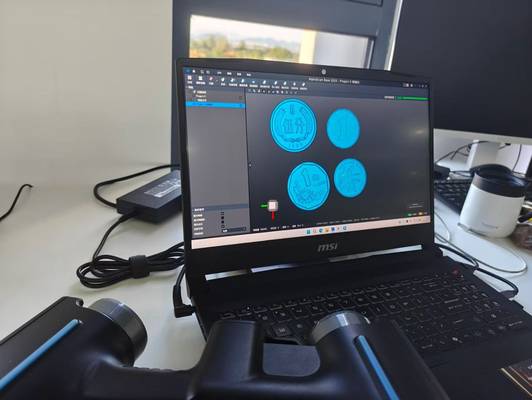
Traditional tools remain valuable, but large objects expose their workflow limits. A stationary CMM may not cover the full volume. A laser tracker can require careful line-of-sight planning. Manual gauges and templates may miss subtle surface deformation. The practical question is no longer whether 3D scanning is useful, but how a portable scanning workflow can deliver reliable data under real production conditions.
INSVISION’s AlphaScan handheld 3D scanner is positioned for these large-volume scenarios. The application focus is straightforward: keep the part in place, capture accurate surface data on site, and deliver inspection outputs that quality, engineering, and production teams can act on without waiting for a lab-based measurement cycle.
Typical Operating Conditions and Core Pain Points
A 3d scanner for big objects is usually evaluated when the measured part is too large, too heavy, too delicate, or too time-sensitive to move through a conventional inspection route. The pain points vary by industry, but the operational pattern is similar.
| Industrial scenario | Typical measurement challenge | Workflow impact |
|---|---|---|
| Automotive body-in-white and tooling | Full-surface checks across underbodies, side frames, fixtures, and welded assemblies | Offline measurement can delay tooling correction and fit-up validation |
| Aerospace MRO and legacy reverse engineering | In-situ inspection of fuselage panels, wing sections, nacelles, and structural repairs | Disassembly or transfer to a metrology bay increases downtime |
| Wind turbine blade manufacturing and service | Large curved surfaces, long scan paths, and strict profile consistency requirements | Manual templates and fragmented inspection setups can limit data completeness |
| Heavy equipment, rail, and shipbuilding | Oversized castings, fabrications, hull plates, and car bodies | Conventional measurement may require multiple setups and complex access planning |
In automotive production, quality engineers often need rapid deviation maps against CAD to confirm fixture condition, welded structure alignment, or panel fit. A traditional inspection plan may capture discrete points, while the actual issue is a distributed surface deviation.
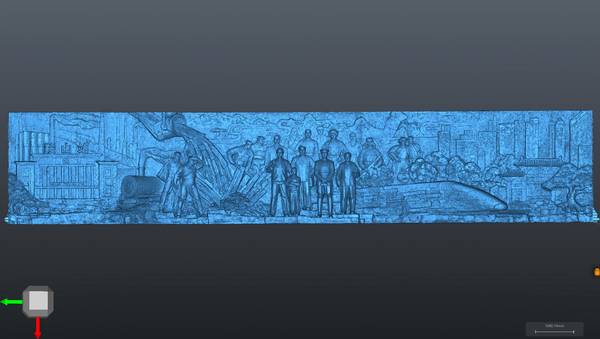
In aerospace MRO, the inspection environment is rarely ideal. Work may occur around scaffolding, jacks, access platforms, and curved surfaces. A 3d scanner for big objects must support damage mapping, repair verification, and reverse engineering without forcing the aircraft section into a dedicated measurement cell.
In wind energy, the scale of blades and molds makes cumulative alignment error a major concern. The inspection task is not only to capture geometry, but to maintain confidence across long curved surfaces from root to tip.
Solution Design for Large-Volume Inspection
A practical large-part scanning solution should be designed around the worksite, not the laboratory. For INSVISION AlphaScan, the workflow centers on portability, broad surface capture, stable alignment, and compatibility with downstream engineering systems.
The scanner is used close to the part, allowing operators to follow the geometry rather than reposition the object. This matters when the surface includes flanges, ribs, pockets, curved shells, repair zones, or welded transitions. Instead of measuring only selected points, the scan captures dense surface data that can be converted into meshes, CAD comparison reports, reverse engineering references, or repair planning inputs.
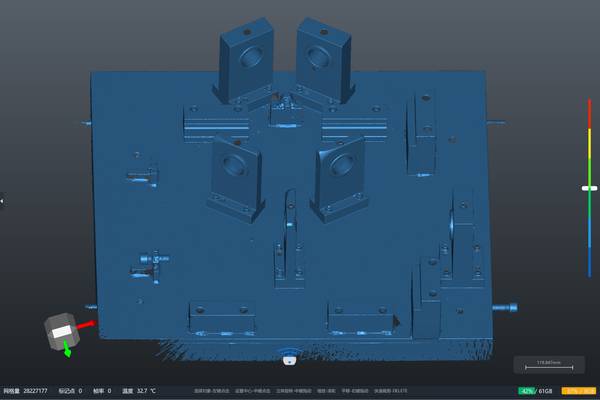
For a 3d scanner for big objects, alignment strategy is critical. Large scans can suffer from drift if the workflow depends on many disconnected measurement segments. AlphaScan is designed to support continuous scanning and real-time visualization, helping operators confirm coverage while the inspection is still in progress.
Where the surface or application requires additional global reference, targets can be used as part of the measurement plan.
The design objective is not to replace every metrology device in the plant. It is to create a faster, more flexible inspection route for large parts where access, time, and full-field data matter.
Deployment Process from Preparation to Report
A successful 3d scanner for big objects deployment depends as much on process discipline as on hardware capability. The following workflow reflects how large-part scanning is typically introduced into automotive, aerospace, wind energy, and heavy industrial environments.
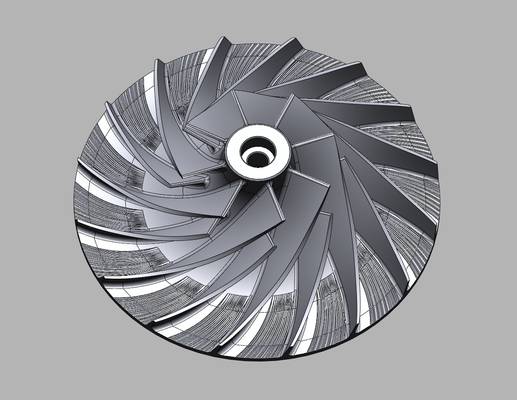
1. Preparation
The part remains in its production, service, or assembly location. The operator checks surface condition, access routes, lighting, and measurement objectives. For shop-floor use, the team may identify key datum features, CAD alignment strategy, and inspection zones before scanning begins.
AlphaScan’s blue laser technology is suitable for a wide range of industrial lighting conditions. If the part has direct glare, reflective patches, or strong sunlight exposure, simple shielding or surface preparation may be used according to the inspection plan.
Preparation should also define the required output: CAD deviation map, mesh file, GD&T report, reverse engineering model, wear comparison, or repair reference. This prevents unnecessary scanning and keeps the workflow aligned with the decision that must be made.
2. Scanning
The operator moves the handheld scanner across the surface at a controlled pace while monitoring real-time scan feedback on the connected workstation or tablet. Areas with complex curvature, edges, holes, ribs, and transitions can be revisited immediately if data density is insufficient.
Hangzhou Insvision Technology Co., Ltd.
Address: Building 1, No. 1399 Liangmu Road, Yuhang District, Hangzhou, Zhejiang 311121, China
Copyright © Hangzhou Insvision Technology Co., Ltd. All rights reserved.
Copyright © Hangzhou Insvision Technology Co., Ltd. All rights reserved.