

Decoding 3D Scanner Specifications for Industrial Metrology Workflows
Learn how 3d scanner specifications translate into shop-floor metrology performance, from volumetric error to validation, workflow fit, and audits.
Decoding 3D Scanner Specifications for Industrial Metrology Workflows
The worst purchase decision in industrial metrology often starts with the most impressive datasheet. A procurement team sees “0.025 mm accuracy,” approves the purchase, and later discovers that the figure was achieved on a vibration-isolated table with a calibrated artifact and a trained operator.
The shop floor, with temperature swings, part variability, surface reflectivity, and changing inspection staff, creates a different measurement problem. This is why 3D scanner specifications need to be read as controlled test results, not as unconditional promises.
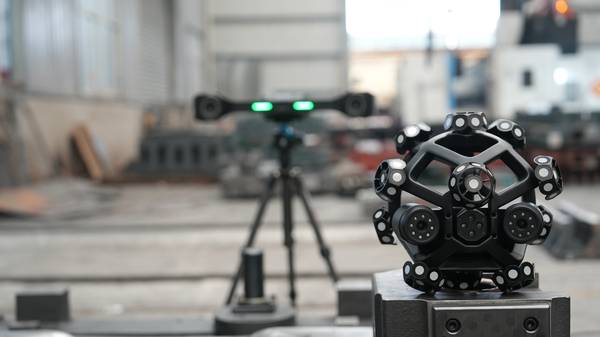
Key Points at a Glance
- The worst purchase decision in industrial metrology often starts with the most impressive datasheet.
- A 3D scanner specification sheet is not a complete performance guarantee.
- 3D scanner specifications are easier to evaluate when the physics behind them is clear.
- Every published accuracy figure has boundary conditions.
In Western manufacturing, the gap between published 3D scanner specifications and actual production performance is where budgets, audit readiness, and throughput can suffer. An aerospace MRO team inspecting turbine blades needs a different validation approach from an automotive supplier checking stamped panels.
Both may chase the same accuracy figure on paper, but ISO 17025 calibration expectations, ASME Y14.5 GD&T requirements, and traceable measurement uncertainty will decide whether the scanner fits the workflow.
This guide explains what 3D scanner specifications mean once a system leaves the metrology lab and enters production. It covers working principles, boundary conditions, related inspection technologies, suitable and unsuitable applications, and practical evaluation steps for engineers, quality managers, and technical procurement teams.
What 3D Scanner Specifications Mean
A 3D scanner specification sheet is not a complete performance guarantee. It is a structured set of results gathered under defined test conditions. To interpret 3D scanner specifications correctly, engineers need to understand how optical measurement works and where error enters the process.
Most industrial 3D scanners use structured light, laser lines, or a combination of optical projection and camera capture. The scanner projects light onto a surface, cameras observe the reflected pattern, and triangulation converts the observed deformation into XYZ coordinates. The result is a point cloud that represents the scanned geometry.
Every number in 3D scanner specifications depends on how well that optical chain handles real-world variables. Surface finish, ambient light, scanner-to-part distance, part motion, thermal drift, calibration status, and software alignment all affect the final measurement result.
The most common specification is accuracy, but accuracy alone is often too broad for metrology decision-making. For 3D scanners, engineers should separate several related concepts:
| Parameter | What It Describes | Why It Matters |
|---|---|---|
| Single-point accuracy | Deviation of an individual measured point from a known reference | Useful for understanding local measurement behavior, but limited for large parts |
| Volumetric accuracy | Measurement error across the full working volume | More relevant for large parts, tooling, panels, and assemblies |
| Repeatability | Variation when the same feature is measured repeatedly | Important for process control and operator confidence |
| Resolution | Ability to distinguish small geometric details | Relevant for fine features, edge quality, and surface characterization |
| Point spacing | Distance between adjacent measured points | Affects data density and feature representation |
| Scan speed | Data capture rate, often expressed as frames per second or points per second | Impacts cycle time and inspection throughput |
| Field of view | Area captured in one scan position | Affects productivity, resolution trade-offs, and part coverage |
A scanner may show excellent single-point accuracy on a small artifact but accumulate error over a larger volume. For automotive panels, composite tooling, castings, and aerospace structures, volumetric accuracy usually matters more than an isolated point figure.
Core Working Principles Behind the Numbers
3D scanner specifications are easier to evaluate when the physics behind them is clear. Optical scanners rely on line-of-sight measurement. If the camera cannot see a surface, the scanner cannot measure it directly. Deep pockets, undercuts, sharp internal corners, thin edges, and multi-reflective surfaces can all create incomplete or noisy data.
Structured light systems capture an area in a single frame or sequence of frames. They can be efficient for cooperative surfaces and freeform geometry because they collect dense surface data quickly. Laser line systems scan along projected lines and can perform well on challenging materials when the optical setup and exposure control are appropriate.
The scan data is then processed into a point cloud, mesh, or inspection report. Software alignment also affects results. Common approaches include datum-based alignment, best-fit alignment, target-based tracking, and feature-based registration. A strong scanner can still produce questionable inspection results if the alignment method does not match the drawing requirement.
For this reason, 3D scanner specifications should be connected to the whole workflow: scanner hardware, calibration method, tracking approach, surface preparation, software processing, operator technique, and reporting format.
Boundary Conditions That Change Real Performance
Every published accuracy figure has boundary conditions. Ignoring those conditions is one of the most common causes of failed scanner deployments.
Surface finish and reflectivity are major variables. Optical scanners generally perform most predictably on diffuse, matte surfaces. Polished steel, machined aluminum, black plastics, transparent materials, and wet or oily parts can reduce signal quality. If 3D scanner specifications were measured on matte ceramic artifacts, they may not directly represent performance on production castings or shiny machined components.
Ambient light and vibration also matter. Shop-floor lighting, sunlight from open bay doors, welding arcs, nearby presses, and machine vibration can introduce measurement noise. A lab specification measured under stable lighting and low vibration may not carry over to a near-line cell without environmental control.
Temperature stability affects both the scanner and the part. Many metrology specifications assume a controlled environment close to 20 °C. On a production floor, temperature changes across a shift can cause thermal expansion in parts, fixtures, and scanner components. Compensation can help, but only when the environment is understood and monitored.
Operator influence is especially important for handheld scanning. Scan distance, angle, speed, overlap, and coverage strategy all affect data quality. Automated or robot-mounted scanning can reduce human variation, but it introduces integration requirements such as robot calibration, path planning, safety guarding, and fixture repeatability.
Part geometry creates another boundary condition. Simple spheres, gauge blocks, and step artifacts do not behave like turbine blades, orthopedic implants, stamped panels, or complex castings. Occlusions, thin walls, sharp transitions, and compound curves can expose weaknesses that do not appear in a controlled datasheet test.
How 3D Scanning Compares with Adjacent Metrology Tools
3D scanners do not replace every traditional inspection method. They are strongest when dense surface data, fast digitization, and visual deviation mapping matter. CMMs, laser trackers, manual gauges, and CT systems remain important in specific measurement tasks.
| Technology | Strengths | Limitations | Common Industrial Use |
|---|---|---|---|
| Structured light or laser 3D scanning | Dense surface data, fast capture of freeform geometry, portable options | Sensitive to surface, line of sight, environment, and alignment method | Reverse engineering, first-article inspection, tooling verification, near-line inspection |
| CMM tactile probing | Traceable point measurement, strong for prismatic features and datum verification | Slower data capture, sparse points, needs stable fixturing | GD&T verification, final inspection, calibration labs |
| Laser tracker | Large-volume measurement, useful over long distances | Requires line of sight, point-by-point workflow, specialized setup | Aircraft assembly, tooling alignment, robot calibration |
| Industrial CT scanning | Internal geometry and non-destructive volumetric data | Higher cost, limited part size, slower throughput | Additive manufacturing validation, internal defect analysis, complex assemblies |
A CMM may remain the stronger choice for tight-tolerance bores, datum features, and prismatic dimensions requiring defensible tactile traceability. A 3D scanner is often more efficient for freeform surfaces, springback analysis, gap-and-flush checks, wear analysis, and reverse engineering. The right workflow may combine both technologies.
Key Technical Elements Engineers Should Check
When reviewing 3D scanner specifications, engineers should move beyond the headline accuracy number and ask how the number was obtained.
Measurement standard and test artifact: Ask whether the test followed a recognized method such as VDI/VDE 2634 or ISO 10360-related procedures, and which artifact was used. Different artifacts reveal different error modes.
Working volume: Confirm whether the quoted accuracy applies to the full scan volume or only a smaller measurement area. Large parts often expose drift and registration error.
Surface assumptions: Check whether the test used matte, coated, ceramic, or reflective surfaces. If your production parts are shiny, dark, transparent, or rough-cast, validation should include those materials.
Calibration interval and on-site calibration: Understand how often the system needs calibration and whether calibration can be performed in the actual inspection environment.
Tracking method: Handheld systems, target-based systems, robot-mounted systems, and optical tracking setups manage scanner position differently. Tracking stability directly affects volumetric accuracy.
Software workflow: Inspection software should support datum alignment, GD&T reporting, deviation maps, mesh handling, SPC export, and quality documentation without excessive manual rework.
Traceability and audit support: For regulated or audit-heavy environments, 3D scanner specifications should be supported by calibration records, documented procedures, and repeatable validation data.
Suitable and Unsuitable Applications
For a reliable selection, manufacturers should validate the scanner with real parts, existing inspection workflows, and reporting requirements before making a decision. INSVISION can support this process with application demos, sample data verification, and practical recommendations for integrating 3D scanning into quality control and production improvement.
Hangzhou Insvision Technology Co., Ltd.
Address: Building 1, No. 1399 Liangmu Road, Yuhang District, Hangzhou, Zhejiang 311121, China
Copyright © Hangzhou Insvision Technology Co., Ltd. All rights reserved.
Copyright © Hangzhou Insvision Technology Co., Ltd. All rights reserved.