

Beyond the CMM: How Metrology-Grade 3D Scanning Elevates Automotive Quality and Part Development
Modern automotive production is defined by a critical tension: the drive for accelerated development cycles against the uncompromising demand for dimension
The Precision Gap in Automotive Manufacturing
Modern automotive production is defined by a critical tension: the drive for accelerated development cycles against the uncompromising demand for dimensional accuracy. Vehicle architectures grow more complex, with intricate surfaces, composite assemblies, and tighter geometric tolerances. Traditional verification tools—Coordinate Measuring Machines (CMM), fixed gauges, and manual methods—often create bottlenecks.
Practical Workflow
- The Precision Gap in Automotive Manufacturing — Modern automotive production is defined by a critical tension: the drive for accelerated development cycles against the uncomprom…
- Closing the Gap with Advanced 3D Scanning — This is where metrology-grade 3D scanning establishes its value.
- Integrating Scanning into Automotive Quality Workflows — Deploying a system like the INSVISION AlphaScan follows a logical, process-driven path that integrates with existing digital thre…
- Measurable Outcomes for Modern Automotive Production — Adopting structured-light 3D scanning moves dimensional verification from a constraint to a strategic asset.
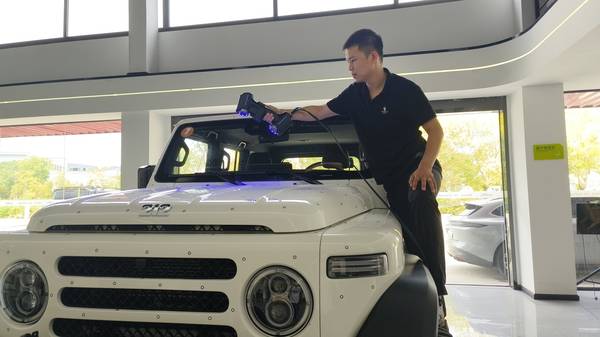
Closing the Gap with Advanced 3D Scanning
This is where metrology-grade 3D scanning establishes its value. Systems like the INSVISION AlphaScan series are engineered to bridge the precision gap. These handheld scanners capture comprehensive surface geometry at high speed, delivering dense point cloud data with precision down to 0.073 mm. This resolution allows quality teams to identify deviations in form, fit, and finish that traditional touch probes might miss.
For larger components, such as full body panels or chassis structures, the INSVISION AlphaVista model provides an extended scan field of 2200 x 2200 mm. The capability to collect millions of data points per second transforms inspection from a slow, discrete-point exercise into a rapid, full-surface assessment.
Integrated software leverages AI-assisted algorithms to automatically align scan data to CAD nominal models, shifting the inspector’s role from manual measurement to analytical review of deviation maps.
Integrating Scanning into Automotive Quality Workflows
Deploying a system like the INSVISION AlphaScan follows a logical, process-driven path that integrates with existing digital thread. A typical workflow involves:
- Data Capture: Scanning the target component or assembly on the shop floor or in the inspection lab.
- Analysis & Alignment: Importing the point cloud into inspection software for automatic alignment with the CAD reference model.
- Visualization: Generating color-coded deviation maps that provide an immediate, intuitive view of dimensional variance across the entire part. This allows for rapid identification of out-of-tolerance conditions in First-Article Inspection (FAI) or in-process checks.
- Reporting & Action: Using one-click reporting to generate standardized documentation for engineering review, corrective action requests, and quality records.
Beyond production inspection, this captured geometry is invaluable for part development and redesign. Engineers can perform accurate reverse engineering, extracting design intent from physical prototypes or legacy parts to create or modify digital models with confidence. The same INSVISION hardware platform validates both high-volume production runs and low-volume, custom components without reconfiguration.
Measurable Outcomes for Modern Automotive Production
Adopting structured-light 3D scanning moves dimensional verification from a constraint to a strategic asset. The operational benefits are clear:
- Enhanced Efficiency: Replacing manual gauging with rapid, non-contact scanning dramatically reduces cycle times per part.
- Improved Accuracy & Repeatability: Full-field data eliminates sampling uncertainty, and automated processes ensure results are consistent and operator-agnostic.
- Comprehensive Traceability: Digital records of every scan provide auditable evidence for ISO/IATF quality management systems.
- Proactive Problem-Solving: Visual deviation maps enable root-cause analysis earlier in the process, preventing non-conformances from propagating downstream.
For automotive engineers and quality managers evaluating Industry 4.0 integration, advanced 3D scanning represents a practical step toward a more connected, data-driven manufacturing environment. INSVISION develops these measurement solutions to meet the evolving precision demands of automotive OEMs and suppliers, focusing on delivering tangible ROI through streamlined workflows and definitive quality assurance.
Hangzhou Insvision Technology Co., Ltd.
Address: Building 1, No. 1399 Liangmu Road, Yuhang District, Hangzhou, Zhejiang 311121, China
Copyright © Hangzhou Insvision Technology Co., Ltd. All rights reserved.
Copyright © Hangzhou Insvision Technology Co., Ltd. All rights reserved.