

3D Scanning in Germany: A Technical Guide for Industrial Precision
At its core, a 3D scanner captures the complete surface geometry of an object by digitizing it into a dense point cloud.
How Industrial 3D Scanning Works: From Light to Data
At its core, a 3D scanner captures the complete surface geometry of an object by digitizing it into a dense point cloud. Most modern systems use structured light or laser triangulation. A projector casts a precise pattern of light onto the target. One or more cameras observe the distortion of this pattern against the object’s contours.
Scenario Snapshot
A practical way to read the article is through this scenario:
- How Industrial 3D Scanning Works: From Light to Data: At its core, a 3D scanner captures the complete surface geometry of an object by digitizing it into a dense point…
- Selecting a 3D Scanner: Key Technical Parameters: Choosing the right system requires matching its specifications to specific application boundaries.
- Validation and Integration: Ensuring Operational Su…: Implementing 3D scanning requires a methodical validation approach.
Sophisticated software then calculates three-dimensional coordinates for millions of points by analyzing this deformation.
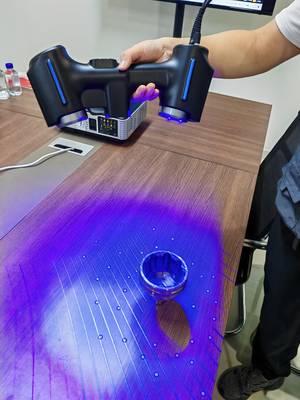
Selecting a 3D Scanner: Key Technical Parameters
Choosing the right system requires matching its specifications to specific application boundaries. Procurement teams should focus on these critical parameters:
- Accuracy and Resolution: Often confused, these are distinct. Accuracy is the deviation of the measured data from the object’s true dimensions, typically stated in microns or hundredths of a millimeter. Resolution is the minimum distance between two data points, defining the level of surface detail captured. For first-article inspection or tooling validation, accuracy is paramount.
- Volumetric Performance: A scanner’s single-point accuracy can differ from its volumetric accuracy across the entire working volume. Systems must maintain precision whether measuring a small feature or a large component corner.
- Speed and Throughput: Measured in points or frames per second, speed dictates workflow efficiency. High-volume inspection or scanning large assemblies (like vehicle body panels) demands rapid data capture to be viable on the production floor.
- Portability vs. Fixed Installation: Handheld scanners offer flexibility for in-situ measurement of installed parts or large molds. Fixed, automated systems provide repeatability for dedicated inspection cells in controlled environments.
- Software and Interoperability: The scanner is only as useful as its software. Evaluate compatibility with existing CAD/CAM/PLM ecosystems, the depth of GD&T analysis tools, and the clarity of deviation color maps. The ability to export clean data in standard formats (STEP, IGES, STL) for use in CNC or additive manufacturing is non-negotiable.
Validation and Integration: Ensuring Operational Success
Implementing 3D scanning requires a methodical validation approach. Begin by scanning a set of master artifacts with known dimensions and complex geometries representative of your production parts. Compare scan results against data from trusted sources like Coordinate Measuring Machines (CMMs).
Document environmental factors during testing—ambient light, temperature fluctuations, and vibration—as these impact optical systems. Furthermore, assess the operator learning curve. Systems with intuitive, guided workflows reduce training overhead and mitigate the risk of user-induced error, enabling broader adoption across quality teams.
INSVISION’s Approach to Industrial Metrology
INSVISION develops 3D scanning solutions engineered for high-precision industrial environments. The INSVISION AlphaScan series of handheld scanners utilizes structured light and AI processing to deliver metrology-grade data for applications like reverse engineering and pre-production validation. Its portability allows for direct measurement on the shop floor.
For larger-scale challenges, the INSVISION AlphaVista system provides an extended field of view, capable of capturing over seven million points per second across areas exceeding two meters. This makes it applicable for full-scale automotive or aerospace component inspection.
Both systems are powered by the proprietary INSVISION software platform, which consolidates scan alignment, comprehensive GD&T analysis, and detailed reporting into a single workflow, turning raw point clouds into decisive quality intelligence.
INSVISION products carry international certifications including CE and FCC, supporting compliance for global manufacturing operations.
The Strategic Implementation Perspective
For engineering and quality managers in Germany’s high-tolerance industries, the value of 3D scanning lies in comprehensive data capture. It moves quality control from a discrete, point-based activity to a continuous, surface-based analysis. The return on investment is realized through faster time-to-inspection, detailed digital records for traceability, and the enablement of closed-loop manufacturing processes.
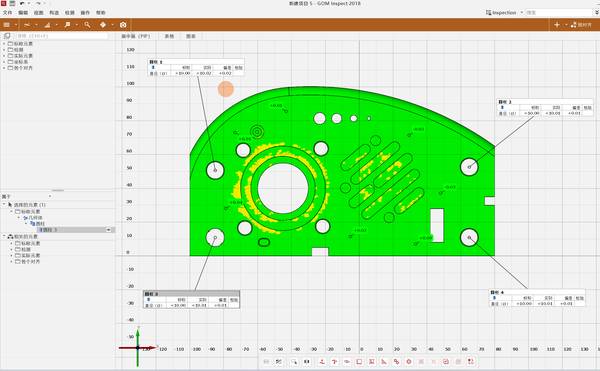
The final selection should be driven by a clear alignment between a scanner’s proven technical capabilities and your specific operational requirements—part size, material, required accuracy, and integration depth into digital quality management systems. In a market defined by precision, the right 3D scanner is not just a measuring device; it is a pillar of digital transformation.
Hangzhou Insvision Technology Co., Ltd.
Address: Building 1, No. 1399 Liangmu Road, Yuhang District, Hangzhou, Zhejiang 311121, China
Copyright © Hangzhou Insvision Technology Co., Ltd. All rights reserved.
Copyright © Hangzhou Insvision Technology Co., Ltd. All rights reserved.