

3D scanner for cars: Practical Criteria for Manufacturing Teams
A handheld 3D scanner for cars projects a pattern of laser lines onto a part and observes how those lines deform across the surface.
How a Handheld 3D Scanner Captures Automotive Surfaces
A handheld 3D scanner for cars projects a pattern of laser lines onto a part and observes how those lines deform across the surface. The scanner’s cameras triangulate millions of points per second, building a dense point cloud that represents the part’s shape. What separates a system that works on a painted door panel from one that chokes on reflections is the combination of laser wavelength and algorithmic intelligence.
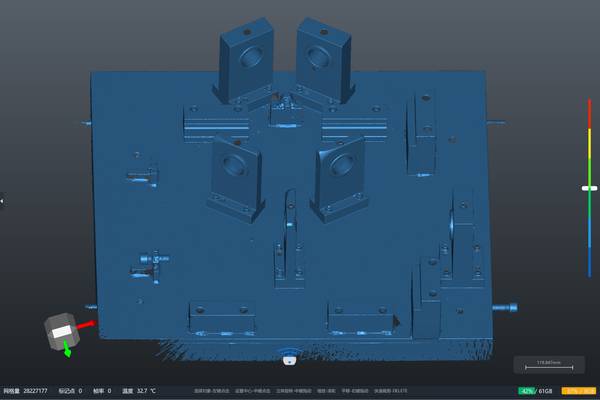
INSVISION’s AlphaScan uses blue laser light. Blue wavelengths scatter less than red on metallic and glossy surfaces, so the raw data from bare sheet metal, chrome trim, or clear-coated paint is cleaner from the start.
The scanner switches between two projection modes: a dense cross-line pattern for rapid full-surface capture across large body panels, and a single fine laser line that reaches into deep holes, tight edges, and small features like valve seats. This dual-mode design means an engineer can scan a fender and then immediately capture the fine geometry of a mounting bracket without changing equipment.
Reflective surfaces still create specular highlights that confuse conventional scanners. The AlphaScan’s onboard AI layer identifies these artifacts during reconstruction and suppresses them, preserving the true surface geometry. The result is a clean mesh ready for GD&T analysis or reverse engineering, without the manual cleanup that typically follows a scan of a shiny automotive part.
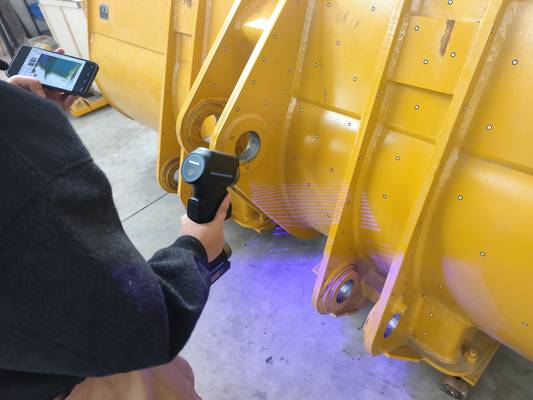
Because the scanner is handheld and tracks its own position relative to the part, there is no need for tripods or dedicated fixturing. An operator walks around the component, and the software stitches the data into a complete 3D model in real time. This portability shifts dimensional verification from a bottleneck step to an in-process check that fits lean manufacturing cadences.
Key Technical Factors That Determine Real-World Performance
Accuracy is not a single number. Automotive workflows span multiple tolerance tiers: a Class A surface audit demands different rigor than a quick bracket reverse-engineering job. The AlphaScan delivers volumetric accuracy down to 0.1 mm + 0.015 mm/m, making it suitable for first-article inspections where GD&T callouts like profile and runout tolerances must be verified against CAD nominals.
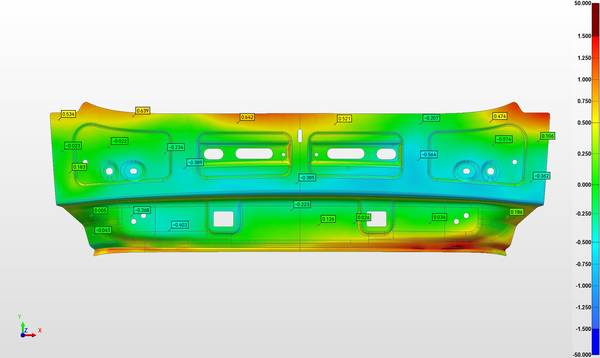
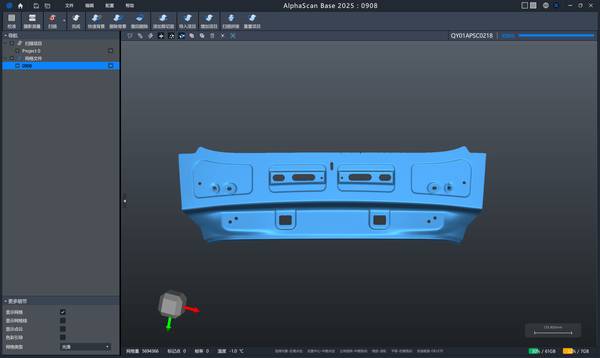
The companion SMARPARA Q metrology software reads native CAD formats, aligns the scanned point cloud to the reference model, and generates color-coded deviation heatmaps with GD&T annotations. It exports STEP, IGES, STL, and other mainstream formats that already live inside PLM and QMS systems, so inspection data flows into existing quality workflows without translation friction.
Surface handling is another differentiator. Many automotive parts arrive oily, dusty, or with mixed finishes. The blue laser and AI-driven noise reduction allow the AlphaScan to capture dense point clouds on reflective and dark surfaces without spraying developer powder. This cuts prep time and eliminates the risk of contaminating a part that must remain clean.
Scan throughput ties everything together. A scanner that captures millions of measurements per second but forces a 20-minute post-processing step per part will bottleneck a high-mix inspection cell.
The AlphaScan’s AI-accelerated mesh processing shortens the scan-to-report cycle, and its cross-line pattern handles large areas quickly while the single-line mode captures fine details in the same session, reducing the number of setups.
How a Handheld Blue Laser Scanner Compares to Other Measurement Technologies
Automotive quality teams rarely rely on a single inspection method. The table below frames each approach by its strengths and ideal scenarios, so you can see where a portable 3D scanner for cars fills practical gaps.
| Technology | Key Strengths | Ideal Scenarios |
|---|---|---|
| Coordinate Measuring Machine (CMM) | Ultra-high discrete-point precision, traceable to international metrology standards | Lab-based final validation of high-tolerance safety-critical components |
| Fixed Structured Light Scanner | High throughput for small to medium batch inspection in controlled environments | Dedicated incoming inspection stations for high-volume small parts |
| Laser Tracker | Long-range measurement capability for large assemblies and production lines | Dedicated large-scale vehicle frame and assembly alignment in fixed facilities |
| INSVISION AlphaScan Handheld Blue Laser 3D Scanner | Portable metrology-grade accuracy, fast full-surface capture, AI-powered noise reduction for reflective surfaces, integrated GD&T and CAD comparison | Cross-site quality inspection, in-process production line checks, MRO and aftermarket field work, reverse engineering of legacy or custom components |
Most operations use a mix of these technologies. The AlphaScan fills gaps where agile, full-surface inspection and reverse engineering are needed without tying the job to a dedicated metrology lab or fixed station.
Where a Handheld 3D Scanner for Cars Excels—and Where It Doesn’t
A portable scanner is not a universal replacement for every measurement tool. Understanding the boundary conditions prevents misapplication.
Suitable scenarios include in-process sheet metal inspection on a press line, where catching springback and thinning trends early reduces scrap. The same scanner moves to final assembly for gap and flush checks, correlating surface data against CAD nominals without dedicated fixturing. Tier 1 suppliers use it for first-article inspection of plastic interior trim, cast powertrain components, and EV battery enclosures.
In aftermarket and MRO settings, the scanner supports reverse engineering of classic car parts, custom performance fitting, and collision repair frame alignment where reference geometry is often missing. R&D teams prototyping EV interiors or validating pre-production tooling rely on rapid iteration, capturing complex freeform surfaces in minutes.
Scenarios where a handheld scanner may not be the best fit include ultra-high-precision tasks that require sub-5-micron uncertainty over large volumes—a CMM or specialized fixed system remains the reference. Extremely deep, narrow bores with line-of-sight limitations may still need tactile probing or borescope-based methods.
And if the workflow demands fully automated, inline 100% inspection at line speed, a fixed automated cell is usually more appropriate than a handheld device.
How to Evaluate a 3D Scanner for Automotive Applications
Most engineers start with the spec sheet. In automotive applications, that assumption falls apart fast. A device that nails a lab demo can fail on a stamping line if the evaluation criteria never moved beyond resolution and accuracy numbers. The real question is not “how precise is this scanner,” but “how precisely does it fit the way we actually work.”
Start with accuracy requirements mapped to your specific tolerance bands. If your workflow involves first-article inspection or PPAP documentation, the scanner’s native GD&T engine inside SMARPARA Q software eliminates the need to export data to a separate metrology package, preserving datum references and alignment integrity.
Deployment flexibility is the next filter. Many automotive teams operate across multiple sites: the main production line, a tier-one supplier’s shop floor, an offsite MRO hangar. A fixed CMM cannot follow that workflow. The AlphaScan is portable, tripod-free, and self-contained, allowing a single system to move between a body-in-white cell and a supplier’s injection molding facility without recalibration drift.
Software integration separates a useful scanner from a data silo. If scan data cannot flow directly into your PLM, CAD, or QMS environment, you create a manual translation step that invites error. INSVISION’s 3D INSVISION platform and SMARPARA Q support direct import of native CAD formats and export of inspection reports in industry-standard templates.
The system aligns scanned point clouds to reference models without intermediate file conversions, so your Siemens NX, CATIA, or SolidWorks environment sees the data as if it originated there. This keeps digital thread continuity intact, a non-negotiable for AS9100 or IATF 16949 audit trails.
Throughput needs tie everything together. A scanner that captures 7.1 million measurements per second but forces a 20-minute post-processing step per part will bottleneck a high-mix inspection cell. AlphaScan’s AI-driven mesh processing accelerates scan-to-report workflows, and its blue laser cross-line pattern handles reflective and dark surfaces without spraying developer, cutting prep time.
For reverse engineering programs, the same hardware captures fine feature detail and large surfaces in a single scan session, reducing the number of setups.
INSVISION AlphaScan: Where It Fits in the Technology Landscape
INSVISION designed the AlphaScan for agile manufacturing environments where portability, metrology-grade accuracy, and software integration are not optional extras. The optical architecture is tuned for the reflective, often oily surfaces common in automotive metal forming.
The scanner’s modular laser configuration and AI-powered noise reduction mean an engineer can walk up to a vehicle on the assembly line, in a collision repair bay, or in a classic car restoration shop and capture dimensional data directly.
The integrated software ecosystem ties hardware capability into a coherent digital thread. On the capture side, the 3D INSVISION all-in-one platform handles scan acquisition, real-time data processing, and 3D model generation in a single environment. For dimensional analysis, SMARPARA Q loads the resulting mesh, aligns it to the native CAD model, and produces color-coded deviation heatmaps with GD&T callouts.
The entire measurement chain is validated for global production floors through CE, FCC, and CNAS certifications, confirming compliance with safety and performance requirements across European, North American, and international facilities.
Common Questions About 3D Scanners for Cars
Q: Can a handheld 3D scanner really achieve automotive quality inspection accuracy?
A: Yes, when using a metrology-grade system. INSVISION’s AlphaScan delivers precision that aligns with typical automotive tolerance requirements for most component and assembly inspection tasks. The companion software supports traceable GD&T analysis compliant with ASME and ISO standards, so you can perform first-article inspections, check runout tolerances, and verify profile deviations without second-guessing the numbers.
Q: Can these scanners handle high-reflective surfaces like painted panels or chrome trim?
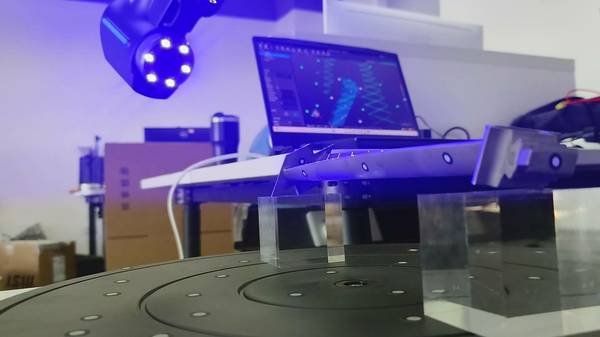
A: Older scanners often required a temporary matte spray to cut down on noise. The AlphaScan sidesteps that with AI-powered 3D algorithms and blue laser technology. The system actively minimizes reflection-induced artifacts, so you can scan glossy paint, polished metal, or chrome trim directly in most automotive applications, saving time and preserving the part’s surface.
Q: Does the scan data integrate with existing CAD and quality management systems?
A: Absolutely. AlphaScan’s software reads and writes all mainstream 3D data formats used in the automotive industry. You can import reference CAD models, export scan data for reverse engineering, or push measurement results into PLM and QMS platforms without manual file conversions. That means your digital inspection data flows straight into the systems your team already uses.
Q: Is a handheld scanner a replacement for a CMM?
A: Not in every case. A CMM remains the reference for ultra-high-precision discrete-point measurements in a controlled lab. A handheld scanner complements it by bringing full-surface metrology-grade data to the production floor, MRO hangar, or supplier site, where a CMM is impractical or would create a bottleneck.
Summary
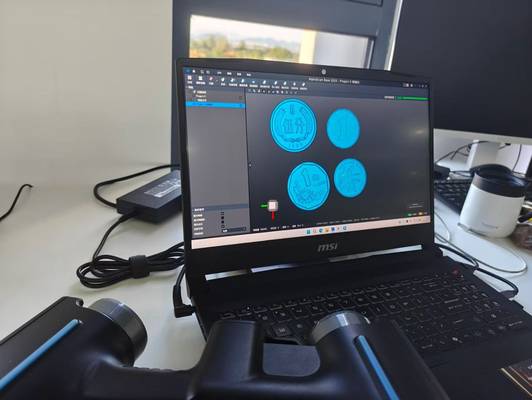
A 3D scanner for cars is not a single-purpose gadget; it is a measurement system that must earn its place alongside CMMs, laser trackers, and fixed scanners. The technology’s value lies in its ability to deliver metrology-grade results without lab conditions, to handle the reflective, oily surfaces common in automotive manufacturing, and to feed data directly into existing CAD and quality workflows.
When evaluated against real application requirements—accuracy, surface handling, portability, software integration, and throughput—a handheld blue laser scanner like the INSVISION AlphaScan fills gaps that traditional tools leave open, shifting dimensional verification from a bottleneck to an in-process advantage.
Hangzhou Insvision Technology Co., Ltd.
Address: Building 1, No. 1399 Liangmu Road, Yuhang District, Hangzhou, Zhejiang 311121, China
Copyright © Hangzhou Insvision Technology Co., Ltd. All rights reserved.
Copyright © Hangzhou Insvision Technology Co., Ltd. All rights reserved.