

How to Evaluate 3D scanner high resolution for Inspection
Discover how a 3D scanner high resolution ensures industrial compliance. Learn principles, volumetric accuracy, and validation for ISO, IATF, and AS9102 audits.
What a High-Resolution 3D Scanner Really Measures
In industrial inspection, resolution is not simply point spacing. It is the smallest feature a system can reliably measure across the entire working volume, not just at the center of the field. ISO 10360, the acceptance test standard for coordinate measuring systems, forces a hard distinction between single-point accuracy and full-volume accuracy.
A scanner might deliver 0.010 mm on an artifact placed dead center, yet drift to 0.040 mm at the edges of its scan envelope. That edge drift can invalidate GD&T verification on a large gear, housing, or casting.
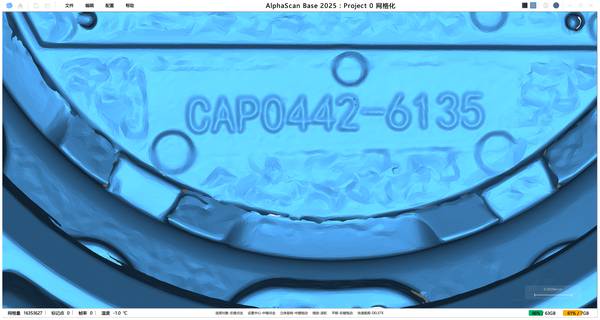
Metrology-grade high-resolution 3D scanners therefore specify volumetric accuracy—typically expressed as a base value plus a length-dependent term, such as 0.015 mm + 0.015 mm/m. This formula tells you how uncertainty grows as the part gets larger.
When a quality engineer asks for a high-resolution scan, what they really need is that consistent, verifiable accuracy envelope, because a single-point spec cannot prove the scanner holds tolerance across the whole part.
How the Technology Delivers Traceable Data
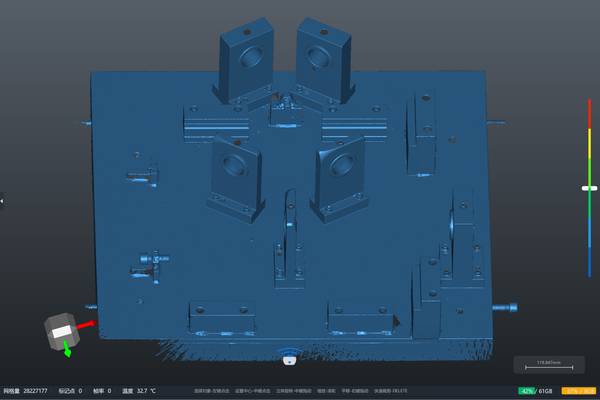
A high-resolution 3D scanner generates a dense point cloud—often millions of points—that represents as-built geometry without the interpretation layer of a caliper or height gauge. The workflow turns inspection into a single digital thread:
- Part preparation: Surfaces are cleaned and, only when the scanner’s optical characteristics require it, a thin matting spray is applied to reduce reflectivity.
- Data capture: The scanner collects full-field measurements, producing a point cloud that captures freeform surfaces, deep pockets, and sharp edges in one session.
- GD&T evaluation: Inside metrology software, the point cloud is aligned to the CAD nominal. Built-in tools extract datums, check profile tolerances, and run deviation analyses directly against the GD&T callouts on the drawing.
- Reporting: Every alignment step, tolerance evaluation, and measurement result is recorded automatically. The report links each measured value to the raw scan data, complete with timestamps, operator ID, and device serial number.
This digital chain eliminates manual transcription errors—the kind that get first-article reports kicked back by an automotive OEM because a handwritten deviation entry doesn’t match the digital record. For an AS9102 Form 3, actual measurement values are pulled straight from the scan analysis. For IATF 16949, traceability extends from the individual cavity number on a molded part to the scan file to the deviation report.
For FDA auditors, the system exports a digital report showing exactly how each critical dimension was measured, what the tolerance zone was, and whether it passed.
Key Technical Elements That Determine Compliance Readiness
| Element | What It Means for Audits |
|---|---|
| Volumetric accuracy | The scanner’s uncertainty across its full measurement volume, not just at a single point. Must be comfortably inside the tightest feature tolerance. |
| Resolution | The smallest feature the system can reliably resolve. High resolution alone is not enough; it must be paired with verified volumetric accuracy. |
| Software certification | Metrology software that performs GD&T evaluations natively on the point cloud and locks results to a traceable timestamp. PTB-certified packages like SMARPARA Q provide an additional layer of confidence. |
| Device certifications | CE, FCC, and lab accreditations (e.g., CNAS) that confirm the hardware meets regional regulatory and metrology performance claims. |
| Data export formats | Native output to STEP, IGES, STL, and direct CAD import for alignment, avoiding intermediate format conversions that can introduce error. |
Strong fit scenarios:
- First-article inspection of medium-scale parts (housings, castings, stampings) where multiple GD&T callouts must be verified quickly.
- Reverse engineering of legacy components for which no CAD data exists, especially in aerospace MRO and aftermarket.
- In-line or near-line inspection on the shop floor, where bringing parts to a fixed CMM creates a bottleneck.
- Medical device dimensional verification under FDA quality system requirements, where every out-of-spec feature must trigger a CAPA.
Boundary conditions to watch:
- Extremely tight true position tolerances below 0.05 mm may require a dedicated uncertainty budget study on the specific part geometry before replacing a CMM.
- Highly reflective or transparent surfaces can challenge optical scanners; matting spray may be needed, which adds a process step and must be accounted for in the measurement uncertainty.
- Very large parts that exceed the scanner’s single-setup volume will require multiple scans and alignment, which can accumulate error if not managed with photogrammetry or reference targets.
How to Validate a Scanner for Your Compliance Needs
A structured validation sequence prevents the common mistake of buying on peak resolution and then failing a supplier audit on volumetric performance.
- Map your tightest feature tolerance to the scanner’s stated volumetric accuracy. If a medical device drawing calls out ±0.02 mm, the scanner’s uncertainty must sit comfortably inside that band across the entire part envelope.
- Run a repeatability study on your most complex geometry. Include deep pockets, thin walls, and freeform surfaces. Watch for resolution drop-off at the edges of the scan volume.
- Confirm the software can execute native GD&T on the mesh and export time-stamped, audit-ready reports. The report must link each measured value to the raw scan session without manual intervention.
- Cross-check device certifications (CE, FCC, and any relevant metrology lab accreditations) against your regional requirements. A unit that clears these four gates will hold up under a supplier audit without forcing you to build a parallel paper trail.
INSVISION’s Approach to Metrology-Grade Handheld Scanning
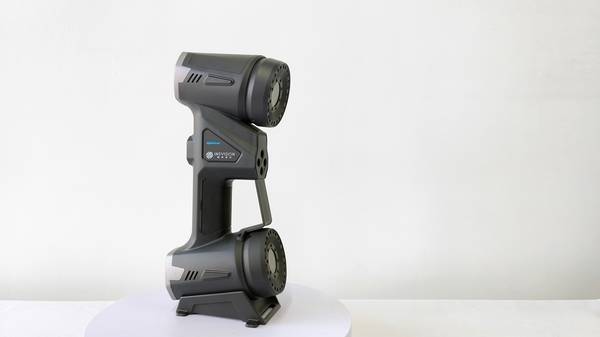
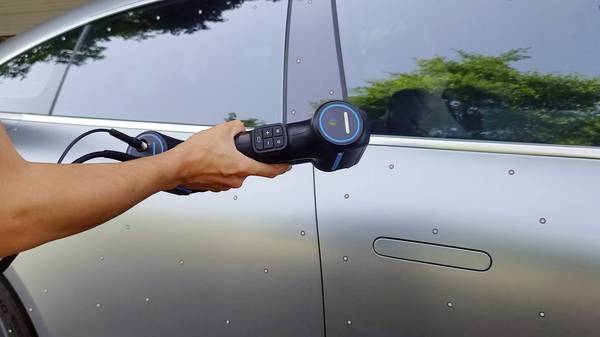
INSVISION builds its high-resolution 3D scanner portfolio around the principle that mobility should not compromise metrological integrity. The AlphaScan handheld scanner specifies resolution down to 0.01 mm and delivers volumetric accuracy across its 650 x 580 mm scan area, not just at a single point.
An AI-powered reconstruction engine maintains data consistency on challenging geometries—deep pockets, sharp edges, glossy surfaces—that cause consumer-grade devices to lose tracking or generate noisy patches.
The hardware carries CE, FCC, and CNAS certifications, supporting global regulatory requirements. For end-to-end workflow, the integrated 3D INSVISION software handles scan acquisition, inspection comparison, and model generation in one environment. When the job demands formal GD&T analysis, multi-source data alignment, and deviation reporting against CAD, the PTB-certified SMARPARA Q software provides traceable results.
This combination of certified hardware and dedicated metrology software removes the guesswork from proving out a new measurement process, whether the task is first-article inspection, reverse engineering, or production-floor quality checks.
Common Questions About High-Resolution 3D Scanners and Compliance
Q: Can high-resolution 3D scan data be used for official ISO 9001 or IATF 16949 audits?
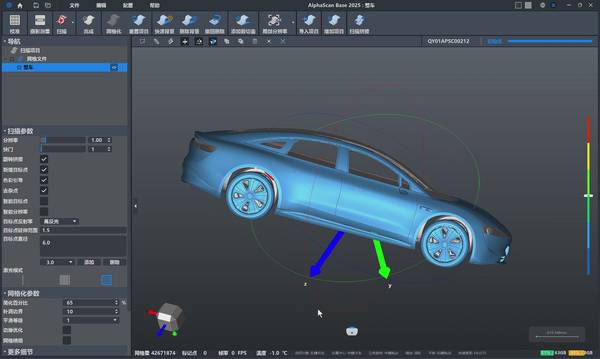
Yes, when captured with a calibrated, metrology-grade scanner and processed through certified software that preserves an unbroken chain of measurement traceability. Auditors need to see that the scanner was within its calibration interval, that the measurement uncertainty is documented, and that the data file includes timestamps, operator ID, and device serial number.
INSVISION’s AlphaScan, paired with SMARPARA Q, records these metadata elements automatically, so the scan data stands as valid objective evidence.
Q: Do handheld high-resolution 3D scanners deliver accurate enough data for ASME Y14.5 GD&T verification?
They do, provided the scanner’s volumetric accuracy and resolution align with the tolerance band of the feature being verified. A metrology-grade handheld with confirmed sub-0.02 mm accuracy can handle GD&T callouts like profile, position, and runout on mid-sized industrial parts. The software matters as much as the hardware.
SMARPARA Q includes built-in GD&T tools that evaluate scanned point clouds directly against CAD nominals, generating reports in the format CMM operators expect. For true position tolerances under 0.05 mm, validate the scanner’s uncertainty budget against the specific part geometry.
Q: What certifications should I look for in a high-resolution 3D scanner for global industrial use?
Prioritize CE marking for EU compliance, FCC for the US, and any relevant metrology performance certifications that confirm the manufacturer’s stated accuracy claims. If your facility ships to multiple regions, having both CE and FCC simplifies deployment. INSVISION’s AlphaScan carries both, and the company’s quality lab holds CNAS accreditation, which adds a layer of confidence when auditors review your measurement systems.
Q: Does scan data from a high-resolution 3D scanner satisfy first-article inspection requirements?
Yes, provided the scanner’s measurement uncertainty is less than 10% of the feature tolerance—a common rule of thumb in aerospace and automotive. The inspection report must clearly link each measured value to the raw scan data. With INSVISION’s workflow, SMARPARA Q generates first-article reports that include deviation color maps, pass/fail flags per characteristic, and full traceability back to the original scan session.
Summary
High-resolution 3D scanning has matured into a primary measurement tool for regulated industries, but its compliance value depends entirely on volumetric accuracy, software traceability, and a validation process that proves performance on your parts—not just on a calibration artifact.
When those conditions are met, the technology replaces manual transcription with a single digital thread that holds up under audit scrutiny, speeds first-article approvals, and gives quality teams a defensible dimensional record.
Hangzhou Insvision Technology Co., Ltd.
Address: Building 1, No. 1399 Liangmu Road, Yuhang District, Hangzhou, Zhejiang 311121, China
Copyright © Hangzhou Insvision Technology Co., Ltd. All rights reserved.
Copyright © Hangzhou Insvision Technology Co., Ltd. All rights reserved.