

Integrated 3D Scanner Workflow for Lean Quality Control
Article Guide Optical Design Engineered for Problem Surfaces The Compressed Workflow: From Scan to Shop-Floor Decision Field Validation: Performance in Critical Operational Zones Positioning for Dynamic Manufacturing Val
For quality managers in aerospace, automotive, and energy, the bottleneck in 3D inspection is no longer data collection. The real time sink lies in the disjointed steps that follow a scan: stitching point clouds, filtering noise, aligning to CAD, and generating reports. This fragmented process extends feedback loops, disrupts production takt times, and obscures root-cause analysis.
A meaningful 3d scanner comparison must, therefore, evaluate the entire workflow from physical part to actionable deviation report.
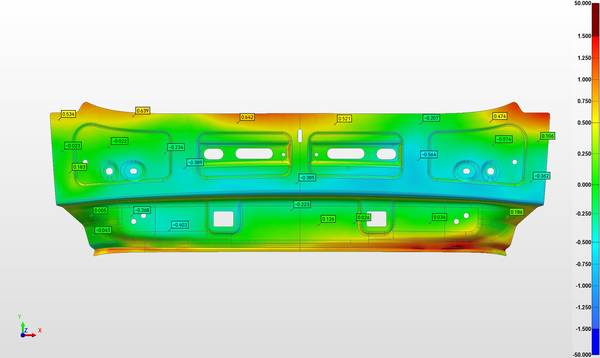
The INSVISION AlphaScan is engineered for this integrated reality. It combines a robust blue laser optical system with onboard AI processing to streamline the path to a clean, aligned mesh. This article examines its architecture and the concrete operational advantages it delivers for in-situ verification, focusing on how it aligns metrology with lean manufacturing principles.
Optical Design Engineered for Problem Surfaces
Reliable data capture dictates production efficiency more than raw speed. The deciding factor in a 3d scanner comparison is often a device’s performance on challenging surfaces like machined aluminum, carbon fiber composites, or matte black coatings—without forcing operators to stop and apply disruptive spray.
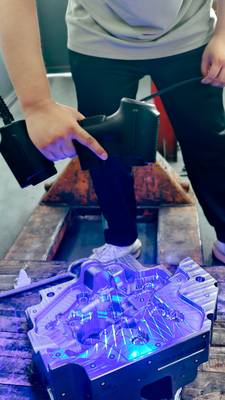
The INSVISION AlphaScan addresses this with a 50-line cross blue laser projection and a dual-LED deep-cavity illumination system.
This combination clarifies data capture in recessed holes, deep threads, and on reflective surfaces, ensuring a continuous flow of usable data. To maintain accuracy across large workpieces, such as a turbine housing or automotive frame, the system uses photogrammetric scale bars to establish a stable global coordinate system, effectively eliminating cumulative drift. This optical foundation is not an end in itself;
it feeds directly into the onboard AI that optimizes the point cloud, removing the need for manual post-scan stitching and cleanup.
The Compressed Workflow: From Scan to Shop-Floor Decision
Traditional inspection fractures across multiple software platforms for scanning, alignment, analysis, and reporting. The INSVISION pipeline consolidates this into a single, coherent process: data integration, intelligent CAD comparison, multi-dimensional validation, and smart reporting. The workflow anchors on automatic CAD-to-scan alignment, eliminating manual fitting errors.
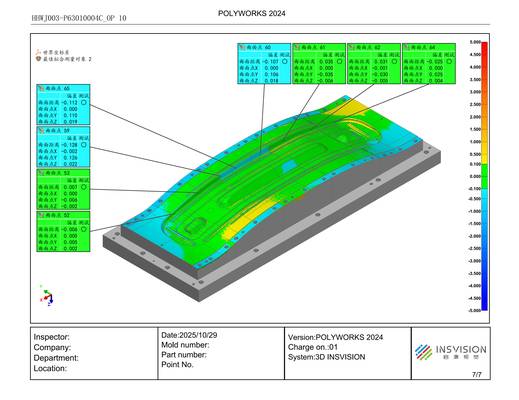
Once aligned, the system generates a color-coded deviation map in real time.
A quality manager can immediately visually isolate an out-of-tolerance zone on a complex injection-molded part or a welded assembly without switching applications. This integration replaces a fragmented software stack with one-click report generation, compressing what was often a multi-hour analysis into a process that aligns with production cycle times.
The ability to execute this full spectrum within one environment is a decisive factor for operational efficiency.
Field Validation: Performance in Critical Operational Zones
Capital justification for handheld metrology hinges on specific, high-value scenarios. The INSVISION AlphaScan delivers maximum ROI where part geometry or size prohibits traditional CMM access or where in-situ measurement is non-negotiable. In aerospace MRO, it captures wear distribution on turbine blades without disassembly.
For automotive body-in-white fixture validation, it enables line-edge inspection that compresses logistics delays. In the energy sector, it handles large-pressure-vessel inspection where photogrammetry controls cumulative error.
Additive manufacturing QA leverages it for verifying complex lattice structures against original CAD models. These scenarios share critical boundaries: a strict requirement for on-location measurement, the necessity for historical trend comparison, and intricate surface geometries.
By shifting verification from a centralized lab to the production floor, the system supports rapid first-article inspection and lot acceptance, ensuring QC keeps pace with production rhythm.
Positioning for Dynamic Manufacturing
Stationary CMMs offer extreme repeatability but create a bottleneck in mixed-model, low-volume production due to fixturing and logistics. A robust evaluation framework distinguishes between static throughput and dynamic adaptability. Handheld structured-light systems like the INSVISION AlphaScan prioritize mobility and large-volume coverage, allowing an operator to capture a complex casting directly on the shop floor.
While fixed optical CMMs excel at ultra-high-throughput repetitive bin inspection, AlphaScan is engineered for rapid in-process verification and immediate on-site deviation reporting. Its embedded AI automates alignment, drastically reducing the setup time associated with traditional methods.
Validating the Fit for Your Operation
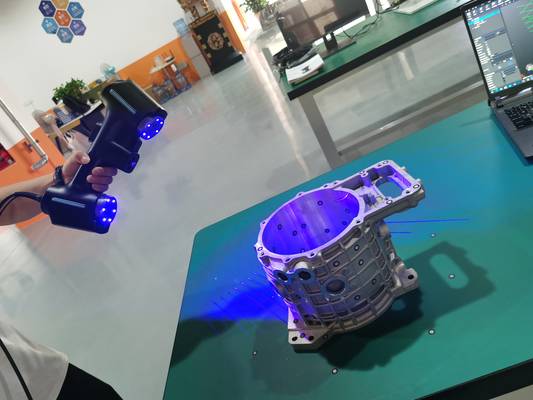
Before finalizing inspection capital planning, the most critical step is a real-world validation. Quality engineers should run a sample-part deviation analysis, reviewing the one-click report outputs against their specific ASME Y14.5 or ISO GPS requirements. Assess how the system handles your most challenging part: a black-anodized component, a deep-bore hydraulic manifold, or a large composite panel.
The goal is to verify that the solution’s accuracy, workflow integration, and output clarity fit your unique tolerance requirements and production tempo.
Hangzhou Insvision Technology Co.,Ltd.
Address: Building 1, No. 1399 Liangmu Road, Yuhang District, Hangzhou, Zhejiang 311121, China