

3d scan object Industrial Inspection Guide
Discover how INSVISION enables in-process 3D scan object validation for complex castings directly on the production floor, reducing inspection bottlenecks
This article examines how INSVISION‘s approach enables in-process validation, moving inspection from a reactive bottleneck to an integrated step that supports lean production cadence without adding headcount.
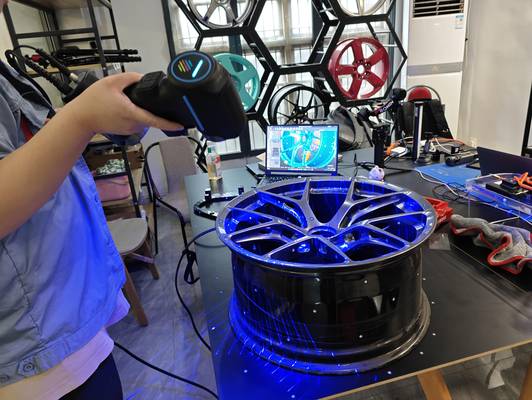
The Specific Challenge of Mixed-Surface Assemblies
The bottleneck isn’t merely moving the part; it’s capturing it. Traditional handheld scanners struggle with the extreme surface variance of a finished casting. Highly reflective machined areas scatter light, while porous, dark cast surfaces absorb it. Deep, intersecting bore holes create shadows and occlusions that discrete touch probes cannot efficiently map.
Key Points at a Glance
- The bottleneck isn’t merely moving the part;
- The INSVISION AlphaScan handheld 3D scanner is engineered for this environment.
- A significant hidden cost in precision measurement is environmental control and operator specialization.
- Selecting the right tool requires matching capability to production reality.
The common workaround—applying a matte spray—adds time, contaminates the part, and is often impractical for in-line verification.
INSVISION addresses this by deploying blue laser technology configured to handle these specific shop-floor conditions. The system uses different laser line patterns—cross-line for large surfaces, a single line for deep features, fine-line for sharp edges—to adapt to the geometry.
An integrated AI-assisted algorithm reconstructs a complete point cloud without surface treatment, delivering a full-field deviation map against the CAD model directly at the workstation.
Integrating the AlphaScan into Production Takt
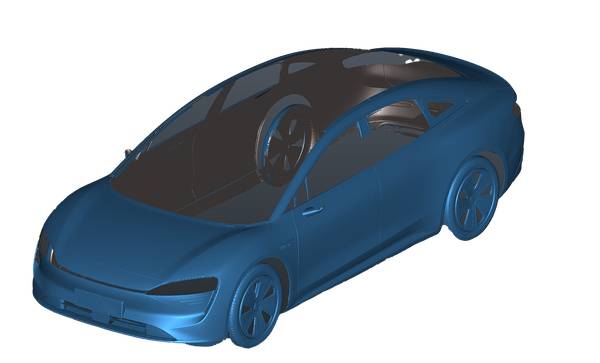
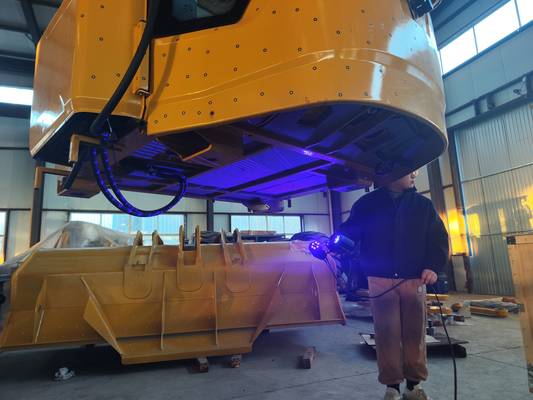
The INSVISION AlphaScan handheld 3D scanner is engineered for this environment. Its value is realized not in a lab, but in the context of a moving line. Operators can scan slow-moving parts on a pallet or capture large assemblies up to two meters away without external photogrammetry markers. The lightweight design reduces fatigue during extended use on complex parts like cylinder heads or differential cases.
Crucially, the workflow integration is designed for efficiency.
The system outputs immediate, one-click tolerance analysis, generating automated GD&T reports compliant with ASME Y14.5 and ISO 1101 standards. This eliminates manual spreadsheet compilation and streamlines the handoff from quality control to production engineering, turning inspection data into a direct input for digital work instructions and compliance certificates.
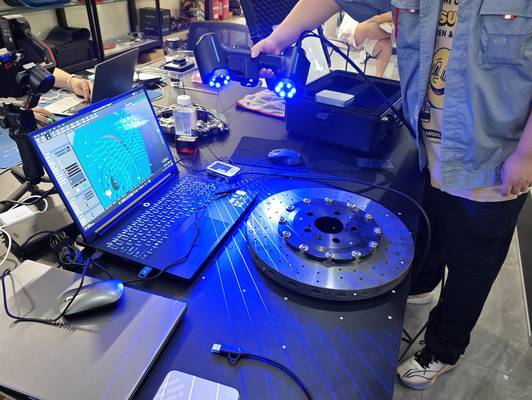
Reducing the Operational Footprint of Precision Metrology
A significant hidden cost in precision measurement is environmental control and operator specialization. INSVISION challenges the assumption that metrology-grade results require an isolated lab. The AlphaScan maintains stability across variable shop-floor temperatures and ambient lighting, removing the capital expense and space requirement for a dedicated climate-controlled room.
Training reflects this practicality: quality technicians typically progress from basic alignment to automated CAD-based routines within a condensed timeframe, using live point-cloud visualization that doesn’t demand a deep metrology background. This standardization across multiple production cells reduces measurement variability between operators and supports continuous improvement audits with consistent digital records.
Guidance for Deployment: Handheld Scanning Versus Fixed CMM
Selecting the right tool requires matching capability to production reality. Fixed CMMs remain the gold standard for high-throughput, repeatable measurement of uniform parts in a controlled lab—a perfect fit for final certification of high-volume components. The INSVISION AlphaScan, however, is the superior choice for adaptability.
It is specifically suited for high-mix lines, large or awkward assemblies, and confined inspection zones where moving the part is impractical.
Its strength is capturing traditionally difficult surfaces—high-gloss stampings, carbon-fiber composites, or deep-black castings—on site.
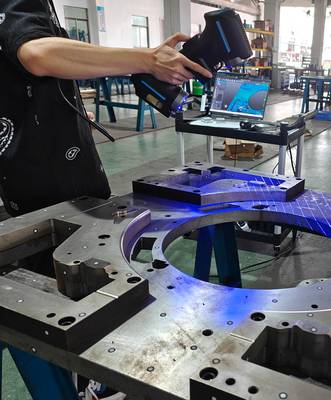
For a grounded evaluation, quality managers should move beyond spec sheets. The critical step is a validation run using your most challenging sample part, such as a casting with thin walls and intersecting holes. Confirm the point cloud density on critical GD&T features, verify the report format aligns with your internal audit trail, and observe the workflow against your production takt time.
This practical test will clarify where flexible, shop-floor scanning accelerates quality sign-off milestones and where the fixed CMM’s repeatability remains essential.
Hangzhou Insvision Technology Co., Ltd.
Address: Building 1, No. 1399 Liangmu Road, Yuhang District, Hangzhou, Zhejiang 311121, China
Copyright © Hangzhou Insvision Technology Co., Ltd. All rights reserved.
Copyright © Hangzhou Insvision Technology Co., Ltd. All rights reserved.