

3d scan resolution Industrial Inspection Guide
Metrology-grade 3D scan resolution tackles floor-level inspection deadlocks on complex automotive and aerospace parts. INSVISION AlphaScan delivers 0.010mm
For quality engineers in automotive or aerospace, verifying GD&T on a complex stamping die or turbine blade often means hitting a hard stop. Conventional optical scanners fail on the very surfaces that define these components: deep-black coatings scatter light, highly reflective mold cavities blind the sensor, and deep recesses like keel structures or bolt holes remain occluded.
This forces a retreat to manual checks, breaking lean manufacturing rhythms and creating a data gap in ISO/ASME workflows.
The critical factor determining success is genuine 3D scan resolution—the ability to capture micron-level geometry on difficult surfaces at production-line speed. INSVISION engineered its AlphaScan handheld series to resolve this exact deadlock.
By combining a dedicated optical architecture with AI-driven processing, the system delivers metrology-grade data where standard lasers fail, turning unscannable surfaces into quantifiable models for wear tracking and dimensional analysis.
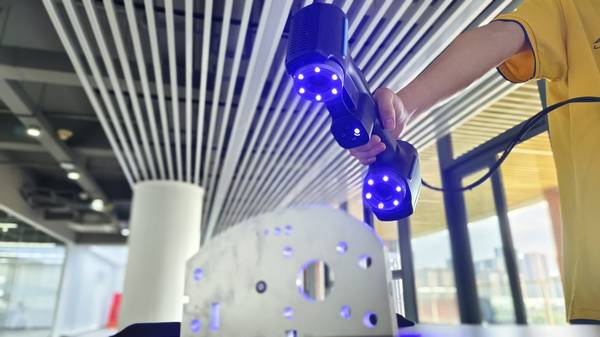
Closing the Data Gap on the Factory Floor
The founding premise was not to chase lab-bound benchmarks but to solve a specific factory-floor problem. Achieving reliable 3D scan resolution on challenging parts required moving beyond hardware alone to an intelligent integration of optics and algorithms. For example, when inspecting a high-gloss injection mold or a deep fuel port in an aerospace component, standard scanners produce noise or null data.
INSVISION’s AlphaScan series addresses this through specialized blue laser line arrays, including a dedicated single line for probing deep holes, coupled with AI-enhanced 3D reconstruction. This enables the system to adapt dynamically, switching resolution modes to maintain a dense, accurate point cloud on complex curved surfaces and narrow gaps.
The result is reliable capture of details down to 0.010mm without requiring spray coatings or manual touch probes, effectively moving high-precision inspection from the controlled lab to the dynamic production line.
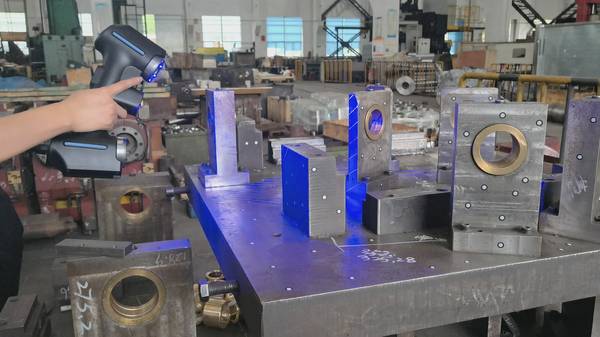
Handheld Precision for Reflective Molds and Deep Recesses
Consider the routine challenge on a tooling maintenance line: capturing the full geometry of a highly reflective mold cavity or a deep-hole structure for historical wear analysis. Traditional methods involve time-consuming spray application or fixed, tripod-bound systems that struggle with accessibility. The INSVISION AlphaScan handheld scanner is built for these scenarios.
Its optical core pairs a large-aperture industrial camera with dynamic blue laser arrays—using cross-lines for speed, seven fine lines for intricate details, and a single line for deep recesses. This allows an engineer to walk onto the floor, scan the part in situ, and generate a high-resolution model suitable for creating a visual inspection report or a color deviation map.
The system’s smart resolution switching adapts point cloud density to the surface condition in real time, ensuring consistent data capture on the curved surfaces of an automotive body die or the internal channels of a casting.
Validating Performance for Cross-Border Procurement
Deploying any measurement technology in regulated industries requires verified compliance. INSVISION has secured CE, FCC, and CNAS certifications for the AlphaScan series, meeting the rigorous standards demanded by aerospace and energy procurement teams. This certification validates that the handheld workflow can replace static inspection stations without sacrificing 3D scan resolution or 0.010mm accuracy.
The system’s standardized calibration ensures repeatable data output, a necessity for suppliers delivering to global OEMs.
Proven through deployment in over 20 countries, it demonstrates that metrology-grade inspection can be fully integrated into floor-level routines, providing the consistent, auditable data required for cross-border quality documentation.
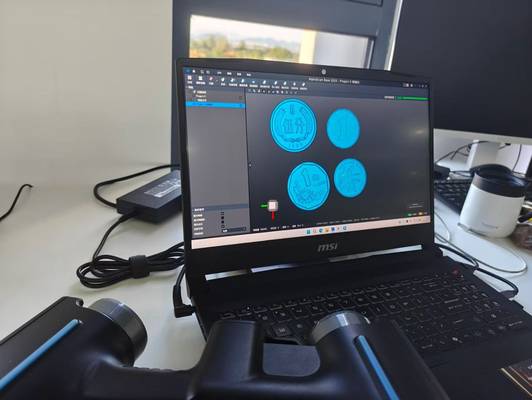
Where AI-Driven Reconstruction Makes the Difference
A common limitation of handheld scanners is the forced compromise between capturing overall form and fine detail, often resulting in multiple scan patches and alignment errors. INSVISION embeds AI-driven 3D reconstruction directly into the AlphaScan Elite to overcome this.
The system performs smart resolution switching autonomously, engaging its array of 7 fine laser lines for surface details or a single line for deep holes without manual intervention.
This is particularly critical for quantitative analysis, such as tracking wear distribution across a turbine blade’s leading edge or performing automated tolerance analysis on narrow gap geometries.
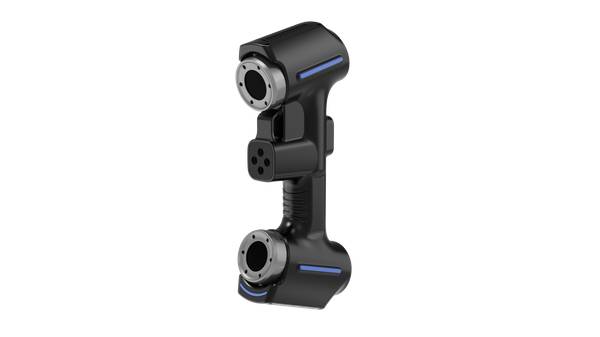
However, performance is contingent on specific site conditions. Before committing to a full production rollout, engineers should validate the system’s AI alignment stability against their most challenging part. A practical verification step involves scanning a deep-black, highly reflective sample component.
Inspect the resulting point cloud for density consistency in recessed areas and check the generated mesh for any artificial “filling” of voids.
This confirms the dynamic laser switching adapts effectively to your unique production environment and material mix.
Integrating Modular 3D Vision into Digital Workflows
As digital manufacturing evolves, the demand shifts from isolated inspection to continuous data flow. INSVISION approaches this through iterative, modular system design. By integrating the AI-enhanced reconstruction and smart scanning modes discussed, the platform maintains consistent 3D scan resolution across additive manufacturing lines and advanced machining centers.
This turns a static quality checkpoint into a continuous optimization loop, grounding high-precision data in actual production rhythms.
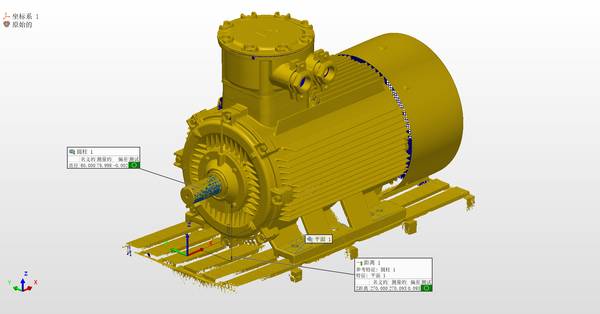
To move beyond specifications and assess real-world fit, quality managers should focus on field validation. The most effective method is to test the technology against your specific production geometries. We recommend scheduling an engineering consultation to map the handheld scanning workflow directly to your inspection cycle.
Bring a sample part—be it a high-reflective component or a part with complex internal channels—for an on-site resolution verification.
This process will clarify how portable metrology-grade scanning can integrate into your reporting requirements and lean manufacturing routine.
Hangzhou Insvision Technology Co.,Ltd.
Address: Building 1, No. 1399 Liangmu Road, Yuhang District, Hangzhou, Zhejiang 311121, China