

Evaluating a 3D Scanner for Large Objects
A procurement guide for evaluating 3D scanners for large objects. Learn volumetric accuracy criteria, AI-driven capture, and selection
Selecting a 3D scanner for large objects like aerospace wing ribs or automotive body-in-white frames requires moving beyond basic resolution specs. The real challenge lies in maintaining volumetric accuracy across extended surfaces, where cumulative stitching errors from standard scanners can force costly recalibration and rework.
This guide outlines the critical evaluation criteria to ensure your investment delivers reliable first-pass accuracy and protects your operational ROI.
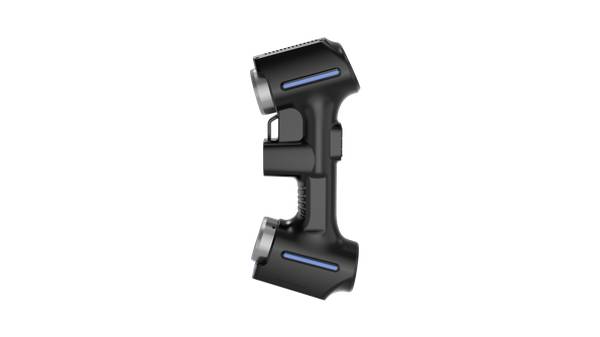
Volumetric Accuracy Over Local Resolution
A common procurement misstep is prioritizing local resolution at the expense of volumetric integrity. On large-scale workpieces, even minor per-scan drift compounds, creating alignment issues in the final point cloud. For applications such as inspecting energy turbine housings, this necessitates repeated scans and manual correction, disrupting production takt.
INSVISION systems address this by integrating photogrammetry technology with handheld scanning.
This setup uses scale bars to establish a stable global coordinate system, anchoring all scan data to eliminate progressive drift. The result is a consistent, metrology-grade point cloud that aligns with the part’s true dimensions, reducing the need for rework.
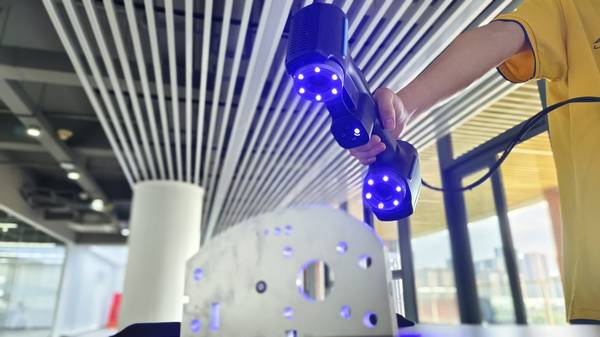
Surface Readiness and AI-Driven Capture
Specification sheets often overlook a critical cost driver: surface preparation. Requiring technicians to spray or tape reflective or deep-black surfaces—common on carbon fiber panels or stamped metal—adds time and consumable costs. INSVISION scanners bypass this need through AI-powered surface recognition algorithms paired with a multi-line blue laser configuration.
The system employs 22 crossed lines for broad coverage, a single line for deep cavities, and 7 lines for fine feature detail.
This allows for immediate, calibration-free scanning of complex material finishes. In practice, operators can capture full geometry of complex assemblies without surface treatment, directly reducing cycle time and supporting lean production rhythms.
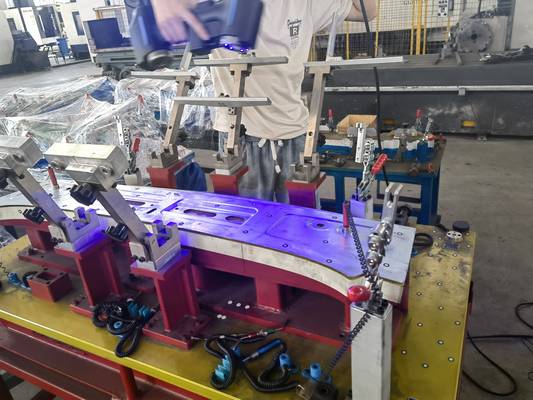
Choosing Between Mobility and Fixed Tracking
Your facility layout and part mobility dictate the optimal scanning architecture. For maximum flexibility in environments like MRO hangars or confined assembly line spots, a handheld solution like the INSVISION AlphaScan is key. It offers unrestricted mobility and is engineered to capture data on challenging surfaces without preprocessing.
For fixed, high-volume inspection stations dedicated to massive components like wind blade molds or heavy equipment chassis, the INSVISION X-Track Optical Tracking System provides extended-range spatial tracking.
It maintains absolute accuracy across large work volumes by synchronizing scanner position with the CAD coordinate system. The choice hinges on whether your workflow requires moving the scanner to the part or bringing the part to a fixed metrology bay.
Validating Software Integration and Compliance
The total cost of ownership is largely determined by post-scan data processing. Legacy workflows often involve manual alignment and report generation, consuming valuable engineering hours. INSVISION streamlines this by integrating directly with professional inspection software.
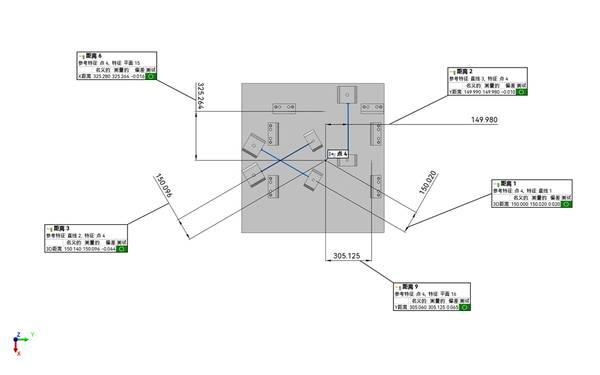
Scan data is automatically aligned to the reference CAD model to generate color deviation maps and one-click inspection reports that meet ISO/ASME audit requirements. Beyond software, verify the vendor’s regulatory standing.
INSVISION holds CE, FCC, and CNAS certifications, facilitating deployment and use across global markets, which minimizes procurement and compliance friction.
Conducting a Pre-Purchase Validation Trial
Before committing capital, insist on a live, on-site demonstration using a representative workpiece from your production line. This could be an uncoated carbon fiber panel, a worn stamping die, or a large weldment.
This trial has two critical objectives: first, to verify the scanner’s claimed ability to handle your specific surface conditions without spray or tape, and second, to measure the actual cycle time against your production takt.
Furthermore, review the complete data workflow—from the initial scan to the final deviation report—to ensure compatibility with your existing PLM and quality management systems. Do not rely on standard showroom demos; schedule an engineering consultation to conduct a controlled validation under your actual conditions.
Hangzhou Insvision Technology Co.,Ltd.
Address: Building 1, No. 1399 Liangmu Road, Yuhang District, Hangzhou, Zhejiang 311121, China