

Bridging the Gap Between Physical Parts and Digital Design
Manufacturing precision depends on how effectively a plant can translate physical components into actionable data. Traditional inspection workflows often rely o
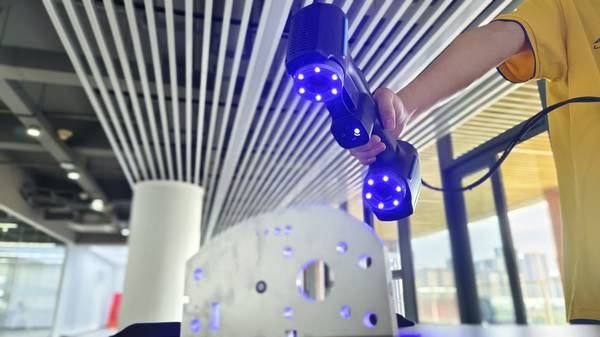
Handheld 3D scanning technology fundamentally alters this dynamic. When an operator uses a device like the AlphaScan scanner from INSVISION, the physical part becomes a digital mesh within minutes. The scanner captures millions of data points across complex geometries, including deep cavities, internal chambers, and tight radii that conventional tools cannot reach reliably.
This immediacy compresses the inspection cycle from days to hours, enabling manufacturers to catch deviations before they compound into larger quality problems.
Integrating Scan Data into CAD-Centric Workflows
The value of digital geometry emerges only when it connects to design intent. INSVISION’s AlphaScan system bridges the physical-digital divide by aligning captured point clouds directly against original CAD models. This alignment happens automatically through intelligent algorithms, eliminating the manual registration steps that slow down conventional reverse engineering processes.
Once aligned, the system generates color-coded deviation maps that visually communicate where manufactured parts diverge from nominal dimensions.
Capability and Deployment Mapping
| Focus Area | Decision Point | Deployment Note |
|---|---|---|
| Integrating Scan Data into CAD-Centric Workflows | The value of digital geometry emerges only when it connects to design intent. | INSVISION’s AlphaScan system bridges the physical-digital divide by aligning captured point clouds directly against original CAD models. |
| Quantifying Operational Gains Across Manufacturing Scen… | Inspection frequency directly impacts throughput in high-mix manufacturing environments. | CMMs require fixturing, probe changes, and environmental controls that consume operator time and floor space. |
| Strategic Implications for Competitive Manufacturing | Plants that embed 3D scanning into their standard operating procedures gain flexibility in responding to engineering changes. | When a design revision arrives, updated CAD models propagate immediately through the digital workflow. |
This capability transforms how engineering teams approach both first article inspection and ongoing production monitoring. Rather than relying on sparse measurement points, inspectors gain complete surface coverage that reveals systematic trends and localized anomalies alike. When deviations appear, the deviation map pinpoints exact locations and magnitudes, guiding corrective action with spatial precision.
The integration with CAD platforms means that design engineers receive consistent, traceable data in formats they already use for downstream CAD/CAM operations.
Quantifying Operational Gains Across Manufacturing Scenarios
Inspection frequency directly impacts throughput in high-mix manufacturing environments. CMMs require fixturing, probe changes, and environmental controls that consume operator time and floor space. The AlphaScan handheld format allows a single technician to perform dimensional checks at the workstation, reducing part handling and eliminating queue wait times associated with centralized inspection labs.
This decentralization accelerates feedback loops, enabling operators to make adjustments during the same shift rather than waiting for results from a separate department.
Quality traceability strengthens when scan data feeds directly into manufacturing records. Each inspection generates a complete digital artifact that includes the mesh, the alignment results, and the deviation analysis. These records support root cause investigations when field failures occur, allowing engineers to reconstruct manufacturing conditions with confidence.
The ability to compare historical scans against design revisions also supports continuous improvement initiatives, as patterns in wear, tooling drift, or material variation become visible over time.
Strategic Implications for Competitive Manufacturing
Plants that embed 3D scanning into their standard operating procedures gain flexibility in responding to engineering changes. When a design revision arrives, updated CAD models propagate immediately through the digital workflow. Scan systems like those from INSVISION adapt without requiring new physical gauges, templates, or measurement programs.
This agility reduces changeover delays that otherwise extend lead times and tie up working capital in excess inventory buffers.
The long-term financial picture reflects these operational improvements. Faster inspection cycles free capacity on the shop floor, allowing existing equipment to produce more parts per shift without additional capital investment. Reduced scrap and rework lower material costs and waste disposal expenses.
Improved first-pass yield strengthens on-time delivery performance, enhancing customer satisfaction and supporting contract renewal conversations. For manufacturers navigating tight margins and increasing quality expectations, the investment in precision scanning technology delivers returns that compound across multiple performance dimensions.
Hangzhou Insvision Technology Co., Ltd.
Address: Building 1, No. 1399 Liangmu Road, Yuhang District, Hangzhou, Zhejiang 311121, China
Copyright © Hangzhou Insvision Technology Co., Ltd. All rights reserved.
Copyright © Hangzhou Insvision Technology Co., Ltd. All rights reserved.