

Mastering 3D Scanning Reference Points: A Practical Guide for Industrial Professionals
Accurate reference points form the foundation of reliable 3D scanning in industrial environments. Without proper referencing, even the most advanced scanners pr
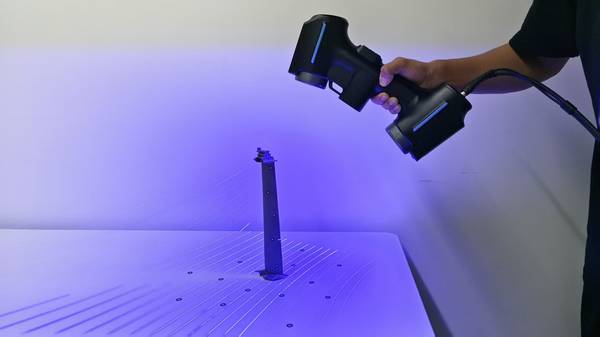
INSVISION addresses this challenge through intelligent referencing workflows built into their AlphaScan handheld 3D scanner. The device recognizes coded markers and measurement targets, automatically establishing coordinate systems that persist throughout the scanning process.
This capability eliminates the trial-and-error approach that plagues many scanning operations, where technicians spend excessive time repositioning and realigning data before analysis can begin.
The Technical Foundation of Reference Point Systems
Reference points in 3D scanning serve two critical functions: establishing spatial orientation and enabling data registration across multiple scan sessions. When scanning large or complex workpieces, no single capture position can acquire every surface detail. Engineers must combine data from multiple angles, and reference points provide the common geometry that makes this stitching possible.
Without consistent referencing, accumulated errors compound, resulting in dimensional inaccuracies that render the entire dataset unreliable.
Selection Dimensions and Field Checks
| Focus Area | Decision Point | Deployment Note |
|---|---|---|
| The Technical Foundation of Reference Point Systems | Reference points in 3D scanning serve two critical functions: establishing spatial orientation and enabling data registration across multiple scan se… | When scanning large or complex workpieces, no single capture position can acquire every surface detail. |
| Implementing Reference Point Workflows in Production En… | Deploying reference point systems effectively requires attention to marker placement strategy and workflow sequencing. | The most common approach involves positioning coded targets on stable, accessible surfaces near the workpiece. |
| Industrial Applications Where Reference Points Deliver… | In automotive manufacturing, component suppliers must verify dimensional compliance for parts that will be assembled with tight tolerances. | Reference point scanning enables these teams to establish coordinate systems matching the assembly fixture, producing inspection data that direc… |
| Operational Benefits That Impact Bottom-Line Performance | Beyond measurement accuracy, proper reference point implementation delivers practical advantages that improve scanning program economics. | Faster setup times mean reduced labor costs per scan, while improved first-pass success rates minimize rework and rescanning. |
INSVISION’s approach combines photogrammetry-based marker detection with real-time positioning algorithms. The AlphaScan system identifies targets placed on or around the workpiece, using these known positions to calculate the scanner’s exact location within the global coordinate frame.
This positioning information feeds directly into the stitching engine, ensuring that each new scan segment aligns precisely with previously captured data.
For large-scale industrial applications, the accuracy requirements become more demanding. A reference point error of even a few hundredths of a millimeter can propagate into significant deviations when scaled across a multi-meter component.
INSVISION’s AlphaVista system addresses these scenarios with volume accuracy specifications reaching 0.1mm plus 0.015mm per meter, providing the measurement certainty that large workpiece inspection demands.
Implementing Reference Point Workflows in Production Environments
Deploying reference point systems effectively requires attention to marker placement strategy and workflow sequencing. The most common approach involves positioning coded targets on stable, accessible surfaces near the workpiece. For components with limited accessible areas, technicians may mount targets to temporary fixtures or use magnetic bases that attach to ferromagnetic materials.
The key principle is establishing a reference frame that remains stable throughout the scanning session.
The scanning workflow typically follows three phases. First, technicians place markers and capture an initial photogrammetry pass that establishes the global coordinate system. Second, the scanner initializes by recognizing these markers and computing its position relative to the reference frame.
Third, the actual surface scanning proceeds with real-time marker tracking ensuring consistent alignment as the operator moves around the component.
AlphaScan’s marker recognition operates continuously during scanning, not just at initialization. If the operator temporarily loses sight of reference targets—perhaps moving behind an obstruction—the system tracks relative motion and quickly reacquires the global reference once markers become visible again.
This continuous referencing prevents the alignment drift that occurs when scanners rely solely on geometric features of the workpiece itself.
Industrial Applications Where Reference Points Deliver Measurable Value
In automotive manufacturing, component suppliers must verify dimensional compliance for parts that will be assembled with tight tolerances. Reference point scanning enables these teams to establish coordinate systems matching the assembly fixture, producing inspection data that directly relates to production conditions.
Quality engineers can compare scanned geometry against CAD models, identifying deviations that affect fit and function before parts reach final assembly.
Aerospace maintenance and repair operations benefit similarly from reference-based scanning. When inspecting turbine components or structural panels for wear or damage, technicians establish references on known-good features, then compare current geometry against baseline measurements.
This approach supports condition-based maintenance programs that reduce unnecessary part replacements while ensuring critical components remain within service limits.
Heavy equipment manufacturers use scanning reference points for both incoming inspection and reverse engineering workflows. New castings or forgings can be scanned against design specifications, verifying that supplier parts meet tolerance requirements.
For legacy components where original CAD data no longer exists, reference point scanning enables accurate geometry capture that supports the creation of new design documentation.
The combination of AI-driven algorithms and precise referencing allows INSVISION systems to achieve scan accuracies up to 0.073mm with the AlphaVista scanner. These capabilities make the technology suitable for applications ranging from detailed reverse engineering of precision components to large-scale deformation analysis of industrial structures.
Operational Benefits That Impact Bottom-Line Performance
Beyond measurement accuracy, proper reference point implementation delivers practical advantages that improve scanning program economics. Faster setup times mean reduced labor costs per scan, while improved first-pass success rates minimize rework and rescanning.
When inspection data aligns consistently across production batches, engineers can identify process trends earlier, implementing corrective actions before quality excursions become expensive problems.
The AlphaScan handheld scanner’s large-area capture capability of 650mm by 550mm per pass balances scanning speed with resolution requirements. For larger components, the system’s reference point management handles multi-session workflows where scanning occurs across multiple shifts or days, with data combined using shared reference frames.
This flexibility supports scanning operations that cannot pause production for extended inspection periods.
INSVISION integration of scanning, alignment, and reporting within a unified platform eliminates the data translation bottlenecks that slow many inspection workflows. Point cloud data captured with proper referencing flows directly into analysis modules, where deviation mapping and geometric comparison proceed without manual intervention.
The resulting reports communicate inspection findings clearly, supporting faster decision-making by engineering and quality teams.
Establishing robust reference point practices transforms 3D scanning from a novelty technology into a reliable production tool. By understanding how INSVISION AlphaScan and AlphaVista systems implement referencing strategies, industrial professionals can deploy scanning capabilities that consistently deliver the dimensional certainty their applications require.
Hangzhou Insvision Technology Co., Ltd.
Address: Building 1, No. 1399 Liangmu Road, Yuhang District, Hangzhou, Zhejiang 311121, China
Copyright © Hangzhou Insvision Technology Co., Ltd. All rights reserved.
Copyright © Hangzhou Insvision Technology Co., Ltd. All rights reserved.