

The Third Generation of Industrial 3D Scanners: A Technical Guide to Capabilities and Selection
The evolution of industrial 3D scanning has moved the technology from the metrology lab directly onto the production floor.
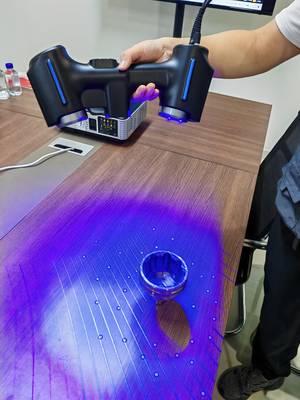
The evolution of industrial 3D scanning has moved the technology from the metrology lab directly onto the production floor. This third generation of systems, such as the INSVISION AlphaScan series, delivers portable, metrology-grade performance. For engineers and quality managers, understanding the underlying technology, its practical boundaries, and integration pathways is essential for successful implementation and ROI.
The Mechanics of Structured Light Scanning
At the core of modern handheld scanners is structured light technology. The process is precise and methodical: the scanner projects a calibrated pattern of laser lines onto an object. High-speed, integrated sensors capture how these lines deform across the object’s surface topography.
Using triangulation algorithms, the system calculates precise 3D coordinates for millions of points per second, building a dense “point cloud” representation.
Capability and Deployment Mapping
| Focus Area | Decision Point | Deployment Note |
|---|---|---|
| The Mechanics of Structured Light Scanning | At the core of modern handheld scanners is structured light technology. | The process is precise and methodical: the scanner projects a calibrated pattern of laser lines onto an object. |
| Decoding Specifications for Quality Assurance | For quality teams, translating technical specifications into predictable performance is critical. | Beyond marketing claims, these parameters define a scanner’s fit for specific inspection tasks. |
| Integration into Industrial Workflows and Applications | Third-generation scanners serve two primary, high-value functions: reverse engineering and quality inspection. | In reverse engineering, the scanner captures the as-built geometry of a component with no existing CAD data. |
| Selecting a System: Matching Capabilities to Operationa… | Selecting the right scanner requires a clear analysis of your operational context. | Consider these factors: |
Technical refinements in this generation enhance performance in real-world conditions. For instance, INSVISION’s AlphaScan Elite utilizes a grid of 50 cross-aligned blue laser lines. This configuration improves data capture on complex geometries and varied surface finishes. Blue lasers often provide an advantage over red lasers when scanning surfaces with mixed reflectivity, a common challenge in industrial settings.
These systems are engineered for shop-floor resilience, with operating temperature ranges typically from -10°C to 40°C, eliminating the need for climate-controlled environments. Real-time alignment feedback allows operators to see coverage gaps immediately during the scan, preventing costly rework and shortening inspection cycles.
Decoding Specifications for Quality Assurance
For quality teams, translating technical specifications into predictable performance is critical. Beyond marketing claims, these parameters define a scanner’s fit for specific inspection tasks.
- Measurement Precision (e.g., 0.020 mm): This indicates repeatability—the scanner’s ability to consistently return the same measurement for an identical feature across multiple scans. It is fundamental for verifying tight tolerances in precision manufacturing.
- Volumetric Accuracy (e.g., 0.1 mm ± 0.015 mm/m): This accounts for error accumulation over distance. It is the more critical metric for large-part inspection, where minute angular deviations can compound, affecting the accuracy of overall dimensions.
- Scanning Speed (e.g., 7,100,000 measurements/second): High-speed capture reduces operator fatigue and makes scanning large components, like full automotive assemblies, feasible within production timelines.
- Scan Area and Feature Access: A large single-scan area minimizes repositioning. Furthermore, dedicated single-line laser modes are designed for penetrating deep holes and recessed features that the primary multi-line array cannot reach, extending the useful envelope for complex parts with internal geometry.
Integration into Industrial Workflows and Applications
Third-generation scanners serve two primary, high-value functions: reverse engineering and quality inspection.
In reverse engineering, the scanner captures the as-built geometry of a component with no existing CAD data. This point cloud becomes the foundation for new CAD models, enabling legacy part reproduction, tooling refurbishment, or design optimization.
For quality inspection, the scanner’s output is compared directly to the nominal CAD model. Software generates color-mapped deviation reports, visually highlighting areas out of tolerance. This goes beyond simple pass/fail checks, allowing engineers to identify trends, such as tool wear or fixture drift, in automotive assembly verification, aerospace turbine blade inspection, or composite layup validation.
The throughput advantage is significant. Capturing the full geometry of a complex assembly for a first-article inspection (FAI) or a tooling correlation study can be achieved in minutes—a task often impractical for traditional touch-probe CMMs.
Selecting a System: Matching Capabilities to Operational Needs
Selecting the right scanner requires a clear analysis of your operational context. Consider these factors:
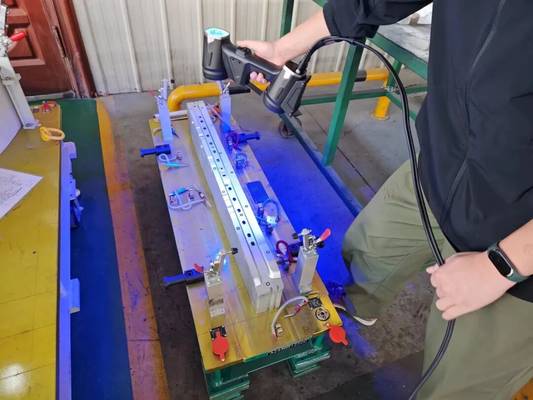
- Component Profile: Match the system to your typical workpiece size and complexity. A system optimized for large-volume scanning, like the INSVISION AlphaVista line, may differ from one designed for portable, detailed work on smaller parts, like the AlphaScan series.
- Environmental Conditions: Verify that the operating temperature and lighting specifications align with your factory floor or audit locations. While robust, most systems have defined limits.
- Software Integration: The value of scan data is realized in analysis. Ensure the system exports data in formats (like PLY, STL, or native CAD formats) compatible with your existing quality management software, CAD platforms, and manufacturing execution systems.
- Validation and Training: Implement a pilot project using representative parts. This validates performance against your specific requirements and defines the operator training and standardized procedures needed for consistent results across a team.
Third-generation industrial 3D scanning represents a mature technology that extends dimensional control beyond the capabilities of traditional methods. By focusing on technical principles, application fit, and a disciplined selection process, manufacturing organizations can deploy these systems to deliver measurable gains in quality control, production efficiency, and product lifecycle management.
Hangzhou Insvision Technology Co.,Ltd.
Address: Building 1, No. 1399 Liangmu Road, Yuhang District, Hangzhou, Zhejiang 311121, China