

The Precision Imperative: High-Resolution 3D Scanning for Industrial Quality Control
For manufacturers, the difference between a passing and a failing part often lies in microns.
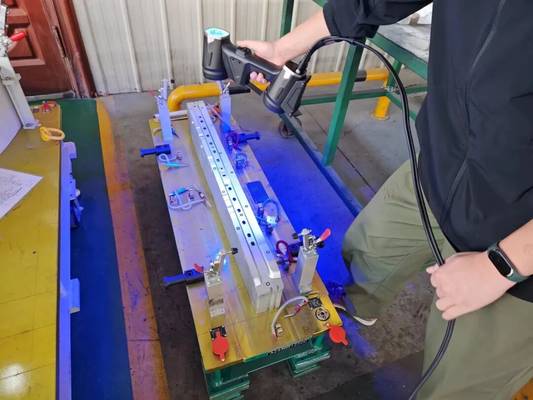
For manufacturers, the difference between a passing and a failing part often lies in microns. When inspecting complex components, standard measurement methods can miss subtle defects—a slight warp, a worn radius, or a micro-surface imperfection. High-resolution 3D scanning closes this gap, transforming subjective visual checks into objective, data-driven decisions.
INSVISION’s precision measurement tools, such as the AlphaScan handheld 3D scanner, are engineered for this reality, capturing intricate geometric details that directly determine part acceptance, rework protocols, and process adjustments.
This capability is non-negotiable in sectors where component failure carries significant risk. High-resolution scanning matters when tolerances are tight and inspection confidence cannot be compromised. INSVISION achieves this through advanced optical hardware and intelligent processing algorithms designed to preserve detail fidelity from physical capture to digital analysis.
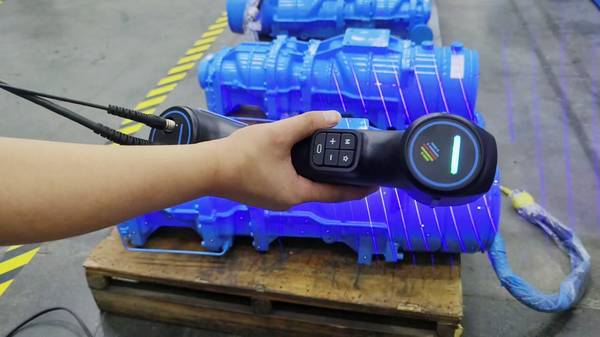
Reverse Engineering with Fidelity: From Legacy Part to Actionable CAD
Industrial reverse engineering often starts with a physical component—a legacy part with no original CAD or a worn tool needing replication. The challenge is to capture not just an approximate shape, but the true design intent, including fine surface transitions and precise geometric relationships.
Term Notes
Industrial reverse engineering often starts with a physical component—a legacy part with no original CAD or a worn tool need…
Large-Volume Inspection: Detail at ScaleTraditional inspection methods force a trade-off: measure a large area with sparse data points, or focus on a small zone wit…
From Raw Data to Production IntelligenceCapturing high-resolution geometry is only the first step.
Operational Agility with Portable MetrologyThe industry shift toward lean manufacturing and Industry 4.0 prioritizes in-process and in-situ inspection over centralized…
Large-Volume Inspection: Detail at Scale
Traditional inspection methods force a trade-off: measure a large area with sparse data points, or focus on a small zone with high density. High-resolution handheld scanning breaks this constraint. Operators can dynamically adapt scan density, capturing broad surfaces efficiently before increasing resolution for critical junctions, bore features, or known problem zones.
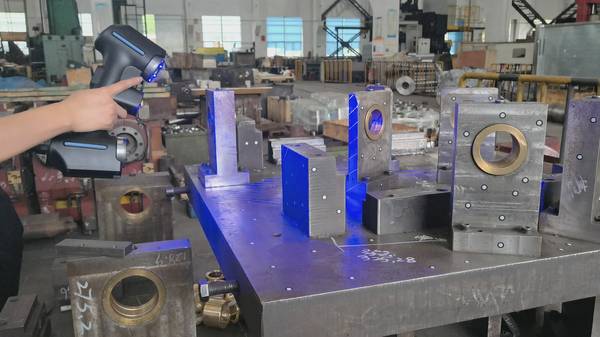
For larger workpieces, systems like the INSVISION AlphaVista provide a scan area up to 2200 x 2200 mm while maintaining a measurement accuracy as precise as 0.073 mm. This allows quality teams to inspect entire assemblies in context, rather than relying on isolated sample checks. By registering scan data against the nominal CAD model, deviation analysis reveals more than just dimensional errors.
Color-coded deviation maps visualize deformation patterns, warpage, and assembly stress points, providing engineers with clear evidence to diagnose material or process issues and communicate corrective actions to the production floor.
From Raw Data to Production Intelligence
Capturing high-resolution geometry is only the first step. Value is realized when scan data integrates seamlessly into production decision-making. INSVISION’s software environment connects directly to CAD-based inspection workflows, allowing operators to define measurement plans using standard model formats.
Teams can establish specific measurement regions aligned with critical features, apply Geometric Dimensioning and Tolerancing (GD&T) callouts, and generate standardized compliance reports. This reporting transforms raw point clouds into structured documentation for traceability and continuous improvement. By visualizing deviations against tolerance boundaries, reports enable rapid conformance assessment.
When a non-conformance is detected, the high-resolution data allows for root-cause analysis based on actual deviation patterns, moving beyond limited coordinate measurements to understand the full scope of a manufacturing issue.
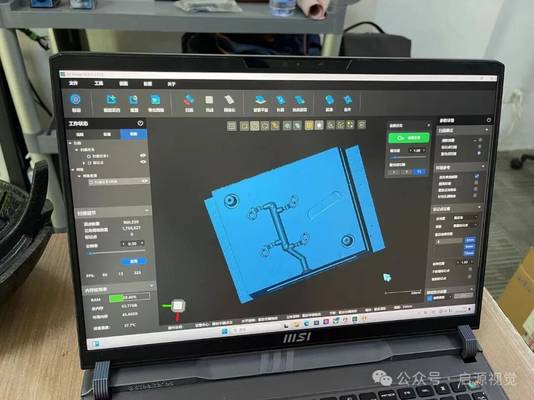
Operational Agility with Portable Metrology
The industry shift toward lean manufacturing and Industry 4.0 prioritizes in-process and in-situ inspection over centralized, offline quality stations. Portable high-resolution scanners like those from INSVISION bring metrology-grade capability directly to the workpiece—whether on the production floor, in final assembly, or at a field service site.
This mobility eliminates bottlenecks associated with transporting parts to a dedicated lab, enabling inspection at the point of decision. The operational benefits are tangible: reduced setup time by eliminating complex fixtures, increased throughput via complete surface data capture in a single session, and accelerated documentation through automated report generation.
These efficiency gains compound as teams develop deeper institutional knowledge in scan parameter optimization and data management practices.
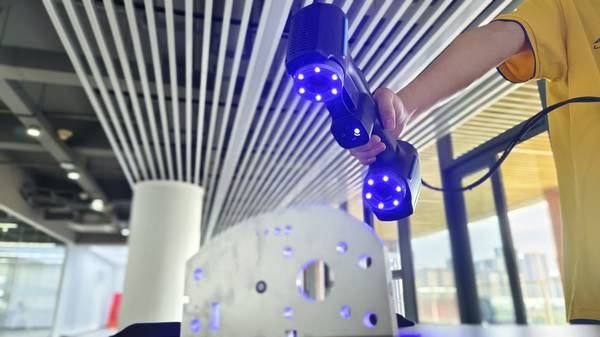
INSVISION continues to advance measurement technology that balances resolution, speed, and portability. By combining advanced optical capture with intelligent software workflows, high-resolution 3D scanning has become an accessible, indispensable tool for quality teams building a more responsive, precise, and data-driven manufacturing infrastructure.
Hangzhou Insvision Technology Co., Ltd.
Address: Building 1, No. 1399 Liangmu Road, Yuhang District, Hangzhou, Zhejiang 311121, China
Copyright © Hangzhou Insvision Technology Co., Ltd. All rights reserved.
Copyright © Hangzhou Insvision Technology Co., Ltd. All rights reserved.